


 Francais
 Deutsch
 Italiano
Refine Your Search
-Cebu,-Philippines stock footage and images
- Showing 16945 to 16950 of 58885 results more
more Hide
Hide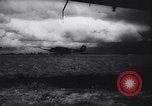
German Luftwaffe (Air Force) steps up bombing campaign over Warsaw and environs, in World War II
German aircrews walk from their aircraft after returning from bombing mission during invasion of Poland, during World War 2. They join other aircrews sitting around a fire. Fuel trucks are busy servicing the bombers. Numerous Junkers Ju-52 bombers are seen parked on the field, and they are seen taking off continually in the background. View from airborne German bomber flying with dramatic clouds in background. Beneath clouds smoke from burning targets is seen.
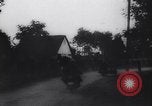
Polish forces launch counterattacks against German invasion forces during World War II.
German motorcyclists,trucks,cavalry and infantry on the move as Polish refugees move to the rear near Warsaw, Poland, in World War 2 . Animated map shows tightening of German forces around Polish defenders, early in September, 1939, in World War 2. It shows Polish counterattacks at the Bzura River (German: Kutno) by combined Polish Armies, Poznan and Pomorze, toward Stryków (9-12 September) and toward Lowicz (13-15 September). The German forces then completely encircle by closing them off on the East.The map shows many arrows indicating strong effort by the Poles to breakout to the East,to Warsaw, without success. Scene shifts to many German He-111 bombers taking off. Aerial view shows the bombers taking off simultaneously across a broad dirt field, leaving dust trails behind them. A formation of 18 He-111s is seen in flight. Then a formation of Do-17s is seen followed by more He-111s. Closeups of He-111s.Views of ground from the nose greenhouse. Brief glimpses of targets burning on ground.Bombs dropping from He-111s. More burning targets on the ground.
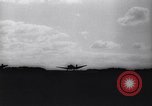
German Luftwaffe (Air Force) employs mix of aircraft during intensified bombing campaign over Poland in World War II
Numerous German Ju-87 Stuka dive bombers are seen taking off from an airfield, on bombing missions against targets in Warsaw, Poland, during invasion of Poland in World War 2. Ground crews load bombs aboard the aircraft. A Dornier D0-17 bomber is seen taking off. A Henkel He-111 is seen in flight. View of ground target from nose of the bomber. Smoke rising from burning targets on the ground. Narrator refers to Bzura River area (where Polish forces had launched a counterattack). The Confluence of the Rivers, Vistula and Narev, are seen and the Polish fortress of Modlin, as the bombers approach it. Fires and smoke are seen rising from the German bombing.
The fall of Warsaw, Poland, and beginning of German occupation, in World War II
Scenes from German invasion of Poland. In the nighttime, Polish soldiers are seen marching out of their fortifications. (Narrator states that 130 thousand have fallen.) German soldiers search the Polish troops. A Polish soldier plays an accordian while another plays the saxaphone. Germans allow Polish railroad workers and firemen to proceed to their jobs. German soldiers escort Polish workers to begin salvage and repairs of bomb damage. Views of utter devastation, with nothing but skeletons of structures remaining and rubble everywhere. Huge numbers of Polish people assembled in an open city square, obtaining rations of food from the German Army.
Adolf Hitler reviews parade of German troops occupying Warsaw after Polish surrender during World war 2
Polish officers leave and German officers enter the Polish military headquarters in Warsaw, Poland. German soldiers take up guard positions, following the invasion of Poland and surrender of Warsaw in World War 2. German officers look over surrendering Polish officers. German troops formally parading into and occupying Warsaw, led by German officers on horseback, followed by mounted troops pulling field artillery pieces. They pass the equestrian statue of Prince Józef standing before the Polish General Staff building (the Saxon Palace). Large numbers of Polish troops and wagons assembled under German guard, in an open field. An Honor Guard of three goose-stepping German soldiers leads a parade of goose-stepping German troops into the city. Adolf Hitler reviews the troops as they march. Major general (generalleutnant) Kurt von Briesen, Commander of the German 30th Infantry Division, is seen briefly with Hitler. The parade continues with German artillery and tanks. Luftwaffe bombers fly in formation overhead.
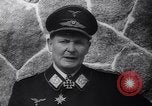
Hermann Goering, Chief of the German Air Force, gives a speech in tribute to the Luftwaffe (Air force)
Chief of the German Air Force (Luftwaffe), Hermann Goering, extols the capabilities and contributions of the Luftwaffe to German conquests, mentioning Poland, and France. As he speaks, a German Henschel Hs 126 observation plane is shown, followed by shots of a Messerschmitt Me-109 and formations of them flying amongst clouds, A German antiaircraft emplacement on a parapet high above a river. A lone German sentry patroling a beach and a flight of Me-109s flying low over his head. View from nose of a German bomber flying low over water. German Dornier Do-17 bombers penetrating a coastline. Pilots and gunner in bombers. Formation of Heinkel He-111 bombers in flight. Animation shows British mainland from perspective of a dive bomber heading toward the ground. Sequence finishes with explosion. Throughout the last half of the clip, a male chorus is heard singing the Luftwaffe's unofficial anthem, "Bomben auf Engelland," (Bombs on England) by Norbert Schultze (Norbert Arnold Wilhelm Richard Schultze).
CRITICALPAST.COM: About Us | Contact Us | FAQs - How to Order | License Agreement | My Account | My Lightboxes | Shopping Cart | Advanced Search | Featured Collections | Website Terms & Conditions | Privacy Policy ©2026 CriticalPast LLC.
License Agreement |
Terms & Conditions |
Privacy Policy
©2026 CriticalPast LLC.