


 Francais
 Deutsch
 Italiano
Refine Your Search
-Cebu,-Philippines stock footage and images
- Showing 17107 to 17112 of 58885 results more
more Hide
Hide
The Battle of Iwo Jima in World War II
Scenes filmed by Navy and Marine combat photographers, of the Battle for Iwo Jima, in February and March, 1944, during World War 2. View from a boat offshore, of Mount Suribachi, on the Island of Iwo Jima. Warships of the U.S. 5th Fleet attack with naval gunfire, as landing craft manuever near shore. U.S. Marines aboard Landing Vehicles Tracked (LVTs) head for the beach, with the heavy cruiser, USS Baltimore (CA-68) in the background. U.S. Carrier-based Grumman TBF Avenger aircraft drops bombs on Mount Suribachi. Landing craft arriving at a fairly level area of beach. U.S. marines moving cautiously on the beachhead. The USS Baltimore and a Fletcher class destroyer offshore in background. Marines hunkered down with smoke rising near them, and then moving forward again, through the black sands. Closeup of a marine with flame thrower. Several U.S. Chance Vought F4U Corsair aircraft fly overhead, dropping bombs on the mountain. Marines continue to move forward, under constant fire from Japanese small arms. A heavy landing craft Infantry, LCI(H) moves toward shore in background. A DUKW ("Duck") coming ashore. Marines using a crane to offload a 105mm howitzer from a landing craft. As they raise the gun, the landing craft moves away and marines Hook the howitzer to a DUKW to help move it. Next, marines are seen setting up two 105s on the beachhead and firing them. Marines with more artillery pieces stacked on the beachhead. A gunboat, LCI (G), firing from close to the shore behind them. Marines digging in sand that the narrator calls the floor of an active volcano. Smoking sulphur gases are seen rising behind them. The USS Baltimore firing her guns from close to shore. Machine gun tracer rounds crossing the beachhead, as Naval gunfire resumes from offshore. Marines crawling and then occasionally sprinting forward across the sand dunes. (One carries a stretcher.) Four marines carrying one wounded back to the beachhead, on a stretcher. Two marines carry another between them. Marines scrambling over brush and rough ground. View from hillside of marines climbing up from below, as shell bursts only a few yards away. Scene shifts to later in the battle for Iwo Jima. A catapillar tractor is parked near bodies of Japanese soldiers strewn across the landscape. (Narrator notes that more than 14 thousand such dead had been counted by March 6, 1944.) Finally, the iconic moving images of U.S. marines raising the American flag over Mount Suribachi.

Fighter aircraft of the U.S. 8th Air Force engage German aircraft and ground targets in Europe during World War II
A film titled 'Activities in European theater of operations' shows gun camera films from U.S. P-47 Thunderbolt and P-51 Mustang fighter planes shooting down German planes during World War II.In one, the German pilot is seen bailing out and falling away from his airplane. In another, the German plane explodes and its wing falls off. One sequence shows the German plane trying evasive maneuvers and then rolling over as the pilot bails out. His chute is seen opening moments later. Other scenes show aircraft losing wings, and one exploding into a ball of fire. One scene shows a strafing run at a steam locomotive pulling a train. The locomotive billows white smoke. Two more attacks against trains result in huge fiery explosions.
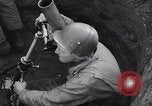
United States 81 mm mortar crews fire shells at enemy targets in Germany during World War II
American soldiers in fortified position firing 81mm mortar in support of U.S. infantry in Germany during final months of World War 2, in Europe. Early in February,1945, U.S. soldiers of Company M, 3rd Battalion, 313th Regiment, 79th Division, are seen supplementing their ammunition with captured German 80mm mortar shells. Closeup of the U.S. 81mm mortar shell next to a German 80mm shell. M Company soldiers firing the German shells from their 81mm mortars at German targets across the Mulde River. They are operating amongst homes in a residential area. Explosions in distance from the mortar shells.
British and Canadian Infantry of 1st Canadian Army capture Kleve (Cleve) Germany during World War 2
Artillery batteries of British and Canadian forces, under command of Field Marshal Montgomery, bombard German positions on the German-Dutch border.British artillery firing BL 4.5 inch Medium Guns and 155mm heavy guns, in an 11 hour bombardment of German positions east of Nijmegen, Netherlands. Snow covers the ground. A British Land Mattress rocket launcher firing a salvo of 3-inch rockets. I Infantry of 1st Canadian Army, under command of General H.T.G Crerar, march toward an area between the Mars and Rhine rivers. They move through forest of the Reichswald, where they encounter Siegfried Line obstacles. British and Canadian tanks using heavy chain mine flails are seen beating their way through mine fields. Infantry in single file silhouetted against a light sky. Canadian Sherman tanks advancing with infantry. One is labeled "Spitfire II." Churchill tanks and heavy vehicles advance, including Churchill AVRE fascine mat-laying vehicles and Churchill ARKs (Armoured Ramp Carriers). Sherman tanks pass, including one named "Diana." British Armor pushing through rain-soaked and partly flooded towns towing BL 4.5 guns. They reach Kleve (formerly spelled Cleve) on February 11, 1945. Roadside sign reads: "Reichs-Grenze"(Border of Germany). Sherman tank of the 6th Guards Tank Brigade firing point blank on city street in Kleve. British troops taking cover behind tank destroyer moving slowly along street. Large number of German prisoners of war being marched to an assembly area. British infantry continuing their advance toward Goch, Germany.
Dimensions of 4.2 inch mortar of United States
A film titled 'Army's newest mortar' Different parts and dimensions of United States 4.2 inch mortar are explained. Used for direct fire against stationary objects 4.2 inch mortar consists of a clamp, reaction chamber, fixed firing pin. Soldiers assemble the mortar. It is mounted on a tripod stand. Soldiers carry it in a machine gun cart. Trinitrotoluene (TNT) filled shells are fired from the mortar Rocket drivers are used for firing at low elevation areas whereas gravity fire is used for the areas at a higher elevation. (World War II period).
British 26th Indian Division captures Ramree island in Burma (WW2)
A World War II film titled 'Capture of Ramree.' Aboard ship, the Commander, 51st Punjab Regiment, 71st Brigade, briefs his officers about the mission using a map and pointer. U.S Air Force B-24 Liberator bombers drop fragmentation bombs over the island causing thick smoke to rise up. Royal Navy ships bombard the island. British assault troops go ashore from landing craft. Vehicles and artillery pieces are unloaded onto the beach. Out in the water, a British assault craft strikes a mine and blows up. British infantry move through mine clear areas marked with rope lines. They advance towards the war damaged interiors of Kyakpyu town. A wounded Indian soldier is given medical aid. Soldiers occupy the town. A U.S. C-47 aircraft lands bringing U.S. Lieutenant General Raymond A. Wheeler, Deputy Supreme Commander, Southeast Asia, who is met by British Major General Cyril E.N. Lomax, Commander of the 26th Indian Division. The Generals consult together.
CRITICALPAST.COM: About Us | Contact Us | FAQs - How to Order | License Agreement | My Account | My Lightboxes | Shopping Cart | Advanced Search | Featured Collections | Website Terms & Conditions | Privacy Policy ©2026 CriticalPast LLC.
License Agreement |
Terms & Conditions |
Privacy Policy
©2026 CriticalPast LLC.