


 Francais
 Deutsch
 Italiano
Refine Your Search
-Cebu,-Philippines stock footage and images
- Showing 21811 to 21816 of 58887 results more
more Hide
Hide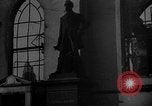
Coal being mined under government control in a British occupied zone of Germany after World War II.
Life of people in a British occupied zone of Germany after World War II. A statue of Alfred Krupp. Men at typewriters. Coal being mined under Allied control. Soldiers load coal onto a truck. Soldiers look at a map. German men and women cut trees to burn wood in place of coal. Soldiers and officials at a meeting. A freight train and a convoy of trucks on the move.
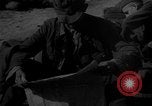
A British military government view of a British occupied zone of Germany after World War II.
Life of people in a British occupied zone of Germany after World War II. A German man reads a newspaper and looks at advertisements. Narrator indicates many advertisements are seeking missing persons after the war. Women workers at the Central Postal Inquiry Bureau in Hamburg reviewing written requests that have been received as people look for relatives. People seek permission to travel by trains. German people on foot and with bicycles wait in groups to cross pontoon bridges built by British engineers. Military government trucks and traffic cross a bridge with city buildings visible behind. Elevated view over tracks of locomotive train pulling slowly into train station with many passenger rail cars. Large group of German people on the train platform as the railroad train pulls up. People struggle to get onto the train. British guards pull a man away from a train at a station as he is trying to ride on the side bumper. Bicyclists and pedestrians moving forward on town streets after clearance. More views of fully loaded passenger train pulling out from German train station with many passengers visible in open top cars. A British flag at a military government court room. A hearing being conducted. An officer presides as judge over the hearing. Several man stand in front of the judge in a largely empty court room, including the accused, an interpreter, German defense counsel, and British prosecutor. A German police band plays. Narrator describes the remaking of the German police force. Two uniformed German police officers talking on a street as traffic goes by. A Red Cross team with nurses and technicians checks the blood pressure, height, weight and performs laboratory tests like blood content, measuring the health of German civilians, who the narrator says are receiving about 1000-1200 calories per day, or half the British military allotment. German children idle, at work, and at play: Two young boys playing in rubble of destroyed buildings; A German teenage boy walks behind a horse plowing a field; boys and girls playing amid rubble of buildings; German boys playing on moving turnstile equipment or a moving partial antiaircraft gun platform in a bombed railroad yard. Wide view of German children playing on top of a giant mound of dirt and rubble from bombing. Older German man delivers a speech and people listen in a hall. A German school teacher in a classroom (possibly a church, with crucifix on wall behind him), and crowd of children in the classroom. Chalk board at front of room. German boys seated at desks with pencils and paper doing school work.
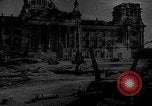
Captured German soldiers being interrogated for demobilization in a British occupied zone of Germany after World War II.
Life of people in a British occupied zone of Germany after World War II. Ground level view of the heavily damaged Reichstag building in Berlin, with destroyed defense equipment on the grounds. Interior view of rubble inside the Reichstag. Close-up panning view of a painting of the Krupp family that produced arms during both world wars. A destroyed steel frame and girder structure that narrator says was part of Krupp arms factory. Former German soldiers being processed. They are lined up, sprayed with delousing powder, interrogated and their documents checked during demobilization. Demobilized former German soldiers give their thumb print impressions. A British officer interrogates an older man in civilian clothes, and then his Luftwaffe picture and papers are shown. Shirtless German men with their arms up in the air pass by a British inspector looking for SS mark under their left armpit. A British interrogator talks to a captured German soldier and rejects him for demobilization, based on his answers or his paperwork. A guard steps forward to escort the man back to prison.
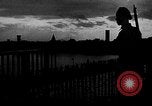
German judges being administered an oath of office in a British occupied zone of Germany after World War II.
Life of people in a British occupied zone of Germany after World War II. A British soldier guards the area as German civilians move about on a bridge in the background. Women move down a staircase. An air raid siren sounds. People sleep on benches. Shadow of girls as they move round in a circle. A damaged building. Judges being administered an oath of office by a British officer. Girls hold hands as they move round in a circle.

Flexible pipelines to supply gasoline being laid out under the water in the English Channel during World War II.
' Operation Pluto ' about the British operation to lay down under the sea pipe lines to supply gasoline in the European theater during World War II. A map of France. Flexible pipelines to transport gasoline between France and England are tarred and wrapped in Britain. Pipelines being manufactured and piled up in a yard. Ships and boats underway in the English Channel as the pipes are being laid.
Allied commander in chiefs sign the papers of partition of Germany in Berlin after world War II.
' Allied control council for Germany ' shows the taking over of the control by the Allied powers in Germany. British Field Marshal Bernard Montgomery gets off a plane as he arrives in Germany. Montgomery being greeted by officers and he inspects an honor guard of Soviet troops. Commander in Chiefs of various Allied armies arrive at a building on June 5th, 1945. U.S. General Dwight D. Eisenhower, French Major General Jean de Lattre de Tassigny and the Soviet representative Georgy Zhukov arrive and enter the building. General Eisenhower, Field Marshal Montgomery, Zhukov and Major General Tassigny sign the documents of the partition of Germany. The Commander in Chiefs pose outside the building.
CRITICALPAST.COM: About Us | Contact Us | FAQs - How to Order | License Agreement | My Account | My Lightboxes | Shopping Cart | Advanced Search | Featured Collections | Website Terms & Conditions | Privacy Policy ©2026 CriticalPast LLC.
License Agreement |
Terms & Conditions |
Privacy Policy
©2026 CriticalPast LLC.