


 Francais
 Deutsch
 Italiano
Refine Your Search
-Cebu,-Philippines stock footage and images
- Showing 22729 to 22734 of 58986 results more
more Hide
Hide
U.S. soldiers show peep holes on a camouflaged scrap heap and make dummies with paper pulp in France.
Film 'Camouflage' demonstrates various camouflages used by U.S. soldiers during World War 1 to deceive the enemy. An American Army soldier points at various peep holes on a camouflaged scrap heap. The soldier lifts an opening on the scrap heap and brings out a rifle. Soldiers with dummy heads behind a wall and above trenches. A man gives finishing touch to dummy mannequin heads made of paper pulp.
United States soldiers demonstrate camouflage; hide in small shell holes and place trench periscope in stumps in France.
Demonstration of various camouflages used by American Army soldiers during World War I. United States soldiers in small shell holes. A soldier places a Trench Periscope in a stump. Bark of a tree used as trench periscope. The soldier removes platform from the base of the tree.
French women make camouflaged screens using chicken wire and burlap in France.
Demonstration of various camouflage materials and techniques used by U.S. Army soldiers during World War 1. French women prepare Raffa grass for camouflage. They cut burlap into camouflaged screens. Women weave screens. These screen are made of chicken wire and burlap. Group of men mix camouflage paints. French men and women paint strips of burlap. Product placed on drying shed.
Camouflaged screen placed over observation posts to shield them from enemy observation in France.
Demonstration of various World War 1 camouflage techniques employed by American soldiers. Burlap shuts off the sight of a street from enemy's field glasses. U.S. Army soldiers walk under the burlap screens. A soldier screens headquarters from observation by enemy aviators. Troops march on road.
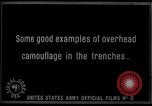
Screen overhead camouflages used in trenches by United States soldiers in France.
Demonstration of various camouflages used by soldiers during war. View of overhead camouflage in World War 1 trenches. An American soldier walks under the screen in a trench. Camouflaged road in the background. U.S. Army soldiers carry artillery in the camouflaged trench. American soldiers load shells in artillery and fire.

United States Army soldiers use sound deception to deceive the German in Film 'Sonic Deception'.
Film 'Sonic Deception' shows the use of sounds to deceive the enemy (sometimes described as the "Ghost Army" in World War 2). Dramatization shows United States troops crossing river in small boats and arriving on beach. They establish beachhead on river bank and defeat German troops located there, having arrived by suprise. Film recounts through actors how a German spy at a German army corps headquarters informs about the presence of United States tanks and trucks. Film demonstrates how sound recordings were used by U.S. soldiers to create false impression of troop activities including bridge building and tank and vehicle movements, in order to serve as a decoy and mislead Germany enemy forces about U.S. Army activities. Dramatization shows German officials consulting and looking at maps. German soldier looks through binoculars and informs officials through phone. Tanks cross a bridge and artillery on field. Actual scenes of front gate of Army Experimental Center station headquarters at Pine Camp in Great Bend, New York (upper New York State). U.S. Army soldiers are shown recording via microphone the sounds of actual bridge construction at the center. The microphone routes to a recording truck where a turntable for pressing recordings is running, creating a phonograph recording of the bridge building decoy sounds. Recording of other sounds is shown, including sound of a bulldozer at work, sounds of men unloading trucks, and sounds of tanks crossing a bridge. Soldier is seen selecting a phonograph record from the Army Experimental Station Library.
CRITICALPAST.COM: About Us | Contact Us | FAQs - How to Order | License Agreement | My Account | My Lightboxes | Shopping Cart | Advanced Search | Featured Collections | Website Terms & Conditions | Privacy Policy ©2026 CriticalPast LLC.
License Agreement |
Terms & Conditions |
Privacy Policy
©2026 CriticalPast LLC.