


 Francais
 Deutsch
 Italiano
Refine Your Search
-Cebu,-Philippines stock footage and images
- Showing 23095 to 23100 of 58986 results more
more Hide
Hide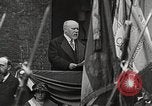
Poincaré resigns from Reparations Commission. Germans object to conditions in Treaty of Versailles
French Prime Minister Raymond Poincaré resigns from his position as President of the Interallied Reparations Commission. Scene shifts to closup, on board a ship, of Reinhold Wulle, leader of a monarchist wing in the conservative German National Peoples Party (DNVP). Scene shifts again, to Berlin, Germany, where well-dressed citizens are gathered on a sidewalk. It shifts again, to German citizens at a newsstand holding many different newspapers, all reflecting unhappiness with restrictions and economic effects from the conditions of the Treaty of Versailles, following World War I. A poster shows a facsimile of the Treaty with arrows pointing to Part 5, requiring demilitarization of the Rhineland. Scene shifts back to the well-dressed gathering, where a photographer stands on an iron fence railing as a car arrives and an official steps into the group waiting for him. Next, a man is seen seated on the roof of a truck driving on Unter Den Linden, with Brandenburg Gate in background. He throws monarchist leaflets to bystanders. Men on bicycles accompany the truck. Leaflets are also seen being thrown from an automobile on a Berlin street. Six men distribute monarchist leaflets from a truck. Leaflets fill the air as traffic, including a tram, moves through main streets of Berlin. A contingent of Berlin police officers begins clearing crowds from sidewalks and streets. Mounted police clearing a square.
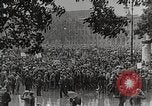
Demonstrators in front of the Altes Museum in the Lustgarten, Berlin, Germany
Demonstrations in Berlin, Germany. People gather in large numbers in front of the Altes Museum (Bodestraße 1-3, 10178 Berlin, Germany) in Lustgarten. They hold signs and banners. One sign reads, " Frankreich gieb unserer Kameraden Frei," an appeal for France to free German prisoners of war. (Note: After World War 1, France was slow to repatriate German prisoners of war, and had transported many abroad, to work in her colonies.)
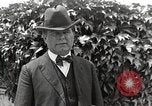
United States Senator from Idaho William Edgar Borah poses for the camera in the United States.
United States Senator from Idaho William Edgar Borah in the United States. Borah poses and removes his hat. (Note: Senator Borah was famous for his opposition to the Treaty of Versailles and formation of the League of Nations. His opposition was instrumental in the U.S. rejection of the League.)
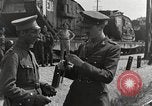
British Colonel Archibald Percival Wavell and 2nd Battalion, Black Watch in Oppeln,Upper Silesia
Colonel Archibald Percival Wavell (Rt. Hon. Archibald Percival Wavell, 1st Earl Wavell) Commander of the 2nd Battalion, Black Watch (Royal Highland Regiment) is seen conversing with a Colonel of local German forces in Oppeln,Upper Silesia. (This is during the period when elements of the British Durham Light Infantry, the Black Watch and the 2nd Battalion, Royal Canadian Leinsters, were serving, under the auspices of the Inter-Allied Commission of Government and plebiscite, as "peace keepers" to stop conflict between the Germans and Polish insurgents, in Upper Silesia.) Colonel Wavell is showing his counterpart a flexible spring mace, which the latter manipulates and examines. Behind them on a railroad siding are flat cars carrying Mark V tanks of Company B, 5th Battalion, British Tank Corps. Numbers: E18 and E17 appear on two tanks, respectively. Scene shifts to a checkpoint supported by soldiers of the Black Watch. A German officer checks credentials of a civilian leading a goat. He is permitted to pass and walks along smoking a pipe. A German lights the cigarette of a Black Watch soldier. German soldiers relax at edge of woods where they fly the Imperial flag of black, White, and red. A wagon load of German irregulars is pulled by a horse. They display the German flag. A team of horses pulls two caissons with irregulars riding on them.
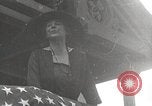
Jeannette Rankin, first woman elected to U.S. Congress, speaks in Union Square, New York City
Jeannette Rankin, of Montana, the first woman elected to U.S. House of Representatives (served April 1917 through December 1918). A pacifist, co-founder of the American Civil Liberties Union, and champion of humanitarian causes, she is seen addressing a group from a speakers pavilion in Union Square, Manhattan, New York City, in September, 1924. She accepts a glass of water from an associate (unseen). Closeups of Rankin leaning over the railing above an American flag, as she speaks to assembled group of men and women. From further away, several men and women associates can be seen at work behind her in the pavilion. Views from behind and to her right, with listeners below and cars parked in the square. Street scene in background. As before, Ms Rankin leans forward to be better heard. (There is no evidence of microphone in use.)
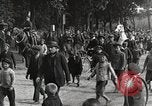
British forces march into Oppeln, Upper Silesia, following Third Silesian Uprising
A large crowd gathers in the city of Oppeln (Opole), Upper Silesia (now Poland). People crowd around contingent of British Black Watch (Royal Highlanders) as they march into the city along Ozimska and Damrota streets, after arriving from Rosenberg, 20 miles to the Northeast, where they had first been quartered in June. The Regimental Pipe Band leads the procession. Officers are mounted and infantry march as they enter the city. The final scenes show the troops moving on Cracow Street, passing the Cafe Residenz.
CRITICALPAST.COM: About Us | Contact Us | FAQs - How to Order | License Agreement | My Account | My Lightboxes | Shopping Cart | Advanced Search | Featured Collections | Website Terms & Conditions | Privacy Policy ©2026 CriticalPast LLC.
License Agreement |
Terms & Conditions |
Privacy Policy
©2026 CriticalPast LLC.