


 Francais
 Deutsch
 Italiano
Refine Your Search
-Cebu,-Philippines stock footage and images
- Showing 23203 to 23208 of 58986 results more
more Hide
Hide
German invasion of the Soviet Union in World War II turns into slow moving grim house-by-house battle in Soviet cities.
German Operation Barbarossa, invasion of the Soviet Union in World War 2. Opening scene of film shows wartime damage near the sand bag protected Opera and Ballet Theater building in Odessa during World War 2. Glimpse of a Soviet armored vehicle, derived from an STZ-3 agricultural tractor, used during the Siege of Odessa. View of Soviet defenders running through a trench, during the two month German siege. View of Sevastopol, Crimea. A statue in the foreground and Legislative Assembly building in the background, with dense white smoke rising from behind it. Soviet soldiers firing a large defense gun in a Gorky fortress; firing a large gun from a seaport wharf and from a railroad car, and Soviet troops firing small arms in fields, including Degtyaryov machine guns. A Soviet soldier firing a Maxim heavy machine gun. View from overlooking hill of the Odessa Black Sea Naval Base. German troops entering the fringes of Sevastopol. One throws a hand grenade. Views of Soviet defenders firing machine guns. In the city, German soldiers fight street by street. Several are seen scurrying along a sidewalk, keeping close to a building for protection. Others rush into damaged buildings trying to flush out Soviet defenders with hand grenades. Camera pans over ruins of the destroyed city of Sevastopol. Dead German soldiers lying in ruins. One lies atop across the front of a Panzer VI tank. His uniform is in flames. Closeup of his hand. More dead German soldier are seen on the ground near a knocked out German tank. View of a large crowd of people. Soviet officers on horseback review a formation of troops. Glimpse of marching armed Soviet soldiers.
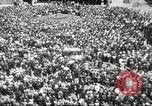
The Soviet Union is placed on a total war footing in June 1941, as the Fascist axis powers invade in Operation Barbarossa.
Soviet Union mobilizes in wake of the Operation Barbarossa, invasion by Germany and its allies in World War 2. At beginning, the film shows a large crowd of Soviet citizens gathered as they learn about the invasion on June 22, 1941, Camera pans over the crowd and shows many closeups of individuals and groups. Brief view of Joseph Stalin broadcasting to the Soviet people on June 22nd, saying, "This war is not an ordinary war. It is a war of the entire Russian people, not only to eliminate the danger hanging over our head, but to aid all people groaning under the yoke of Fascism." High speed printers produce news reports for distribution across the land. Views of men on horseback leaving a rural village to answer the call for recruits to defend the nation. Views of conscripts being marched in formation on a city street, under direction of a Soviet officer. Film emphasizes the roll of women in the war effort, showing women pasting patriotic posters on a wall. A cadre of uniformed women soldiers is seen marching along a city street past spectators. A large group of many kinds of Soviet citizens walking together, including men, women, and youths. A boy works, checking a newly manufactured rifle, in an arms factory. Boys digging with pickaxes alongside older miners in a coal mine. Women in an army unit wearing full uniforms including bed rolls. A Soviet army unit containing both men and women. A woman operating a lathe in a war plant machine shop. An old man seen along with women harvesting grain by hand, on a farm. A steam locomotive moving on a rail road. A woman at the helm of a ship. Women operating farm equipment. Soviet soldiers removing usable metal objects from a dwelling to use in the war effort. Women and children gleaning remains in a farm field. Cattle being driven to prevent their capture by the enemy. An old man with an old fashioned rifle, tanding watch over rural fields, on the lookout for German airplanes.
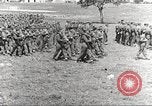
A battalion of uniformed Yugoslav Partisans march as a group during World War II
A battalion of uniformed Yugoslav partisan soldiers marches across uneven ground during a training exercise. They reform into a large square formation and parade across a smoother field. A number of women are included in their ranks. Next, all are seen marching, with some carrying Zastava M84 Medium Machine Guns, slung over their shoulders. They halt and stand at attention, and then resume marching. They break into two formations and march as the camera focuses on the space between them. The two formations pass on either side of the camera.
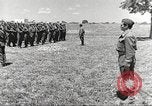
Yugoslav Partisans being reviewed by their leaders in Yugoslavia during World War II.
A Battalion of Yugoslav Partisans training in Yugoslavia during World War II. Partisans assembled on a field as four company commanders step forward and salute the Battalion commander, who gives them an order. The four officers salute and return to ranks. The Battalion commander reviews troops, including women in uniform. He talks to a an older officer. Closeups of several women partisans. Some partisans display their mustaches. One soldier twirls the end of his mustache. Two women wearing Red Cross on their sleeves.
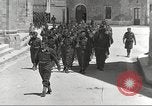
Uniformed Yugoslav Partisans march through a town and line up for mess in a field during World War II
A Battalion of uniformed, armed Yugoslav Partisans march through a town, past stone buildings, during World War 2. They proceed to an open field where form up in several lines, with their mess kits for a meal. Mess workers dole out cupfuls of food, from large caldrons, to each soldier. A number of women soldiers are seen in the Battalion
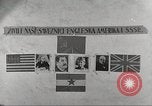
Yugoslav Partisans read and rest in a building in Yugoslavia during World War II.
The Yugoslav Partisans in Yugoslavia during World War 2. Pictures of Allied leaders and Allied flags. The flag of the United States and a picture of U.S. President Franklin D. Roosevelt. The British flag and a picture of British Prime Minister Winston Churchill. The flag of the Soviet Union and a picture of Soviet Premier Joseph Stalin. The flag of Yugoslavia and a picture of Marshal Josip Broz Tito. Partisans read and rest inside a building.
CRITICALPAST.COM: About Us | Contact Us | FAQs - How to Order | License Agreement | My Account | My Lightboxes | Shopping Cart | Advanced Search | Featured Collections | Website Terms & Conditions | Privacy Policy ©2026 CriticalPast LLC.
License Agreement |
Terms & Conditions |
Privacy Policy
©2026 CriticalPast LLC.