


 Francais
 Deutsch
 Italiano
Refine Your Search
-Cebu,-Philippines stock footage and images
- Showing 23479 to 23484 of 58986 results more
more Hide
Hide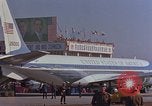
U.S. President Lyndon B Johnson visits Korea and returns back to United States.
United States President Lyndon B. Johnson visits Korea after attending the Manila Summit Conference. View of the United States Air Force One presidential plane after landing in Seoul. South Korean Air Force performs aerobatics to welcome President Johnson. Korean crowd welcomes President Lyndon B Johnson. Koreans hold American flags in hand. School girls, wearing traditional chima jeogori, sing to welcome the President. President Johnson reviews Korean troops. Sign says “Welcome President and Mrs. Johnson”. President Johnson holds both American and Korean flags in front of crowds. President Johnson leaves in his aircraft after his visit in Korea. Koreans sing the traditional “Arirang” song upon President Johnson’s departure from Korea. The President talks about his visit to different nations and the local people he met.
Attack on Pearl Harbor by Japanese, and President Roosevelt asks for war declaration on Japan in 'date of infamy' speech.
United States Government film entitled "The World At War" dealing with World War 2. Film opens showing Japanese warplanes in formation above a Japanese military installation. Slate reads: "Pearl Harbor December 7, 1941. An airfield is seen filled with parked U.S. Army Air Forces B-17 bombers. Two Boeing XB-17 (Model 299) bombers are parked next to each other on the ramp. Derricks and ships are shown at the Pearl Harbor naval base. A formation of Japanese Mitsubishi G3M bombers is seen in flight. They are seen overhead as bombs explode on the U.S. Navy Air Station at Ford Island destroying hangars and aircraft. Next, is shown the famous image of the USS Arizona burning, listing, and sinking, after being bombed. Film continues, panning over post-air raid views of destruction. On December 8, 1941, U.S. President Franklin D. Roosevelt, addresses the Congress, delivering his declaration of war message. He calls December 7, 1941 "a date which will live in infamy." Roosevelt recounts that the United States was at peace with japan and in conversation with its government and Emperor, in the interest of maintaining peace.in the Pacific. even at the time of the attack. Japanese ambassador and his colleagues seen visiting State Department offices to meet with U.S. Secretary of State prior and even during the initial attack operations by Japan.Roosevelt recounts that the United States was still in conversation with Japan even at the time of the attack. Japanese ambassador and his colleagues seen visiting State Department offices to meet with U.S. Secretary of State prior and even during the initial attack operations by Japan. Photographers take pictures of the visiting Japanese delegation. President Roosevelt asks Congress to affirm that a state of War exists between the United States and the Japanese Empire.
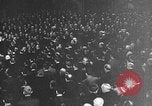
Varying sentiments about war and labor in lead up to World War 2. Roosevelt delivers his war message in the United States.
Disturbances and conflicting views about war versus isolationist approach in the United States prior to World War II. Officials speak about lend lease and officials with anti-war involvement stance advocate protectionism. Speakers include Senator Gerald P. Nye. and Senator Burton K. Wheeler. Wendell Willkie speak advocating a unified approach. Senator Joshua B. Lee of Oklahoma speaks. United States President Franklin D. Roosevelt addresses the Congress and delivers his war message. Pacifist student protestors on street in front of the White House with anti-war banners that read 'Peace Mobilization'. Counter demonstrators also picket, including a man with a sign, "We Americans Protest Communists Picketing the White House." Vehicles drive past in front of the White House. A group of women anti-war protestors are seen seated at an event, and together they pull down black veils in front of their faces. German Bund officials (German-American Bund) are seen meeting at an outdoor rally, and then again at Madison Square Garden in New York City in 1939. A band plays and the leader Fritz Julius Kuhn gives a brief speech during which a protestor leaps the stage and is beaten down by Bund members. Workers on streets protesting for various labor rights. They march and picket on a street. Demonstrators for other causes in American society in the early 1940s, including a woman demonstrator who carries a sign advocating civil rights or equal rights that says "Did Lincoln Free the Slaves?" Clip ends with scenes of violence at various labor strikes, including scabs (strike-breakers) being attacked, beaten, and hit by strikers, and authorities directing water hoses on strikers to repel them away from a building gate.
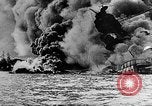
Japan extends its empire into Manchuria, Mongolia, and China in 1931 and 1932
Brief opening scenes show ships being engulfed in flames and smoke from Japanese attack on Pearl Harbor, December 7, 1941 in World War 2. Focus is primarily on the USS Arizona. Scene shifts to Japanese troops assembling on a pier and boarding troop transport ships bound for Manchuria and China, following the Mukden Incident of September, 1931. Japanese troops are then seen marching into Manchuria on September 18, 1931. A formation of Japanese soldiers presents arms. In another formation, they shoulder swords. Closeup of a Japanese soldier in a steel helmet with chin strap in place. A steam locomotive pulls a train into the Chin Hsien station on the South Manchurian Railway. A Japanese train on that line had been dynamited, triggering a Japanese push into Mukden. View from behind a train leaving Chin Hsien on the South Manchurian Railway. Japanese battalions place bundles of straw across a stream to facilitate troop crossing. A column of Japanese troops is seen crossing the water on the makeshift straw crossing. Japanese troops advancing along with supplies carried by pack animals. Troops traverse a sandy berm past an abandoned two-wheel cart. A formation of 12 Japanese G3M bombers flies overhead in a "V" formation en route to bomb Mukden. View of Chinese population running for shelter from the bombing. Chinese walk past some civilian casualties lying in a street. The League of Nations headquarters in Palais Wilson, Geneva, Switzerland. A memorial to Woodrow Wilson at the Palais Wilson reads: "A La Memoire De Woodrow Wilson President des Etats-Vnis,Fondatevr DL La Societe Des Nations, La Ville de Geneve." A car driving away from the entrance of the League Headquarters. Closeup of doorway with sign identifying it as the entrance for delegates and members of the Press. League delegates are seen inside its meeting hall. Japanese warships are seen next, attacking 15 miles from Shanghai with naval gunfire.Three Mitsubishi 2MR4 (Type 10)Reconnaissance biplanes are seen in flight above the barrel of a large naval gun. Japanese troops marching into Shanghai, as people on the roadside wave Japanese flags. Next, they are seen marching out of Shanghai at the insistence of the League of Nations. After signing a truce with China, on May 4, 1932, Japanese troops are seen entering Mongolia, in September, 1932, which they reconstituted as the Puppet State of Manchuko. A Japanese soldier standing atop a building waving a Japanese flag. Japanese statesmen resigning and leaving the League of Nations in protest after it labeled Japan an aggressor. Japanese forces fire a long barrel Type 89 cannon (150mm) as they push into China proper. Group of Japanese artillerymen use range finders, Periscopic viewers and binoculars to guide the gunners. Shell explodes raising large amount of earth. More views of artillery firing and infantry advancing. Infantry crossing a bridge and raising siege ladders to scale a fortress. Engines running on Japanese Ki 30 Type 97 airplanes, as pilots get final briefing and orders. They salute, board their aircraft, and are seen in formation aloft, dropping bombs. View from the air of bombs striking below. View from a bomber of its bombs dropping from the aircraft (bombs away view) and exploding on the ground. A column of Chinese soldiers moves along a section of the Great Wall of China heading into the interior of China. Civilians moving all manner of equipment and machinery into the interior.
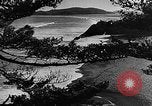
Film contrasting traditional views of Japan with modern Japan in the 20th Century.
Film begins showing a calm beach and Mount Fuji in Japan. Japanese women in traditional kimonos are seen strolling in orchard of cherry trees in bloom and water gardens. Geisha girls dance with fans. Peasants harvest rice by hand. Modern buildings in a city with automobiles, trams, and pedestrians dressed mostly in Western fashions. View of a large baseball stadium, filled with spectators. The baseball teams march into the stadium accompanied by a brass band. The teams assemble in formation and collectively move a rope to raise their national flag over the stadium. A nationalistic announcer speaks to the audience while flags of various kinds are held by men standing behind him. Next, players are seen during a baseball game.
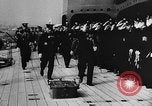
Axis powers organizing for World War II
Senior Japanese Naval Officers make inspection visit on a warship. Japanese warships underway at sea. A Japanese destroyer. Numerous Japanese warships with several formations of Naval aircraft overhead. A loose formation of Kawanishi H6K Naval flying boats in flight. Japanese light and medium tanks on parade, including Type 95 Ha-Go tanks (some with offset turrets). Many tanks cross a field. In Japan, Emperor Hirohito, riding a white horse, reviews Type 97 Chi-Ha medium tanks as their crews stand at attention. Tanks create clouds of dust as they move on a road and a field. Japanese infantry soldiers march in review past Emperor Hirohito on his white horse. Large formation of Japanese infantry marching. High-stepping Japanese infantry compared to Italian infantry goosestepping. Benito Mussolini speaking to Italians from his balcony on the Palazzo Venezia of Rome on November 4th, 1938. Numerous Italian Army SPAD XIII biplanes parked in a large field. Ethiopia's Emperor, Haile Selassie, speaks from a shelter and invokes tribesmen fight invasion by Italian forces. Tribesmen are in tribal dress, armed with spears and ancient rifles, as they rally to their Emperor. Italian L3 light tanks being used in the Ethiopian campaign. Contingent of Italian cavalry charging and infantry advancing. Italian Caproni Ca.111bis light bomber in flight. Bombs falling. Italian artillery firing and shells striking a hilltop fortress. Japanese attendees waving Japanese flags in a large stadium in Italy. A Japanese statesman reading a speech in Japanese. Most of the stadium is filled with Italians. "Saluti" is written at the section occupied by Japanese attendees. An Italian spokesman welcomes the Japanese participants. A Japanese translator is beside him. Japanese cheer as they hear the translated greeting.
CRITICALPAST.COM: About Us | Contact Us | FAQs - How to Order | License Agreement | My Account | My Lightboxes | Shopping Cart | Advanced Search | Featured Collections | Website Terms & Conditions | Privacy Policy ©2026 CriticalPast LLC.
License Agreement |
Terms & Conditions |
Privacy Policy
©2026 CriticalPast LLC.