


 Francais
 Deutsch
 Italiano
Refine Your Search
-Cebu,-Philippines stock footage and images
- Showing 23683 to 23688 of 58986 results more
more Hide
Hide
Soldiers watch a football game and L-4 plane in flight over stadium to drop ball for start of game in Marseilles, France.
Soldiers watch a football match and cheer participants in Marseilles, France. Several bands parade on field with the U.S. flag. The game is played in stadium. Soldiers in audience. Large crowd of spectators watch the game. Game in progress. L-4 plane in flight over the stadium drops ball for start of game. Players during the game. (World War II period).
Combat fatigued U.S. soldiers are interviewed and sent for treatment in the Training and Rehabilitation Center, Italy.
Psychiatric procedures for United States soldiers in combat areas during World War 2 suffering stress following trauma of battle. Battle scenes: Strong and courageous soldiers sent for fight. They attack enemy and fire rifles from hidden places. Smoke rises. They face danger in battle day after day. View of wounded, burned and dead soldiers in battle. Strongest soldiers of the army maneuver over field. Soldiers seated facing the stress of combat and become psychiatric casualties. Chart depicts fighting front and its three levels: division, army and base. Soldiers are sent to battalion aid station and back to clearing stations for treatment. Medical van brings the wounded soldiers and psychiatric casualties to battalion aid station. One officer checks the ID card of soldiers. ID card reads: '1st battalion, 168 infantry regiment, yes incurred in Italy'. Chart shows training and rehabilitation center (T& R center) near clearing station. Soldiers reach to training and rehabilitation center. A Sign of 'Training and Rehabilitation Center'. Combat fatigue cases are reconditioned by battle training. A psychiatrist interviews a soldier suffering from reactive depression and asks about troubles and feelings faced by him when he got wounded. After interview soldiers are send to clearing center. Soldier enters into tent at camp. They take rest, make social contacts with other soldiers, write letter, get shaved and eat food. Two days later, soldier is re-interviewed about improvement after relaxation in training center. He shows improvement and is encouraged. Recovered soldiers fill the artillery outside the tent near training center. (Modern equivalent - PTSD or post traumatic stress disorder treatment)

On 8 December, 1944, U.S. soldiers test a new type rocket launcher at Viareggio, Italy, during World War II
U.S. soldiers insert charges into rockets and then load them into a multi-barrel rocket launcher mounted on a 37mm gun carriage, set up on the shore at Viareggio, Italy in World War 2. They load the 4.5 mm rockets into the firing tubes. Next the rockets are seen being fired by a soldier from a remote position. (Ordnance and Artillery Sections of the U.S. 5th Army developed this rocket launcher.)
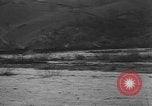
Troops of the U.S. 92 Infantry division (Buffalo Soldiers) evacuate a flooded bivouac area in Italy during World War II.
Throughout the film, flood waters from heavy rains are seen inundating the normally dry Idice river bed in the vicinity of Borgo di Bisano, 17miles from Bologna, Italy, where U.S. troops of the 92nd Infantry Division (Buffalo Soldiers) were encamped, in World War 2. Army vehicles are moving cautiously through the flood waters as troops work to rescue supplies and equipment. Camera pans over the wide area covered by the fast moving waters.
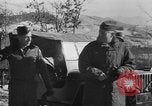
Lieutenant General Lucian K. Truscott assumes command of the 5th Army in Italy during World War II
On 10 December 1944, Lieutenant General Lucian K. Truscott, Jr. (newly appointed Commander of the 5th Army) arrives by jeep at a U.S. Army encampment in Italy during World War II. He is escorted the headquarters of II Corps, on the Apennine front below Bologna, where he is greeted by Major General Geoffrey T. Keyes. They walk together around a building. The next day General Truscott is seen saluting as he is escorted by Major General Willis D. Crittenberger, Commander 1V Corps. Next, General Truscott is seen at the headquarters of the Brazilian Expeditionary Forces contingent of the 5th Army, where he greets its Commander, General João Baptista Mascarenhas de Morais and his aides. As General Truscott leaves, his jeep passes a Brazilian honor of soldiers who salute him. Brigadier General, Donald Carlson. new Chief of Staff of the 5th Army, accompanies Generals Truscott and Crittenberger to a forward observation post near the village of Castelluccio. They observe from a bunker overlooking a valley, where white smoke is rising. (Narrator states that the smoke screen indicates the position of the Allied line of the IV Corps Sector on 11 December.) Next the three American officers are seen making their way up a mountain side, with smoke rising from the town of Vergato, in the background below, where heavy fighting is taking place. (World War II; WW II; World War 2; World War Two)
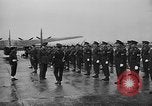
Various Allied Generals assume new commands in Italy during December, 1944, World War II.
On 12 December, 1944, at an airport in Naples, Italy, British General Sir Henry Nathan Wilson inspects an honor guard of American Military Policemen in formation. (Narrator states he is en route to replace the late Field Marshal Sir John Dill, in Washington, DC, USA) A contingent of British troops is also present as part of the honor guard, on the wet airport tarmac. (Narrator states that Wilson will head the British Joint Staff Mission and be personal military representative for Prime Minister Winston Churchill.) He approaches a line of U.S. military officers who salute him. Closeup of General Wilson With U.S. Army Air Forces Lieutenant General Ira C. Eaker, next to U.S. Vice Admiral Kent Hewitt. Also with them (back to camera) is British Admiral Sir John Henry Dacres Cunningham, Commander-in-Chief for the Mediterranean Fleet. Next, General Wilson and his party are seen boarding a British Avro York four-engine Heavy Transport aircraft. View from the ground, of the aircraft cockpit and the engines running as it taxis out for takeoff. Change of scene shows troops gathered in open air battlefield environment. General Mark Clark, now Commander-in-Chief of the Allied 15th Army Group, decorates some members of the 5th Army, as General Lucian King Truscott Jr. (new 5th Army Commander) stands by his side. General Clark says farewell to members of the 5th Army and shakes hands with many of them. (World War II; WW II; World War 2; World War Two)
CRITICALPAST.COM: About Us | Contact Us | FAQs - How to Order | License Agreement | My Account | My Lightboxes | Shopping Cart | Advanced Search | Featured Collections | Website Terms & Conditions | Privacy Policy ©2026 CriticalPast LLC.
License Agreement |
Terms & Conditions |
Privacy Policy
©2026 CriticalPast LLC.