


 Francais
 Deutsch
 Italiano
Refine Your Search
-Cebu,-Philippines stock footage and images
- Showing 24049 to 24054 of 58986 results more
more Hide
Hide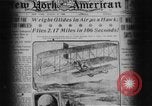
Newspaper headlines Wilbur Wright sustained demonstration flight in France.
Headline of the newspaper 'New York American' reads 'Wright Glides in Air as a Hawk, Flies 2.17 miles in 106 seconds'. Pictures of the Wright Model A Flyer under the headlines. Wright Model A Flyer being readied for flight at the Hunaudieres horse racing track near Le Mans, France. A horse-drawn wagon pulls the flyer into a field. Crew of men pull rope to raise a launching weight in a tower. The plane is catapulted along a rail and into the air, when the men release the weight. Spectators in a grandstand look through binoculars. Louis Bleriot is seen. Views of the Wright plane in flight, where it attained an altitude of 360 feet.
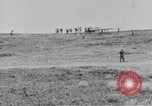
Early primary glider launched from hilltop in the United States
Film leads with slate reading: "How the Wrights learned to fly--the motorless, man-carrying glider." A group of people stand on a hilltop, watching as two men launch a primary glider with a downhill running start. The glider consists of tubular frame tapering to nearly a point at the empennage. It is equipped with wheels, and the pilot sits upright with legs extended straight ahead.. The glider has a single high wing. It rises quickly and flies above ground for a good distance, appearing to approach the ground as it moves downhill.
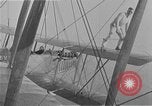
Barnstorming between the wars. Wing-walker preparing to transfer from one biplane aircraft to another, in flight.
Between World War I and World War II, so-called barnstorming was popular. Here a wing-walker stands on wing of a Curtis "Jenny" JN4 biplane, preparing to transfer to another , in flight.
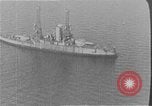
USS Alabama is hit by bombs during demonstration by Army Air Service DH4 bomber airplanes in the Chesapeake Bay.
Bombing demonstration by U.S. Army Air Service DH4 aircraft under command of Brigadier General Billy Mitchell. The target is Battleship USS Alabama, in September, 1921 in the Chesapeake Bay, United States. Army flier is seen checking security of a bomb under wing of aircraft. USS Alabama underway in the Chesapeake Bay. Aerial views from United States Army Air Service planes in flight over the battleship. USS Alabama is hit by a bomb. Later it is hit by a phosphorus poison gas bomb. Finally it is hit by 2000 pound bombs. The USS Alabama rolls over halfway, in shallow waters.
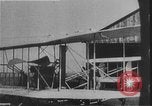
Wright Flyer is rolled from hangar, catapulted, and flown. View of wing, from the airplane.
A Wright Flyer is pulled from a hangar by ground crew. They raise a heavy weight on a tower to provide energy for catapulting the Flyer into the air. The Airplane takes off. Views of the wing from aboard the Wright Flyer. Views of Orville Wright.
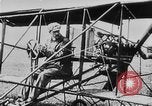
Glenn Curtiss at the Grande Semaine d'Aviation in Rheims, France, in 1909
Glenn Hammond Curtiss at the controls his Pusher airplane, the "Rheims Rider", which he flew to win the Gordon Bennett trophy, on August 28, 1909, in the Grande Semaine d'Aviation, at Rheims, France. Ground crew turns propeller and engine starts. Glenn Curtiss taxis out for takeoff.
CRITICALPAST.COM: About Us | Contact Us | FAQs - How to Order | License Agreement | My Account | My Lightboxes | Shopping Cart | Advanced Search | Featured Collections | Website Terms & Conditions | Privacy Policy ©2026 CriticalPast LLC.
License Agreement |
Terms & Conditions |
Privacy Policy
©2026 CriticalPast LLC.