


 Francais
 Deutsch
 Italiano

Refine Your Search
-Cebu,-Philippines stock footage and images
- Showing 25075 to 25080 of 58986 results more
 Hide
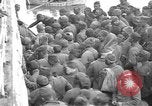
Repatriated Turkish prisoners of war board a ship.
Turkish prisoners of war being repatriated in Europe. They board a ship and some receive cigarettes from well-dressed civilian men who reach from the dock to the former prisoners, on board. Several former prisoners pose in the tatters and rags of their former uniforms. Many of the former prisoners wear garrison caps. All have had recent hair cuts and appear clean. Many prisoners are seen gathered in an open yard in the port of embarkation, which also contains a shelter and a fenced area filled with baggage, in the background.
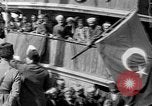
Turkish Nationalists arrive by ship at Samsun, Anatolia (Turkey)
Turkish Nationalists on a ship docked at Samsun, Anatolia (Turkey). Large Turkish flags are displayed on the ship, and on the dock. Officials pose on the gangplank. Turkish irregulars disembark , carrying large sacks of belongings. A Turkish officer is seen carrying a sidearm. But no other weapons are seen. Scene shifts to a procession through the war ravaged city during the period of the Turkish War of Independence and the end of the Greco-Turkish War. The procession is led by officials riding in horse-drawn carriages. Numerous Turkish flags are carried in the procession. The scene shifts, again, to destroyed buildings, including the Governor's office building. Other destruction is seen, resulting from earlier bombardment by the U.S. and Greek warships. (Note: Naval bombardment of virtually undefended Samsun was carried out by the following, on June 7, 1922: American warships:USS Sands (DD-243); USS McFarland (DD-237); USS Sturtevant (DD-240); Greek warships: Cruiser, Georgios Averof; Destroyer, Nazos; Battleship, Kilkis; Destroyer,Leon; plus several other Greek Cruisers and minesweepers.)
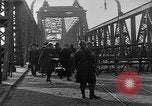
French troops monitor civilians crossing steel bridge over the Rhein (Rhine) river, between Ruhrort and Homberg, Germany
Civilians crossing steel Bridge across the Rein (Rhine) River between Ruhrort and Homberg, Germany, under observation by armed French troops in 1921. The bridge is partially obstructed by barbed wire obstacles deliberately placed. The roadbed is paved with stone blocks and has a rail line in it's center. The civilians appear to be heading to work. As they leave the bridge, heavy industrial facilities, including smoke stacks can be seen in the distance. View of waterway from bridge, showing several commercial side-wheeler steam vessels. French troops man a machine gun emplacement.
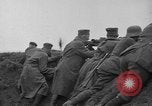
German troops on the firing line at the Eastern Front during the First World War.
German troops man a firing line on the Eastern front in World War I. Opening scene shows German army officers and soldiers in a trench. They all wear cloth hats, except for one soldier wearing the new 1916 model steel helmet. They don't seem too concerned about possible enemy fire. An officer stands up, relatively exposed, and points out directions. Several soldiers lean forward in the trench, next to one manning a 1916 model MG-08/15 machine gun with wooden gunstock and a pistol grip (Maschinengewehr 08/15).The principal gunner is suddenly struck by an enemy bullet and falls back from the line. Two other soldiers seize the machine gun before it can fall from its position. (World War I; World War 1; WWI; WW1)
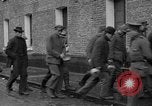
Civilian workers carry personal mess pans as they proceed to get a meal. An armed Russian soldier stands nearby.
Civilians holding personal mess pans line up and enter a building. A Russian soldier, with rifle slung over his shoulder, stands outside the building and watches the men.
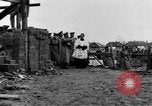
Tsar Nicholas II with a priest and other officials. Fallen soldiers are brought for burial, in World War I.
Russian officials along with Tsar Nicholas II arrive at a field cemetery on the Eastern front during World War I. A priest accompanies them as they walk. The officers and soldiers walk into a fenced area where fallen soldiers, in uniform, are laid out. soldiers unload more war dead from wagons and place them on the ground. Some houses are seen in the background. In a different setting, war dead, with some snow on them, are laid out on the ground. Tsar Nicholas II and officers are seen proceeding on horseback, ahead of marching troops. Snow covered fields in the background.
CRITICALPAST.COM: About Us | Contact Us | FAQs - How to Order | License Agreement | My Account | My Lightboxes | Shopping Cart | Advanced Search | Featured Collections | Website Terms & Conditions | Privacy Policy ©2026 CriticalPast LLC.
License Agreement |
Terms & Conditions |
Privacy Policy
©2026 CriticalPast LLC.