


 Francais
 Deutsch
 Italiano

Refine Your Search
-Cebu,-Philippines stock footage and images
- Showing 25453 to 25458 of 58986 results more
 Hide

USS Samuel Chase (APA-26) stops at Casablanca en route to the U.S. for repairs, in World War II
Scene aboard the USS Samuel Chase (APA-26) as she approaches the pier in Casablanca port, during World War 2. Life preserver reads "USS Samuel Chase, USCG". American flag flies. Officers and men on deck. Ship's wake seen astern. Line handlers on pier, with hawser in their hands, walk across the pier to secure the lines. As Coast Guardsmen on the pier watch, a Scuffle breaks out among some local men on the pier. Several are knocked to the ground. Rifle-armed Moroccan gendarmerie in brown uniforms and red fezs, chase the troublemakers off the pier, and restore order. Crewmen are seen retrieving the ship's lines. The Navy Jack is lowered from the stern flag pole as the Chase begins to move away from the pier. The French battleship, Jean Bart, can be seen at an adjacent pier, beyond a group of intervening warehouses. A U.S. PBY aircraft flies overhead. Several scenes show crew members as they settle down for the voyage home.Several play acey ducey backgammon on deck. Some simply relax on the deck. Four crewmen play cards. The USS Samuel Chase heads West into the sunset.

USS Samuel Chase (APA-26) en route to Norfolk, Virginia, U.S.A. for repairs during World War II
U.S. Coast Guard Captain Roger C.Heimer of the Samuel Chase (APA-26), steps down to the main deck, where crewmen are assembled. They honor Captain Heimer, who will be leaving the ship in Norfolk, by presenting him with a plaque, that appears to chronicle the major campaigns in which the Chase participated. The Captain thanks them and speaks to the crew. He then climbs a ladder down the ship's side. Other officers follow him. Soon, the captain and officers are seen climbing back on the main deck, where they converse. A Consolidated PB2Y Coronado flying boat is seen flying overhead. The American flag flutters from the ship.
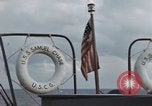
Activities of crew members on USS Samuel Chase on mission to Algiers in World War II
The USS Samuel Chase (APA-26) en route to Oran, Algeria, in World War 2. A life preserver reads "USS Samuel Chase, USCG". American flag flies nearby. Silhouette shot of another transport ahead, gun mount and rigging in foreground. Silhouette of transport, sun in right side. Looking down on main deck of transport shows several Free French sailors in dress blues. Crew of ship on main deck. Landing Craft Vehicle Personnel (Higgins Boat) on deck with identification "PA 26 3" painted on its hull. Transport underway. Marine dressed in fatigues. Water in background. Men lounge around on deck. Chief speaking to assembled Coast Guardsmen.
The film of T-3A camera developed and a print is taken from B-7 printer in United States.
A U.S. Army training film about developing camera film containing aerial reconnaissance views. Film titled 'Aerial Photography', Part -5, 'Processing the Film'. A T-3A camera is unloaded from a plane. It is taken to a dark room at photographic laboratory Dept. 59. Exposed film roll is removed from camera and is put into its original box. The T-3A film development assembly, placed on table consist of 3 metal boxes, spool plates and motor to transfer film and a loading plate. Development of film starts with first fixing the film onto the loading plate and transferring it on to spools. These spools are then immersed in clean water and transferred from one solution to other. It is then transferred to the developing solution, then in water and hypo solution and then kept in fixing base for 30 minutes. It is washed in running water for 30 minutes. Film is then dried on film dryer blower drum. Then it is transferred to take up spool and laid on lettering table. Each film is lettered on right lower side with title, location, organization, date, day, length and altitude. Developer is prepared at appropriate temperature with water. Print is taken on paper. A B-7 printer is used for printing. The paper is immersed into different solutions and then dried on a canvas belt over a heated drum.
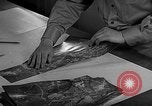
The film mosaic of T-3A camera is assembled together and interpreted in United States.
A U.S. Army training film about interpreting a camera film with aerial views. A print of T-3A camera film is developed. The mosaic prints are mounted by adhesive or staples. Completed mosaic is matched for contrast control networking. It is contrasted with U.S. geographical survey sheets and road maps. These are used to mark known places. Then these prints are pasted together. These pictures are send to an interpreter officer who translates the desired information. He uses stereoscope to find new enemy gun position, camouflage or other informations. (World War II period).
Parts of a K-12 camera described in United States.
A U.S. Army training film about parts of the K-12 camera. Title of the film 'Aerial Photography', Part 2, 'The K-12 Camera'. A man shows a K-12 camera used for night photography. A diagram of the camera. A pointer shows parts of the camera like photo electric cell and amplifier. A solenoid is attached to the shutter. Lenses and 12 volt battery. The aligned system of camera must be 13 and a half inches. Portals attached to a battery current. Before assembling the camera it is cleaned by air blower. Lenses are wiped. Amplifier is attached and locked over camera. Electric nodes are fastened. horizontal and lateral leveling of camera is measured. Number of exposures are calculated. Shutter speed is provided at three levels. Shutter and amplifier are set at on position. Cut film holder is loaded in a dark room and roll film magazine is loaded. The man shows the parts of camera mount.
CRITICALPAST.COM: About Us | Contact Us | FAQs - How to Order | License Agreement | My Account | My Lightboxes | Shopping Cart | Advanced Search | Featured Collections | Website Terms & Conditions | Privacy Policy ©2026 CriticalPast LLC.
License Agreement |
Terms & Conditions |
Privacy Policy
©2026 CriticalPast LLC.