


 Francais
 Deutsch
 Italiano

Refine Your Search
-Cebu,-Philippines stock footage and images
- Showing 26929 to 26934 of 58987 results more
 Hide
Color Sound
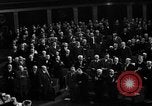
President Harry Truman addresses Joint Session of Congress in Washington DC, United States.
U.S. President Harry Truman addresses Joint Session of Congress in Washington DC. The gallery is packed with spectators. The President is applauded upon arrival. Members of Congress listen as the President speaks.

Ernest Green works to provide job education and construction trade jobs to black citizens in New York City
The work of African American civil rights leaders in the United States. Ernest Green, one of the "Little Rock Nine" students, encourages black apprenticeships in building trades. Through his work at the Recruitment and Training Program, or RTP, Inc., in Brooklyn, New York City, Ernie Green reaches out and speaks to young black men in need of jobs. Young black workers without jobs stands outside a fenced area and look in at white men working at a construction site. Young black men unemployed on street corners and in front of shops. African American children on a city street, bundled in coats and walking to school. Ernest Green reflecting on the difficulty for black young men in getting jobs and in feeling welcome in the work force. Two young black men talking on a city sidewalk, looking in store windows, and then talking and doing a multiple step hand shake. Blacks in a classroom coaching young minority men in preparation for a sheet metal or other building trade union qualification test. African American men with construction jobs are seen laying bricks for a new building, working with steel beams, pouring cement, and constructing a building. Black workers install building windows and work with a torch on steel girders.

Ernest Green in a meeting with other officials in New York, planning programs to train unemployed youth.
The work of African American civil rights leaders in the United States. Ernie Green, leader of the Recruitment and Training Program. or RTP, Inc. in Brooklyn, New York, is seen in a meeting with officials. Green and others working to create construction trade training opportunities for young unemployed African American men, and any young man who needs assistance. Black and white students exit an integrated high school. African American men and women stand in a queue to cast their votes in an election as narrator notes increase in black voting. Scenes of African American citizens in voting booths. An African American politician running for office greets voters on the street.
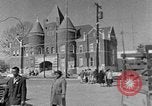
Mayor Carl Burton Stokes elected as Mayor of Cleveland in 1967; citizens of Cleveland and its City Council; Stokes meeting with President Nixon
Mayor Carl Burton Stokes, African American political leader in Cleveland, at the time of his election as Mayor of Cleveland on November 7, 1967. Mayor Stokes and his wife emerge from a building (possibly a polling place) into lightly falling snow in winter, as reporters and media gather nearby. Views of his campaign headquarters and posters in it that read 'Stokes For Progress'. Men and women wearing Stokes hats. The crowd cheers at his mayoral victory. Newly elected Mayor Stokes addresses the crowd from microphone and receives constant applause and cheering. Audio of new Mayor Stokes speaking to supporters in his victory speech while scenes are shown of African American and white men and women citizens of Cleveland walking on streets of the city in typical late 1960's and early 1970's fashions. Scene includes pedestrians young and old walking and boarding a city bus. Mayor Stokes seen exiting a building and walking in Cleveland. Meeting in progress in Cleveland City Council chamber. Views of various City Council members including a number of African American council members. Mayor Stokes seated with U.S. President Richard Nixon and other big city mayors discussing the urban crisis.

Mayor Carl Burton Stokes in Cleveland Ohio appointing retired General Benjamin O. Davis Jr; induction of new police officers
The work of African American civil rights leaders in the United States. Mayor Carl Burton Stokes, political leader in Cleveland, along with other officials at a formal gathering where former General Benjamin O. Davis Jr. takes oath of service as Public Safety Director and assumes duties in Cleveland. A board in the background reads 'City Of Cleveland'. Black and white police officers take oath of service. Carl Burton Stokes speaks to the people of Cleveland Ohio, standing on winter snow covered ground, about a new hospital or hospital addition, and then sits in a moving bulldozer with a nurse and the machine operator.

Gulf of Tonkin response: President Johnson announces U.S. action as United States soldiers and aircraft are rushed to Vietnam
United States planes and soldiers are rushed to Vietnam, responding to the Gulf of Tonkin crisis. U.S. Destroyer Maddox seen underway in the gulf of North Vietnam following reported skirmish with North Vietnamese torpedo boats (the "Maddox Incident.") Narrator indicates U.S. war planes from two carriers avenged the unwarranted Red communist assault with 64 sorties against North Vietnam. An airman boards a U.S. aircraft. Night view of the White House in Washington DC. President Lyndon Johnson addresses the American people in a midnight speech on August 4, 1964 describing U.S. actions in response to the Gulf of Tonkin incident. Scenes of South Vietnamese women and children evacuees looking exhausted and scared beside nearby American helicopters. The President's speech continues, including, "We Americans know, although others appear to forget, the risks of spreading conflict. We still seek no wider war." View of the United Nations building in New York and flags of various nations at the UN building. Ambassador Adlai Stevenson is seen making his report of the Gulf of Tonkin attacks to the UN Security Council and affirms U.S. position that it wants the people in Vietnam to be free of North Vietnamese intervention and agression. United States military advisors and U.S. Army soldiers board helicopters. A gunner aims at a target on the ground. Vietnamese troops accompany U.S. soldiers. South Vietnamese forces exit a helicopter and wade through water and rice paddies. U.S. soldiers advance in trucks with artillery. A Douglas TBD Devastator aircraft takes off armed with a torpedo. Another one lands at an airfield. A TBD plane, armed with a torpedo, taxis with wings folded. several TBD aircraft parked on a flight line. The President concludes his remarks referring to "firmness in the right" being indispensible for peace. (Vietnam War period).
CRITICALPAST.COM: About Us | Contact Us | FAQs - How to Order | License Agreement | My Account | My Lightboxes | Shopping Cart | Advanced Search | Featured Collections | Website Terms & Conditions | Privacy Policy ©2026 CriticalPast LLC.
License Agreement |
Terms & Conditions |
Privacy Policy
©2026 CriticalPast LLC.