


 Francais
 Deutsch
 Italiano

Refine Your Search
-Cebu,-Philippines stock footage and images
- Showing 27049 to 27054 of 58987 results more
 Hide
Color Sound
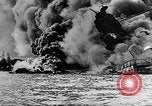
Japan extends its empire into Manchuria, Mongolia, and China in 1931 and 1932
Brief opening scenes show ships being engulfed in flames and smoke from Japanese attack on Pearl Harbor, December 7, 1941 in World War 2. Focus is primarily on the USS Arizona. Scene shifts to Japanese troops assembling on a pier and boarding troop transport ships bound for Manchuria and China, following the Mukden Incident of September, 1931. Japanese troops are then seen marching into Manchuria on September 18, 1931. A formation of Japanese soldiers presents arms. In another formation, they shoulder swords. Closeup of a Japanese soldier in a steel helmet with chin strap in place. A steam locomotive pulls a train into the Chin Hsien station on the South Manchurian Railway. A Japanese train on that line had been dynamited, triggering a Japanese push into Mukden. View from behind a train leaving Chin Hsien on the South Manchurian Railway. Japanese battalions place bundles of straw across a stream to facilitate troop crossing. A column of Japanese troops is seen crossing the water on the makeshift straw crossing. Japanese troops advancing along with supplies carried by pack animals. Troops traverse a sandy berm past an abandoned two-wheel cart. A formation of 12 Japanese G3M bombers flies overhead in a "V" formation en route to bomb Mukden. View of Chinese population running for shelter from the bombing. Chinese walk past some civilian casualties lying in a street. The League of Nations headquarters in Palais Wilson, Geneva, Switzerland. A memorial to Woodrow Wilson at the Palais Wilson reads: "A La Memoire De Woodrow Wilson President des Etats-Vnis,Fondatevr DL La Societe Des Nations, La Ville de Geneve." A car driving away from the entrance of the League Headquarters. Closeup of doorway with sign identifying it as the entrance for delegates and members of the Press. League delegates are seen inside its meeting hall. Japanese warships are seen next, attacking 15 miles from Shanghai with naval gunfire.Three Mitsubishi 2MR4 (Type 10)Reconnaissance biplanes are seen in flight above the barrel of a large naval gun. Japanese troops marching into Shanghai, as people on the roadside wave Japanese flags. Next, they are seen marching out of Shanghai at the insistence of the League of Nations. After signing a truce with China, on May 4, 1932, Japanese troops are seen entering Mongolia, in September, 1932, which they reconstituted as the Puppet State of Manchuko. A Japanese soldier standing atop a building waving a Japanese flag. Japanese statesmen resigning and leaving the League of Nations in protest after it labeled Japan an aggressor. Japanese forces fire a long barrel Type 89 cannon (150mm) as they push into China proper. Group of Japanese artillerymen use range finders, Periscopic viewers and binoculars to guide the gunners. Shell explodes raising large amount of earth. More views of artillery firing and infantry advancing. Infantry crossing a bridge and raising siege ladders to scale a fortress. Engines running on Japanese Ki 30 Type 97 airplanes, as pilots get final briefing and orders. They salute, board their aircraft, and are seen in formation aloft, dropping bombs. View from the air of bombs striking below. View from a bomber of its bombs dropping from the aircraft (bombs away view) and exploding on the ground. A column of Chinese soldiers moves along a section of the Great Wall of China heading into the interior of China. Civilians moving all manner of equipment and machinery into the interior.
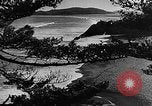
Film contrasting traditional views of Japan with modern Japan in the 20th Century.
Film begins showing a calm beach and Mount Fuji in Japan. Japanese women in traditional kimonos are seen strolling in orchard of cherry trees in bloom and water gardens. Geisha girls dance with fans. Peasants harvest rice by hand. Modern buildings in a city with automobiles, trams, and pedestrians dressed mostly in Western fashions. View of a large baseball stadium, filled with spectators. The baseball teams march into the stadium accompanied by a brass band. The teams assemble in formation and collectively move a rope to raise their national flag over the stadium. A nationalistic announcer speaks to the audience while flags of various kinds are held by men standing behind him. Next, players are seen during a baseball game.
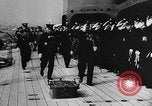
Axis powers organizing for World War II
Senior Japanese Naval Officers make inspection visit on a warship. Japanese warships underway at sea. A Japanese destroyer. Numerous Japanese warships with several formations of Naval aircraft overhead. A loose formation of Kawanishi H6K Naval flying boats in flight. Japanese light and medium tanks on parade, including Type 95 Ha-Go tanks (some with offset turrets). Many tanks cross a field. In Japan, Emperor Hirohito, riding a white horse, reviews Type 97 Chi-Ha medium tanks as their crews stand at attention. Tanks create clouds of dust as they move on a road and a field. Japanese infantry soldiers march in review past Emperor Hirohito on his white horse. Large formation of Japanese infantry marching. High-stepping Japanese infantry compared to Italian infantry goosestepping. Benito Mussolini speaking to Italians from his balcony on the Palazzo Venezia of Rome on November 4th, 1938. Numerous Italian Army SPAD XIII biplanes parked in a large field. Ethiopia's Emperor, Haile Selassie, speaks from a shelter and invokes tribesmen fight invasion by Italian forces. Tribesmen are in tribal dress, armed with spears and ancient rifles, as they rally to their Emperor. Italian L3 light tanks being used in the Ethiopian campaign. Contingent of Italian cavalry charging and infantry advancing. Italian Caproni Ca.111bis light bomber in flight. Bombs falling. Italian artillery firing and shells striking a hilltop fortress. Japanese attendees waving Japanese flags in a large stadium in Italy. A Japanese statesman reading a speech in Japanese. Most of the stadium is filled with Italians. "Saluti" is written at the section occupied by Japanese attendees. An Italian spokesman welcomes the Japanese participants. A Japanese translator is beside him. Japanese cheer as they hear the translated greeting.
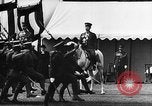
Actions of Axis and Allied powers on brink of World War II in period 1937-1939.
Japanese troops parade for Emperor Hirohito, mounted upon a white horse. Italian troops goosestep and German troops goosestep on parade. View of an Austrian town with snow-covered Alps mountains in background as German troops enter Austria on March 13, 1938 during the Anschluss. Local citizens welcome them, displaying swastika flags and giving Nazi straight arm salutes. Troops, military vehicles, tanks, motorcycles, and horse-drawn artillery comprise the German invading force. Shifts to Spain, where war torn buildings reflect effects of German and Italian intervention during the Spanish Civil War. A donkey standing near field artillery piece. Artillery being fired from an urban park in Spain. Artilleryman using a range finder. German gun crew with heavy artillery piece. Soldiers wearing Adrian steel helmets, firing a two-wheeled water-cooled machine gun. Spanish carrying wounded on stretcher. Spanish civilians inadvertently slain during civil war conflict. Starving dog walking in street. Huge poster of Francisco Franco and view of him on reviewing stand saluting marching Nationalist troops. Repeat of Hirohito reviewing troops and Italian and German troops goosestep. Adolf Hitler and Benito Mussolini stand together in open car heading to Fuhrerbau in Munich, Germany, for signing of Agreement between Germany, Italy, Britain, and France in 1938. Neville Chamberlain, and Edouard Daladier riding in car to Fuhrerbau. Views of the principals signing the accords. First is Adolf Hitler, followed by Prime Minister Neville Chamberlain, Benito Mussolini, and Edouard Daladier. After the signing, the principals, plus Hermann Goering, mingle and converse. Change of scene to nighttime in Rome, Italy, where Benito Mussolini addresses a huge throng gathered near the Victor Emmanuel Memorial to cheer him after his return from Munich. Next, German troops are seen entering Sudetenland (Czechoslovakia) greeted by joyous ethnic German inhabitants. Banners are stretched across a street. One gives thanks to the Fuhrer. Several scenes of cheering population. A woman strews flowers in a roadway. Hitler arrives, standing in an open car, and is met with cheers of adulation. A military brass band plays from the open beds of two moving army trucks. Signpost points to Prag (Prague), Eger (Cheb), Joachimstal (Jáchymov), and Komotau (Chomutov) after German annexation. Scene shifts to Prague, where German troops are seen occupying the city. High ranking German officers in a car are seen coming through the gateway from the Court d´honneur of the Prague Castle into the Hradčany Square. The next sequence shows an Italian Freccia-Class destroyer in the Albanian Port of Durrës. An Italian L3/35 Tankette is driven off a large cargo ship. Italian troops on bicycles ride in a city street. A German 88mm antiaircraft (flak) gun is shown, mounted at a fort overlooking a river and city. Final scene shows Adolf Hitler addressing a meeting of the Bundestag in the Kroll Opera House (alternate meeting place after burning of the Reichstag). He reads, contemptuously from an April 14, 1939 letter sent to him by U.S. President Roosevelt, asking him to give "assurance that your armed forces will not attack or invade the territory or possessions of the following independent nations: Finland, Estonia, Latvia, Lithuania, Sweden, Norway, Denmark, The Netherlands, Belgium, Great Britain and Ireland, France, Portugal, Spain, Switzerland, Liechtenstein, Luxembourg, Poland, Hungary, Rumania, Yugoslavia, Russia, Bulgaria, Greece, Turkey, Iraq, the Arabias, Syria, Palestine, Egypt and Iran." As Hitler reads through the litany of nations, the Bundestag erupts in laughter.
Events leading to World War II in Europe and German attack on Poland in 1939
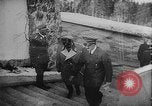
Adolf Hitler and Hermann Goering walk together up the steps of Hitler's Berghof residence in Berchtesgaden, Bavaria, Germany. Inside the two walk about and converse. Views of them in several different rooms of the building. Hitler and Goering silhouetted against the large windows in one room, containing a long table and a world globe. Change of scene showing Nazi foreign minister, Joachim von Ribbentrop, being greeted by Soviet Union Minister of Foreign affairs, Vyacheslav Molotov, in Moscow, Russia, where they negotiated the signing of the German–Soviet non-aggression pact (also called the Molotov–Ribbentrop Pact) in August 1939. Von Ribbentrop is seen seated with Soviet negotiators. Various newspapers reflect mixed world wide views. Some question whether war or peace is ahead. Another notes that the Reichstag supports the diplomatic initiative. Another suggests that England and France must decide. One headline says Chamberlain will want war. Next, Polish forces are seen on parade being reviewed by General Władysław Bortnowski. Among forces parading are mounted cavalry, marching infantry, a formation of PZL P.11 fighter planes, Tk-3 tankettes (Tankietka), 120 mm wz. field guns, CP7 Ursus artillery tractors pulling wagons, antiaircraft guns mounted on trucks, and army trucks carrying soldiers. Scene shifts to German airmen loading bombs on aircraft; arming machine guns; refueling; and testing functionality of aircraft elements, such as turrets. Pilot in cockpit as engines start on a Dornier Do 17 bomber. Ground crew pull chocks and aircraft taxis out. A Heinkel He 111 bomber taxiing. Two of them take off. A Do 17 takes off, followed by more He 111s. Closeup of one flying low over the camera on takeoff. A mixed formation of German aircraft aloft, including several fighters flying top cover; nine Dornier Do 17s; and other bombers. Aerial closeup of a Do 17 seen from adjacent wingman. Closeup of several He 111s in formation. Closeup of gunner in turret. View from above of three camouflaged Do 17s flying far below. Closeup of pilot in cockpit of He 111 with wingman off to left side. More views of Do 17s flying over patchwork of farmlands. Gunner preparing in his turret. Clouds from antiaircraft fire seen from plane cockpit. Bombs falling and exploding on city below. Succession of bomb craters in a line across a flat area of land. View from aircraft of damaged Polish aircraft on an airfield. Scenes of devastation on the ground including destroyed buildings and Polish aircraft. Waves of German Junkers Ju 87 (Stuka) dive bombers taking off; in formation; and peeling off to dive on targets. View from cockpit of one, through rotating propeller, as it dives to bomb a railroad marshaling yard, and view back as it pulls out, showing clouds of smoke rising in its wake. Several German officers peruse damage at rail site. Destroyed Bridge and shipyard. The German battleship, Schleswig-Holstein bombarding the Polish base at Danzig's Westerplatte on September 1st, 1939. German artillery firing in Poland. Formation of Do 17 bombers overhead. Damaged and abandoned wooden wagons at side of road traveled by Polish civilians evacuating in a horse-drawn wagon and herding their cattle to safety. Destroyed Polish artillery and equipment and horses during German invasion. Men dig graves and bury dead Polish soldiers. Vies from air of bombed out part of Warsaw. Polish citizens gathered in places seeking assistance. German forces on parade in Warsaw, including German soldiers goosestepping. Closeups of Adolf Hitler reviewing them.

Germany invades Denmark, Norway, Holland, Belgium, and Luxembourg, during World War II
Bow view of Allied destroyer plunging through seas during World War 2. A supply ship sinking in the Atlantic. A lifeboat filled with survivors from a sunken ship. A freighter with stern in the air as she sinks. Survivors in the water and on a lifeboat. French troops deploying into the Maginot Line. They ride narrow gauge subway cars inside the fortress complex. View of Copenhagen, Denmark. German troops marching into Denmark. Smoke rising from bombed areas of Norway. Norwegians watch from sidewalk as German troops march into their city. Fires burning at night in Norway. German self-propelled heavy guns and Krupp K5 railway guns during invasion of Holland and Belgium, on May 9, 1940. They are followed by numerous Panzer II tanks and a closeup of a German Panzerkampfwagen 38(t) (originally the Czech LT vz. 38 tank) climbing a steep incline with front completely in mid air before coming down on the other side. German trucks and motorized weapons moving through the low countries and from behind, past dragon's teeth antitank barriers, of the Maginot Line. German soldiers with machine guns aboard a train headed toward France. German troops destroying border barriers as they proceed through Holland, Belgium, and Luxembourg. They pass a large windmill. German motorcycle troops. A formation of German single-engine twin-tailed aircraft in flight overhead. (possibly early versions of Ju-87?)
CRITICALPAST.COM: About Us | Contact Us | FAQs - How to Order | License Agreement | My Account | My Lightboxes | Shopping Cart | Advanced Search | Featured Collections | Website Terms & Conditions | Privacy Policy ©2026 CriticalPast LLC.
License Agreement |
Terms & Conditions |
Privacy Policy
©2026 CriticalPast LLC.