


 Francais
 Deutsch
 Italiano

Refine Your Search
-Cebu,-Philippines stock footage and images
- Showing 30121 to 30126 of 58987 results more
 Hide
Color Sound
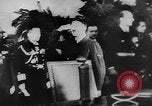
Japanese officer greeted by Fuhrer Adolf Hitler.
Fuhrer Adolf Hitler comes through the door and greets Japanese officer. Japanese officer gives a Nazi salute. Other German officers giving Nazi salute in the background.

President Roosevelt and Winston Churchill in conference with McKenzie King at Quebec.
The chief representatives of the Quebec Conference. President Franklin D Roosevelt and Winston Churchill in conference with McKenzie King, Anthony Eden and several other officials. Press in the background. Large number of cameramen record event.
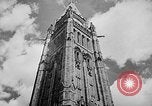
President Roosevelt speaks to crowd in Ottawa. Montage of World War II milestones and military action.
President Franklin D Roosevelt speaking from steps of Parliament, in Ottawa, Canada, during World War 2. Behind him stands Canadian Prime Minister, William Lyon Mackenzie King. Large crowd gathered. Crowd waves at the President. The sequence then shifts to a montage of World War 2 milestones shown in newspaper headlines and battle scenes such as American battleships and destroyers firing on coastal targets; .troops in an amphibious assault; U.S.marines wading ashore, after leaving landing craft. Field artillery firing. Newspaper reads 'Italy Quits'. Newspaper slowly burns. The sequence returns to Roosevelt speaking on steps of Canadian Parliament. US, British and Canadian flags side by side. View of a very large gathering of Canadians at the event.
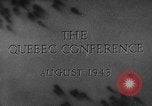
British Prime Minister Winston Churchill in many meetings before and after America's entry into World War II
Opening slate reads: "Quebec Conference August 1943." The English battleship, Prince of Wales, is seen in fog off the Coast of Newfoundland, in August 1941. View of sailor on fore-deck of the British ship. View inside engine room of the ship where sailor manipulates her power. Closeup of engine crankshaft stopping as she drops anchor in Placentia Bay. View of Prime Minister Winston Churchill, greeting U.S. President Franklin D. Roosevelt aboard the Prince of Wales. He proffers a letter to the President, from the King of England. View of Roosevelt and Churchill seated on deck with their respective military leaders standing behind them. Admiral Ernest King, U.S. Chief of Naval Operations converses with U.S. Army Chief of Staff, George Marshall, as they stand behind Churchill and Roosevelt. Wider camera view shows the larger military entourage accompanying the Prime Minister and the President. Glimpse of prisoners and enslaved workers taken by Nazi Germans in Europe. Glimpse of bombs falling from an airplane. Classic film views of the Japanese attack on Pearl Harbor in December 7, 1941. Bombs exploding along "Battleship Row." Heavy smoke rising from the bombed ships. The USS Arizona tilted heavily and burning. Camera pans along the path of destruction, as the voice of President Roosevelt is heard in the background, asking the Congress to declare that the Japanese attack created a state of War between the United States and the Japanese Empire. View of President Roosevelt speaking to the U.S. Congress. Seated behind him are Vice-President Henry Wallace and Speaker of the House, Sam Rayburn. Glimpse of Congress members applauding. Change of scene shows President Roosevelt and Winston Churchill meeting in Washington, DC, in December of 1941, during World War 2. Views of war preparations in the United States, including the building of new war production plants and facilities. A large steel ingot being forged into an artillery gun barrel. Machinist at work turning a gun barrel on a lathe in a munitions factory. Views of manufacturing plants in operation and steel being made. A railroad train carrying new Army trucks. Another meeting of Churchill and Roosevelt in Washington, D.C. June, 1942. Standing behind them is President Roosevelt's special assistant, Harry Hopkins, a British naval officer, and an American navy Captain. American soldiers boarding a troop ship, and closeups of them as they enter the ship, looking out of portholes, and waving from the ship's deck. Glimpse of Washington Monument and its image in the reflecting pool in Washington DC. Closeup of a book entitled, "Time Table for Invasion." General George Marshall with several of his generals doing preliminary planning. Series of scenes involving senior military officers engaged in war planning. A convoy of warships is seen at sea during the Operation Torch Allied invasion of French North Africa during 8–16 November, 1942. Views of Allied Navy ship guns firing. Allied troops riding in landing craft, and advancing from beached craft on shore of Algiers. Aerial view of a flight of Douglas Dauntless bombers in formation. "Bombs away" view from Allied airplane dropping bombs. Allied troops firing camouflaged antiaircraft guns from sandy positions near shore. Enemy shells or bombs exploding nearby. Two U.S. Army soldiers holding a document in French entitled, "Message from the President of the United States.
Montage of scenes showing the continuous close coordination between the United States and Britain during World War II
Film shows an invasion task force at sea overwritten by a slate reading, "Casablanca." Narrator speaks of January, 1943, in World War 2. View of the city of Casablanca in Morocco. U.S. President Franklin D. Roosevelt seated next to British Prime Minister, Winston Churchill as they meet in Casablanca, at the Anfa Hotel, January 14–24, 1943, during World War 2. Roosevelt wears a black armband on his left sleeve in mourning over the death of his mother, in 1941. Backs of Military officers seen from behind, with Churchill and Roosevelt on chairs in the background. Then a closeup of Roosevelt and Churchill seated with high ranking Allied military officers behind them, including U.S. Admiral Ernest King and U.S. General George Marshall. View from directly overhead of marching American soldiers. Huge number of British soldiers led by a Rolls Royce armored car, are seen walking across the desert, celebrating their victory over German forces at Tunisia. Prime Minister Churchill and President Roosevelt seated on the lawn in front of the White House during the third Washington Conference (code-named Trident) held in Washington DC, from May 12 to May 25, 1943. Closeups of both men. Scene shifts to a U.S. invasion task force in the Pacific. Glimpse of a Benson-Livermore class destroyer near hills in the Pacific. A navy Douglas Dauntless dive bomber flies over ships in an invasion task force. U.S. troops are seen in a Higgins Boat landing craft from the transport ship USS President Jackson (APA-18). Troops storming ashore from landing craft. U.S. troops firing artillery field pieces, and raising the U.S. flag on a captured island in the Pacific. Scene shifts to European theater, where an Allied warship is firing its guns during Allied invasion of Sicily, code named Operation Husky, 9 July – 17 August 1943. Amphibious assault taking place. A jeep is seen pulling an artillery piece through shallow surf. An army truck drives through shallow surf, out of a landing craft. Breech view of artillery gun being fired and shell ejecting. A shell exploding near the camera. Camouflaged antiaircraft guns firing. Series of brief scenes showing Soviet Russian infantry and tanks advancing against German forces in Russia. Next scene shows Benito Mussolini in military dress uniform, giving a speech, and then posing next to a Bronze statue of Roman emperor, Julius Caesar, in Rome, Italy, as troops march past him. A bust of Mussolini being pulled down. Rioting Italians. Axis defenders in Sicily, carrying a white flag as they surrender to Allied powers. Views of Lieutenant General Mark Clark and a Major General pleased at the surrender. American troops being cheered by Sicilians as they ride in jeeps. Italian men receiving food after the surrender, as a British soldier stands nearby. U.S. Army Air Force B-24 Liberator bombers in flight over the Northwest Pacific. Aerial view of Kiska in the Aleutians. B-17 flying Fortress bomber in flight with bomb bays open. Bombardier at his station in the aircraft he presses button to release bombs. Formation of B-24 bombers dropping bombs. View from aircraft of them exploding on the ground. Aerial view of surfaced German submarine being strafed by Allied aircraft. After several attacks it is sunk. B-24 bombers raining bombs over Germany. Huge explosions on the ground raising plumes of white smoke. Bombed out remains of Coventry Cathedral in England. Religious services being held in the ruins. View of the Pentagon building just outside Washington DC, and the British Prime Minister's residence at 10 Downing Street, London, England. View of Quebec Canada. A Canadian sentry on a hill. The Wolfe–Montcalm Monument in Governors' Garden beside the Château Frontenac, Quebec, Canada. Views of the Chateau Frontenac. Canadian troops patrolling around the Hotel. Royal Northwest Mounted Police on the grounds. Canadian soldiers with antiaircraft guns, scanning sky for possible threats. Armed couriers loading bags of official dispatches into a car. The dispatches being delivered to waiting aircraft. Censors examining postal mail. Conference attendees showing their passes to Canadian Mounted police officers at the hotel entrance. Closeup of an actual pass issued to a U.S. Army Major.
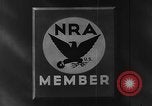
Hollywood actor Dick Powell composes and sings "The Road is Open Again" for the National Recovery Administration
Framed photographs of Presidents George Washington, Abraham Lincoln and Woodrow Wilson on a wall. A song writer writes a song on behalf of the National Recovery Administration (NRA). He falls asleep while writing the song. As he "dreams" actors portraying Washington, Lincoln and Wilson appear in his room asking him why he wants to write such a song and they're reassuring him that Franklin D Roosevelt is the right way. When he starts singing his new song, he finds himself alone, but he knows that Franklin Delano Roosevelt will lead the USA back on the road to prosperity. He sings "The Road is Open Again". Film is a National Recovery Administration and New Deal propaganda piece during the Great Depression.
CRITICALPAST.COM: About Us | Contact Us | FAQs - How to Order | License Agreement | My Account | My Lightboxes | Shopping Cart | Advanced Search | Featured Collections | Website Terms & Conditions | Privacy Policy ©2026 CriticalPast LLC.
License Agreement |
Terms & Conditions |
Privacy Policy
©2026 CriticalPast LLC.