


 Francais
 Deutsch
 Italiano

Refine Your Search
-Cebu,-Philippines stock footage and images
- Showing 30325 to 30330 of 58987 results more
 Hide
Color Sound
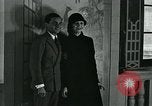
Newly wed Irving Berlin and wife (former Ellin Mackay) during their honeymoon in Atlantic City.
Newly wed American song writer, Irving Berlin, and his wife (former Ellin Mackay) pose for photographer indoors during their honeymoon in Atlantic City, New Jersey. Camera flashes. Berlin and wife pose on porch.

William Eugene "Pussyfoot" Johnson raids an illegal distillery in Sioux City, Iowa during Prohibition.
A staged news film showing Prohibitionist William E. Johnson (aka "pussyfoot") accompanied by uniformed police officers raiding a rum liquor still, in Soux City Iowa. The officers kick open the doors of the distillery, and pull a man out. Then, from inside, two law enforcement men carry out a simple piece of distillation apparatus. Johnson sheds his coat jacket and proceeds to destroy the still equipment with a sledge hammer, bashing holes in the container and breaking pipe and distillation coils from the device. (Note: a slate alludes to Johnson losing an eye while crusading in London. That occurred on November 13,1919, when he was publicly "teased" by medical students who carried him on a stretcher through the streets. Johnson lost sight in one eye, after being struck with an object thrown by a spectator.)

George Bernard Shaw visits his friend, Russian sculptor Prince Paolo Trobetzkoy at his villa on Lake Maggiore, to pose for him.
The famous British dramatist and satirist, George Bernard Shaw, strolls into a garden on shore of Lake Maggiore, in Italy, where his friend, Prince Paulo Troubetzkoy, and wife, Elin Sundström Troubetzkoy, are seated. Shaw kisses her hand, shakes hands with the Prince, and introduces a gentleman accompanying him. The four sit and chat, while petting one of the Prince's two white dogs. (The Prince loves animals greatly and is, accordingly, a vegetarian, as is his friend GB Shaw.) Closeups of Shaw conversing with Troubetzkoy. The Prince points out beauty spots of famed Lake Maggiore. Mountains and clouds in background. Shaw poses while sculptur Troubetzkoy works on a bust of him. Mrs. Troubetzkoy approaches and Shaw turns to speak to her, and smiles when the Prince chastises him for breaking his pose. This happens again. The prince and Shaw look at the bust and seem to be satisfied with the likeness.
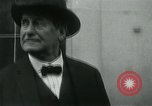
Montage of scenes with William Jennings Bryan
Some restrospective scenes with William Jennings Bryan, assembled after his sudden death in Dayton, Ohio, shortly after the celebtrated "Scopes" trial in 1925. Bryan speaking in front of a residence. (Slate notes he ran for Presidency three times, and was Secretary of State in cabinet of President Woodrow Wilson.) Bryan wearing a cloak and hat, walking on a rainy day, in a city. Automobiles parked at the curb in the background. He smiles, stops and removes his hat to pose for the camera. Next, a closeup of Bryan, bareheaded. Scene shifts to New York City, in 1924, where Bryan stands with his brother, Charles W. Bryan, former Governor of Nebraska, who was nominated as Vice-Presidential candidate during the Democratic Party Convention. William Jennings Bryan conducting one of his weekly Bible classes and Sunday Sermon, to a large outdoor audience, from a stage, in Royal Palm Park, Miami, Florida. Closeup of him gesticulating as he speaks. Bryan and members of his family standing on the bayfront balcony of his residence,“Villa Serena," on the occasion of a visit by former U.S. President Warren G. Harding, who stands behind several Bryan grandchildren

Ceremony of farewell in Paris, as France prepares to send the Panthéon De La Guerre to America
Notables in Paris, France, at ceremonies before the Panthéon De La Guerre is packaged and shipped to the United States, where it would be shown in various places, beginning with Madison Square Garden, New York City, May 19, 1927. Raymond Poincaré, President of the French Council of Ministers, speaks in the building housing the Panthéon De La Guerre. The American flag in a holder to his left. Principal participants including Mrs. W.K Vanderbilt (Virginia Graham Fair Vanderbilt, aka "Birdie") are seen in front row chairs. Closeup of several French officials, including Marshal Philippe Pétain and Aristide Briand, French Foreign Minister. Mrs. Vanderbilt cuts a cord to release the huge cyclorama painting, the world's largest, featuring 5,000 full-length portraits of prominent figures from World War I. Views of the painting.
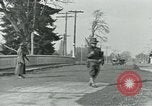
National Guard troops are deployed in streets and at jail where anarchists are held in Centralia, Washington.
Washington State National Guard troops maintain order in Centralia, Washington, following Armistice Day deaths involving the Industrial Workers of the World union (I.W.W.). Soldiers, armed with rifles, patrol a roadway, as cars pass. Armed soldier moves several men from street to sidewalk. Contingent of soldiers march to police station, where they stop and fix bayonets to their rifles. A soldier posted in a vacant lot outside the Centralia jail where 37 anarchists are being held pending trial following the Centralia Massacre. A derelict wagon sits in the lot and a dog sniffs about. A group of men gathers outside building where slate states: " I.W.W.s maintained headquarters and from which they opened murderous fire that resulted in death of four ex-soldiers." (The headquarters was attacked by members of the American Legion during the Armistice Day parade.) Slate states: "Members of the American Legion demolished the headquarters of the anarchists and destroyed their seditious literature." Several men are seen rummaging through papers strewn about in front of the building beside the Roderick Hotel. A final slate quotes statement by Representative Johnson, Chairman of the U.S. Immigration Committee: "The Country must be purged of seditionists and revolutionists, and if this means war, the quicker it is declared the better."
CRITICALPAST.COM: About Us | Contact Us | FAQs - How to Order | License Agreement | My Account | My Lightboxes | Shopping Cart | Advanced Search | Featured Collections | Website Terms & Conditions | Privacy Policy ©2026 CriticalPast LLC.
License Agreement |
Terms & Conditions |
Privacy Policy
©2026 CriticalPast LLC.