


 Francais
 Deutsch
 Italiano

Refine Your Search
-Cebu,-Philippines stock footage and images
- Showing 30913 to 30918 of 58987 results more
 Hide
Color Sound
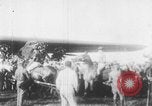
U.S. Army Lieutenants Lester J Maitland and Albert F Hegenberger land in Hawaii after flight from California
U.S. Army soldiers surround aviators and their aircraft at Wheeler field in Hawaii. U.S. Army aviators Lieutenant Lester J Maitland and Lieutenant Albert F Hegenberger wear Hawaiian flower Leis, presented upon their arrival in Hawaii after flying from Oakland, California. The aviators completed the first flight from mainland U.S. to Hawaii, some 2400 miles, setting a new record. Their airplane, a Fokker Trimotor, named Bird of Paradise, is seen in background. They hold a news conference.

A man makes failed attempts to fly on a bicycle with wings in France
Historic vintage aviation and early flight attempt: A man attempts to fly with wings attached to a bicycle like an ornithopter but the wings do not flap. A police officer and several spectators watch the experimental aircraft. An assistant runs behind him. He makes several runs back and forth, to no avail.

John Cobb, a butcher from California, attempts to fly ornithopter bicycle
John Cobb, a butcher, rides an ornithopter bicycle with wings in San Fernando Valley, California. John has a collar to flap wings when he raises his torso. The bicycle has a rocket to assist takeoff. William Modes helps him as he starts riding. Ralph Spergis lights the rocket. The heat of the rocket sets tail on fire. Tail sets John's pants on fire. He purposely falls down, yelling for water. John is caught in the collar wires and can't get away. The rocket breaks loose, which it was do after takeoff, and sets wings on fire. A man throws water from a bucket to extinguish John's pants. (William Modes later became a director at Northrup Aircraft Company. Ralph Spergis later became longtime manager at Agua Dulce Airpark. Ralph and William, at the time this was taken, were roommates in Santa Monica, both working as aircraft mechanics at Douglas Aircraft Company.)
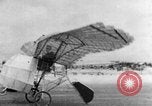
Ornithopter aircraft of various designs demonstrated including Gustav Lilienthal's large ornithopter.
Several attempts to fly ornithopters, intended to fly by flapping of wings. They manage to move their wings but fail in attempts to fly. The largest of them might be Gustav Lilienthal's large ornithopter, which was demonstrated in Germany and had a 3 horse power motor.
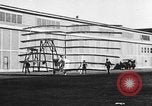
Men attempt to fly a 7-wing airplane contraption.
History of early flight and historic early attempts in aviation. Men run beside a seven-winged airplane as it begins to move in front of a hangar building. The aircraft collapses into pieces on the ground. before attaining speed.
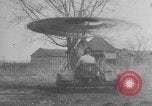
Man attempts to fly the Pitt "Sky Car."
Early attempts at flight during history of aviation. The Pitt Sky Car ornithopter device is seen: A car equipped with an umbrella-like rotor intended for vertical takeoff. 'Sky car' written on a cloth sign on the chassis of the aircraft. A man in aviator's clothing seated at the controls of the machine. The powerful motions of the pulsating rotor cause the machine to rise several inches. But it simply drops to the ground again. This happens with each oscillation of the rotor. (The motor-rotor devise was invented by John W. Pitts, of Detroit, Michigan, and patented in 1926. However, as seen in these images, it was a failure.)
CRITICALPAST.COM: About Us | Contact Us | FAQs - How to Order | License Agreement | My Account | My Lightboxes | Shopping Cart | Advanced Search | Featured Collections | Website Terms & Conditions | Privacy Policy ©2026 CriticalPast LLC.
License Agreement |
Terms & Conditions |
Privacy Policy
©2026 CriticalPast LLC.