


 Francais
 Deutsch
 Italiano

Refine Your Search
-Cebu,-Philippines stock footage and images
- Showing 32467 to 32472 of 58987 results more
 Hide
Color Sound
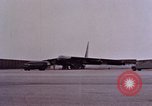
A B-52 Stratofortress takes off from Guam, United States for bombing in South Vietnam.
U.S. Marines write personal messages on a bomb in Guam, United States. A United States Air Force B-52 Stratofortress parked. Two navy hospital vans approach the bomber plane. U.S. Marines get off the van. An airforce officer gives a chalk to the marines to write their personal messages on a bomb. The bombs are attached to the right wing of the bomber. A U.S. Marine writes 'Happy Birthday Charlie' on the bomb. Another marine writes his message on the bomb. The bomber aircraft taxis and takes off for bombing in South Vietnam. Contrails come out of the aircraft. The B-52 in flight. Marines and officers stand in a group and look at the bomber plane in flight. (Vietnam War period).
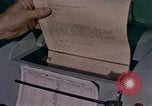
U.S. Air Force B-52 crews begin Operation Arc Light missions to Vietnam from U-Tapao Airbase, Thailand, during the Vietnam War.
Opening scene shows a message being received on a teletype machine from the U.S. 3rd Air Division. Two Air Force officers are seen seated at desks. One is labeled "Ops-Plans." The on duty operations officer passes on the message to his staff where it goes through operation, operation planning, maintenance, ordinance and armament. Technicians preparing the guns and loading ordnance for the mission, on a B-52 aircraft. Air crew members ate seen assembled in their briefing room, Glimpse of the mission briefing officer at a podium. View of wristwatch as narrator speaks of navigators synchronizing their watches. A B-52 crew stepping from their crew bus as they arrive at their aircraft. As other crew member climb aboard the plane, their aircraft commander reviews the aircraft status, as reflected on its Form 781, with the aircraft crew chief. Crew members then begins a pre-flight walk-around inspection, starting with the landing gear and wheel wells. The last of the crew enter the aircraft via a bottom hatch, which a ground crewman then fastens from the outside. Inside, crew members are seen going through pre-flight check lists at their respective duty stations. Back at the Command Post, the duty controller receives the order via secure telephone, from 3rd Air Division headquarters, to execute the mission. He informs the Aircraft Commander and the B-52 starts its engines. View of throttles being pushed forward in the cockpit, as the aircraft begins takeoff. View from ground as the B-52 takes off and flies overhead. Glimpse of the aircraft commander in the cockpit wearing helmet and oxygen mask. Hand of radar observer is seen as he checks out his equipment. Aerial closeup of a B-52 in flight. View of radar observer placing the aircraft controls in so-called "Second Station," with the autopilot controlled by the bombing navigation computer. Inflight closeup of B-52 opening its bomb bay doors and starting to drop bombs. Glimpse of the aircraft commander in cockpit and of B-52 aircraft in flight, as narrator states they are returning to U-Tapao Airbase,or to Guam. The aircraft in the mission are seen landing back at U-Tapao Airbase, Thailand, where other B-52s are parked on the ramp. They taxi to their parking places and crew members board buses back to operations for a mission debriefing.

Modified C-135 aircraft of the Strategic Air Command (SAC) serve as "Combat Lightning" aircraft in Vietnam War
Opening scene shows two U.S. Air Force F-105 Thunderchief aircraft taking off in pre-dawn from Vietnam on a bombing mission, in 1966, during the Vietnam War. Next, the F-105s are seen diving and dropping bombs that explode into fire and smoke on the ground. Closeup of a Strategic Air Command (SAC) KC-135 aircraft in flight. It has been modified to serve as as a "Combat Lightning" aircraft that serves as a communication link between the Tactical Air Reporting Center at Monkey Mountain, near Danang, Vietnam and ground radar, airborne radar and any U.S. aircraft operating over North Vietnam. KC-135 "Combat Lightning" crew members are seated in a briefing room at the U-Tapao Royal Thai Navy Airfield, in Thailand. A briefing officer explains their mission, using charts and a map labeled SECRET Noforn (no foreign access) showing Vietnam and the Gulf of Tonkin. The briefer points to an area in the Gulf, and sketches a figure eight, showing where and how the KC-135 should maneuver in a holding pattern during its mission. Crew members rise and leave at the end of the briefing. View of a Strategic Air Command EC-135L that arrived on May 29, 1967, along with another, to support 24 hour "Combat Lightning" operations. Ground crewman directs the EC-135L as it taxis out and then takes off, past a C-130 aircraft holding short of the active runway. (Narrator notes that by the end of July, 1967, there were four "Combat Lightning" C-135 aircraft operating at U-Tapao airfield.) View from above of EC-135L aircraft in flight above clouds, en route to its assigned location over the Gulf of Tonkin. View of radio operator inside the aircraft, who is in radio contact with U-Tapao and the aircraft they are going to relieve. View of map showing their destination figure-eight holding pattern. Radio operator establishes the same contacts used by the aircraft they are relieving, to assure continuity of communications. Remainder of the film contains extended views of the radio operator at his station and of the EC-135 aircraft in flight. Near the end, the crew's Armaments and Electronics Technician is seen pulling a piece of malfunctioning electronic gear from a rack and replacing it with a spare, stored nearby.
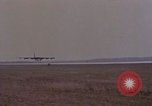
U.S. 306th and 91st Bomb Wing aircraft and personnel return to McCoy AFB, Florida and Glasgow AFB, Montana
U.S. Air Force (Strategic Air Command) B-52 bombers land back in the U.S. after 6 months deployment in Southeast Asia, during the Vietnam War. United States 306th Bomb Wing planes and crews return back to McCoy Air Force Base in Florida, and those of the 91st Bomb Wing return to Glasgow Air Force Base, in Montana. Both units had been operating out of Andersen Air Force Base, in Guam. The commander of 306th, Colonel Earl L. Johnson steps from the last B-52 to return to McCoy AFB. He meets his daughter and wife. Men take pictures in the background. Officers stand in the a group. He shakes hand with local officials. Crewmen with their luggage. A KC-135 Stratotanker taxis as it brings home ground crews and other support personnel. Relatives of the crewmen wait to meet them. They step from the plane. A banner reads '306th Bomb Wing Reception Center Happy Day'. The airmen enter a hangar and go through customs. The airmen meet their relatives. The scene changes from Florida, to Montana, where the final U.S. Air Force B-52 Stratofortress of 91st Bomb wing arrives at Glasgow Air Force Base. "McNamara's Band," playing kazoos, pot, and other contrived instruments, greets the arrivals. Colonel George Phieffer Jr., Commander of 91st bomb Wing greets his wife and others. Ground crews and other support personnel also meet their families.
U.S. Air Force film report about the Strategic Air Command (made in January 1960.)
Film opens with still portrait of U.S. Strategic Air (SAC) Commander in Chief, General Thomas S. Power., who is heard saying "Peace is Our Profession." Signs outside SAC headquarters, bearing the same message. Glimpse of entry gate to the headquarters. View of Atlas missile displayed on the headquarters grounds. Closeups of the missile, at top and bottom. Air Force personnel manning phones in SAC Control Center, underground,at Offutt Air Force Base, Nebraska. Others are seen walking near extremely large wall displays. View of the main Control Center with officers at their respective stations. View of person entering past guards into the underground facility. A briefing officer climbs onto a moving platform that elevates him so he can brief the center personnel, while referring to one of the large wall displays. View of teletype machines receiving messages in the Center. Digital clocks show times in places like Guam and Alaska. The famous "Red Telephone" from which it is possible to launch the entire SAC strike force, all over the world, within seconds after warning of an enemy attack has been received at SAC Headquarters. B-47 bombers taxiing on a base. Closeups of some taxiing. A B-47 bomber taking off and flying high above the camera. Extreme closeup from outside of crew members in cockpit of B-47 in flight. Flight of three B-47s flying in formation.
Various views of U.S. Air Force Strategic Air Command B-52 bombers and KC-135 aerial refueling aircraft
Opens shows a Strategic Air Command (SAC) B-52 Stratofortress heavy bomber taxiing on an airfield. Views from the side and from above the taxiing aircraft. AGM-28 Hound Dog missiles seen under the wings. View of underside of wings. A gloved hand raises guards on switches and they are activated. From inside an aircraft, two Hound Dog missiles are seen as they drop from it. Scene shifts to a KC-135 aerial refueling tanker aircraft taking off. Views of a B-52 bomber hooking up to refuel from a KC-135 tanker aircraft. Refueling boom is seen slowly extending to connect with the refueling input of the B-52. View of the boom operator lying down in the tail of the KC-135 tanker, maneuvering the boom. View, from his perspective, of the B-52 and refueling boom as they connect and begin refueling. Aerial views of the the two aircraft hooked together and then disconnecting after refueling is complete. Animated world globe is shown depicting Soviet threat. An Atlas intercontinental ballistic missile is seen launching. Views of B-52 bombers in flight.
CRITICALPAST.COM: About Us | Contact Us | FAQs - How to Order | License Agreement | My Account | My Lightboxes | Shopping Cart | Advanced Search | Featured Collections | Website Terms & Conditions | Privacy Policy ©2026 CriticalPast LLC.
License Agreement |
Terms & Conditions |
Privacy Policy
©2026 CriticalPast LLC.