


 Francais
 Deutsch
 Italiano

Refine Your Search
-Cebu,-Philippines stock footage and images
- Showing 32503 to 32508 of 58987 results more
 Hide
Color Sound
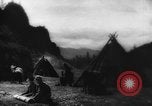
Natives of the Altai Mountains in Central Asia move with all their belongings to a new region.
The Altai mountains in Central Asia (at convergence of Russia, China, Mongolia, and Kazakhstan). Natives of the region in their tents. A woman milks a cow and grinds grain with a stone. Interior of a native tent. Activity in a tent village. The nomadic people move with all their belongings, family and animals to a new region. Children on sheep as they move along with a group. Skeleton structure of tents abandoned by natives.
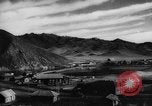
Men and women on horseback watch head of cattle as a woman milks a cow on a field in Central Asia.
The Altai mountains region in Central Asia (at convergence of Russia, China, Mongolia, and Kazakhstan). A small village consisting of huts in the mountains. A village near a river. Native with a heard of cattle in fields. Men and women on horseback watch herd of cattle. Cattle at a water hole. A large bull. Herd of yaks in a field. A woman milks a cow. They pour milk into a large pail. A herd of sheep in field. Shepherd on horseback as he holds a lamb. Sheep, rams and goats in the field.

German troops fire artillery on Eastern Front during World War II during invasion of Soviet Union.
German troops at the Eastern front during World War II during Operation Barbarossa invasion of Soviet Union. A map of Europe. A bridge. Fire in a village and smoke arises. German troops stand in a group near artillery. They load a shell and fire.. A board reads 'Eydtkau'. Soldiers pulling artillery. German soldiers capture two Soviet soldier prisoners of war. German soldiers advance, as they walk on the street.

Lithuanian villagers present flowers to German troops and Kaunasians wave to passing German vehicles in Kaunas, Lithuania.
German troops at the Eastern Front during World War II . Animated map illustrates Eastern Prussian-Lithuanian border and German troop's movement into Kaunas German troops stand near a field gun. Troops loaded on tanks and march forward. They fire a gun. Smoke arises due to fire. Damaged buildings due to fire. Trucks loaded with troops and as they enter a city. Kaunasians wave to passing German vehicles. A view of the city. Lithuanian villagers present flowers to advancing German troops. A German soldier on a bicycle waves.
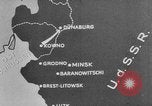
German troops on a tank as they march forward in Daugavpils, Lithuania during World War II.
German troops at the Eastern Front during World War 2. Animated map illustrates Eastern Prussian-Lithuanian border and German troop's movement into Daugavpils. Troops march forward with their vehicles. Soldiers fire artillery and quickly cross the road. Villagers give flowers and waves to the advancing German troops. A soldier on a tank.
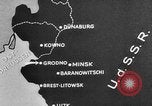
German Army forces invade and occupy Grodno, Poland, destroying buildings and setting houses on fire during World War 2.
German troops on the Eastern Front, invading Grodno, Poland (now Hrodna Belarus) during World War II. A map illustrates Eastern Prussian-Lithuanian border and German troop movements into Daugavpils, Kaunas, Brest-Litovsk and Grodno. German troops on horseback and carts on a road, passing by damaged and burning buildings in the village. German Wehrmacht soldiers fire artillery. Smoke arises due to explosion. A German officer points out a target. An industrial chimney collapses. German forces march forward and round up Russian Army prisoners. A wrecked Soviet tank. A dead body lying near a disabled tank. German troops sitting atop a tank as it moves. Elevated view across the Old Bridge spanning the Neman River toward the city of Grodno, with many buildings burning. The Grodno Catholic church of the Discovery of the Holy Cross (Bernardine), also called the Church of the Finding of the Holy Cross, seen rising from the city, with damage to its main steeple. Houses and buildings in the city burning, as German troops move through the city. Brief view of the The Jesuit Cathedral of Grodno (now The Jesuit Cathedral of Hrodna) behind burning buildings, as a German soldier passes by on a motorcyle with sidecar.
CRITICALPAST.COM: About Us | Contact Us | FAQs - How to Order | License Agreement | My Account | My Lightboxes | Shopping Cart | Advanced Search | Featured Collections | Website Terms & Conditions | Privacy Policy ©2026 CriticalPast LLC.
License Agreement |
Terms & Conditions |
Privacy Policy
©2026 CriticalPast LLC.