


 Francais
 Deutsch
 Italiano

Refine Your Search
-Cebu,-Philippines stock footage and images
- Showing 35137 to 35142 of 58987 results more
 Hide
Color Sound
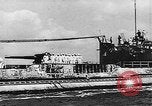
The Japanese submarine I-30, on a mission to German-occupied Lorient,France, during World War II
Scenes from a Japanese Yanagi (Willow) submarine mission that carried war-essential minerals and materiel to German-occupied Lorient, France, in World War 2. The submarine (I-30) code-named Cherry Blossom (Sakura in Japanese and Kirschblüte in German) is the first to travel on a visit from the Pacific to Europe during World War 2. Opening scene shows I-30 underway on the surface, with its crew in dress uniforms on deck and officers in the conning tower. Several German Kriegsmarine (Navy) officers, including Admiral Karl Dönitz, Commander of the German U-boat fleet, and another Admiral, are seen rendering classic military (not nazi) salutes. Closeup of some Japanese officers and men standing on the deck of their submarine as it glides past the pier. Local seamen, all giving the Nazi salute, crowd the deck of a nearby ship. Glimpse of Doenitz and the other Admiral walking a gangplank to board the I-30, where they greet officer delegation of the submarine, as the Japanese Naval Attaché to Germany, Captain Yokoi Tadao, and the I-30's Captain,Commander Endo Shinobu, stand nearby. Doenitz, and the two Japanese officers are seen conversing, on deck amidst gathering of German naval officers. Scene shifts to the land, where German Grand Admiral,Erich Raeder (4-striped admiral insignia on sleeve) speaks with Commander Endo Shinobu, as Captain Yokoi Tadao, stands nearby. Next, Officers and sailors are seen saluting from the conning tower of the I-30. A closeup of Commander Endo Shinobu saluting. The I-30 slowly moves away from the pier.

German Field Marshal Erwin Rommel speaks to soldiers and staff officers in North Africa during World War II.
German Field Marshal Erwin Johannes Eugen Rommel in North Africa during World War II. Rommel arrives at the battlefield in a staff car. He gets off the car and is greeted by officers and soldiers. He speaks to soldiers and staff officers.

German mountain troopers climb up a mountain and fire a howitzer during World War II.
German mountain troopers during World War II. The troopers pull mule packs and climb a rugged snow covered mountain slope. German soldiers fire a 7.5 cm German mountain gun (7.5 cm Gebirgsgeschütz 36) emplaced on the snow capped mountain. Shell explosions on the opposite mountainside. Two German officers near the howitzer. One of them looks through a pair of binoculars. The other one uses a Battery Commander's scope (BC Scope).

Transportation of oil barrels and early methods of digging oil wells in the United States.
The world struggle for oil is depicted. Photographs of oil drilling boom in the Drake Memorial Museum in the United States. Photographs of early oil refineries. A man near an oil refinery. Dramatization shows transportation of oil barrels. Teamsters driving horse drawn carts loaded with oil barrels over a rugged terrain. Barrels of oil are loaded on barges in spring freshets. Horse drawn carts on a river bank. Frontiersmen rig up 'spring poles'. Early methods of digging oil wells is depicted.
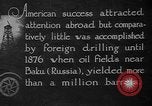
Oil production in the United States is compared with that in the other countries.
The world struggle for oil is depicted. Relative production in 1876 by different countries is shown. A political map of the United States. A map shows Russia, Germany, Italy and other countries. A + sign in Italy shows the oil production being less than 1 % of the world's production. A dot in Galicia and Roumania depicts oil production being 1 % of the world's production. A box on the map shows Japan with a + sign.
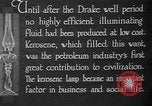
A man and a woman talk in the light of a kerosene lamp in the United States. Also shows the 1893 DeWitt Clinton replica locomotive and train in operation.
The world struggle for oil is depicted. Use of components of oil in homes and in railroads in the United States is shown. A dramatization shows the effect of a kerosene lamp on social life. A woman seated in a chair near a table in a room. A kerosene lamp in a corner. A man opens the door of the room and walks in. The woman gets up and welcomes the man. They both walk to a seat and sit down. Another woman enters the room. The man stands to greet her. She increases the light of the lamp and then leaves the room. The man decreases the light of the lamp. The man and the woman talk. The 1893 replica of the 1831 DeWitt Clinton steam locomotive is shown in operation with its three carriage train, in New York City. The DeWitt Clinton was the first railroad locomotive to operate on the Mohawk & Hudson Railroad in New York. The reproduction seen here was built in 1893 by the New York Central Railroad for the Columbian Exposition in Chicago. This footage was shot on July 17, 1921 when the DeWitt Clinton train was preparing for a trip to another exposition in Chicago. On this day it ran several times from 96th to 116th streets in New York City. New York Central employees are seen on the drain, dressed as passengers would have been in 1831. This replica was later displayed at Grand Central Terminal in New York City, and is is now on display at The Henry Ford museum in Dearborn Michigan. It was acquired by Henry Ford in 1934, in an agreement with the New York Central that it would continue to travel to events on occasion.
CRITICALPAST.COM: About Us | Contact Us | FAQs - How to Order | License Agreement | My Account | My Lightboxes | Shopping Cart | Advanced Search | Featured Collections | Website Terms & Conditions | Privacy Policy ©2026 CriticalPast LLC.
License Agreement |
Terms & Conditions |
Privacy Policy
©2026 CriticalPast LLC.