


 Francais
 Deutsch
 Italiano

Refine Your Search
-Cebu,-Philippines stock footage and images
- Showing 35281 to 35286 of 58987 results more
 Hide
Color Sound

President Kennedy is greeted by Chancellor Adenauer and Vice Chancellor Erhard on his visit to West Germany.
United States President John F. Kennedy visits West Germany. Men rolling out the red carpet in Cologne Bonn Airport (Kennedystraße, 51147 Köln, Germany). President Kennedy disembarks from the Air Force One aircraft (VC-137C SAM 26000, Boeing 707-353B). German Chancellor Konrad Adenauer welcomes President Kennedy. Kennedy and Adenauer review the honor guard. Vice Chancellor Ludwig Erhard greets Kennedy. They board in a car. People on the sides of streets in Cologne as the President's motorcade passes. A large crowd cheers and waves U.S. flags. President Kennedy attends a Catholic mass at Cologne Cathedral (Domkloster 4, 50667 Köln, Germany). Police try to control the people. German men and women running to meet President Kennedy. A banner read ' Welcome President Kennedy'. Another one reads 'common struggle for peace and freedom'. President Kennedy addresses people in front of Bonn City Hall (Markt 2, 53111 Bonn, Germany). People wave small United States flags.

Julius Boros, Jacky Cupit and Arnold Palmer go into an 18 hole playoff at the U.S. Open in Massachusetts, United States.
The United States Open Championship at the Brookline Country Club in Massachusetts, United States. People gather to watch the championship. Golfers strike the ball. A 3 way tie between Julius Boros, Jacky Cupit and Arnold Palmer. The three men go into an 18 hole playoff. Julius Boros shoots one under par and wrests the title from Cupit and Palmer. The players shake hands after the match. Boros with the trophy.
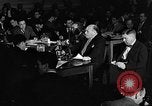
HUAC testimony of "Hollywood Ten" member Samuel Ornitz during investigations into Communist affiliations in Hollywood
Meeting of the House Un-American Activities Committee, or HUAC, in October 1947, under J. Parnell Thomas (the so-called "Thomas Hearings."). Hollywood screenwriter Samuel Ornitz is questioned and asked if he is a member of the Screen Writer's Guild. Ornitz begins his response and expresses that his response is a matter of conscience. He speaks out against the intimidation tactics of the committee chairman. The Committee members continue to cut-off the response from Ornitz and push for a rapid answer to the question. Ornitz continues to give a longer answer and states his belief that the Committee is asking him to violate the Constitution. Robert Stripling is directed to ask the next question. Ornitz is asked "are you now or have you ever been a member of the Communist Party." Ornitz continues to protest the line of questioning and likens his affiliation with any party to be like his affiliation with any religion and thus protected by the Constitution. The Committee asks if his party affiliations are directed by a foreign government. Ornitz is told to stand away and the next witness is called.
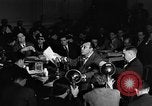
During HUAC hearing in the United States, Herbert Biberman is questioned about his affiliation with the Communist Party
A hearing of the House Un-American Activities Committee (HUAC) in the United States, under Congressman J. Parnell Thomas (the "Thomas Committee") . People seated during the hearing. Hollywood director and screenwriter Herbert Biberman is questioned about his occupation in the Screen Writer's Guild and his affiliation with the Communist Party. Biberman begins his response and does not directly or quickly answer the question, which draws an angry, heated response from J. Parnell Thomas pounding a gavel, shouting from Congressman Thomas and from Robert Stripling, and demanding an answer. Biberman is subsequently asked, "are you or have you ever been a member of the Communist Party" and Biberman begins a response in which he decries the work of the committee and its negative effects on the Hollywood film industry. Biberman, one of the "Hollywood Ten," is dismissed from the stand.
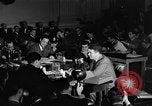
Emmet Lavery, President of the Screenwriters Guild of Los Angeles, is questioned by the HUAC members
Questioning of the President of the Screenwriters Guild of Los Angeles, Mr. Emmet Lavery, by members of the House un-American Activities Committee, including J Parnell Thomas and Robert Stripling, in October 1947. Mr. Lavery speaks into a microphone and answers questions of the Committee. He opens by saying he will break the suspense and states that he is not a Communist and has never been one (even before he is asked.) This elicits laughter from those present in the hearing. In testimony, Emmet Lavery states that he is "a Democrat who in my youth was a Republican, and if the Committee wants to know why I changed..." He is cutoff with response "No we don't want to know..." and again there is laughter. Mr Lavery concedes that there are probably communists in the Guild, but he doesn't know who, by name. He expresses concern that the questioning by the Committee may negatively affect the Guild elections that are approaching. He states that no individuals have control of the Guild. The Committee asks if Trumbo (Dalton Trumbo of the Hollywood Ten) has control of the Guild. Lavery says no. Lavery states that he agrees with J Edgar Hoover of the FBI that it would be wrong to outlaw the Communist party, especially in a time of peace.
Shows the importance and application of camouflage techniques during combat in World War 2.
A film 'Camouflage in Combat' underlines the importance of tactical exploitation and counteraction of shadows and use of nets, underbrush and other camouflage during World War II. The film shows U.S. soldiers going into a theater in the United States and watching a movie 'Camouflage'. The movie shows a soldier in a forest. He is shot down. A soldier approaches him. He looks skywards. He applies mud on his face to camouflage himself. Soldiers paint each other's faces with GI paint. On 5th June 1944, fully camouflaged Airborne and pathfinder U.S. paratroopers preparing for D-Day invasion jump over Normandy, France. Soldiers with camouflaged helmets. A soldier camouflages his helmet with grass and twigs. A soldier on an island with his helmet camouflaged with grass and twigs found in the area which gives him a perfect blend. U.S. soldiers with camouflaged helmets in France. A camouflaged tank rolls. An officer inspects soldiers standing in a line. Their helmets are camouflaged. A U.S. soldier hiding in shadows in Casino, Italy fires his gun. His ring sparkles. A soldier in a prone position fires. A New Zealand soldier fires while in shadows.
CRITICALPAST.COM: About Us | Contact Us | FAQs - How to Order | License Agreement | My Account | My Lightboxes | Shopping Cart | Advanced Search | Featured Collections | Website Terms & Conditions | Privacy Policy ©2026 CriticalPast LLC.
License Agreement |
Terms & Conditions |
Privacy Policy
©2026 CriticalPast LLC.