


 Francais
 Deutsch
 Italiano

Refine Your Search
-Cebu,-Philippines stock footage and images
- Showing 35653 to 35658 of 58987 results more
 Hide
Color Sound

Warships returning to America after World War I, participate in Naval Fleet Review in New York City
U.S. Navy Fleet Review on Christmas Day, 1918, in New York City harbor. View from stern of a ship flying large American flag. Behind it are several other vessels, including a small ship flying the American flag. The wind is strong causing the flags to stand out sharply. Barrage balloons are seen in the sky overhead. The battleship USS Nevada (BB-36) passes nearby, with the ship's company lining her deck in formation around her railings. Sailors loading a deck gun to fire salutes from the camera ship, as a ferry boat passes in the background. A transport ship in camouflage is in far background. Army and Navy officers aboard the camera ship salute colors on passing ship (unseen). A Florida class battleship passing nearby with her company assembled on deck. A New York class battleship passing in review. Sailor firing deck gun in salute from camera ship. Another New York Class battleship passing in review. U.S. Secretary of the Navy Josephus Daniels, and Secretary of War, Newton Baker, both in top hats, standing on deck of camera ship. The Statue of Liberty on Bedloes Island, in New York Harbor. The USS Texas (BB-35) passing in review, with a Camel Sopwith airplane on a launch platform installed atop her gun turret number 2. More battleships making way in trail formation. Aerial view from low altitude of the USS Arizona (BB-39).
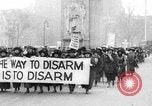
Women pacifists march in New York parade demanding complete disarmament, during anti-war movement of early 1920s
Scenes from a November 12, 1921 protest parade of anti-war women march to support disarmament and promote messages of peace and "No more war". The parade coincided with the start of the Washington Naval Conference, also called the Washington Disarmament Conference. Women march in New York City, under the Washington Square Arch, with a banner that reads "The way to disarm is to disarm." A banner for "Religious Society of Friends" (Quakers). People march holding placards demanding complete military disarmament. A placard reads "Thou shalt not kill" and another reads "War means death famine pestilence." Another sign reads, "Cooperation pays better than competition. Let's try it between nations." A banner reads "Mothers do you teach your sons to save life or to kill?". View changes to parade as it continues on 5th Avenue in Manhattan, New York City. Large banner includes "Immediate, Universal, complete disarmament". Scene changes to Washington DC, several months later, on July 29, 1922. A group of pacifist women in Washington DC in front of their "No more war' banner. Women hang "no more war" signs on a artillery piece that is on display in a public square. Group of women raise their banner for "No more war" in front of the Headquarters of the Council for Limitation of Armaments, located at the National League of Women Voters headquarters building, at 532 17th St., NW, Washington, DC. (The Friends Disarmament Council of the Society of Friends was involved in this group, which was predecessor of the National Council for Prevention of War in the United States.)
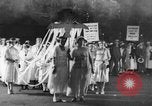
Pacifists, mostly women, march in a night time torchlight parade promoting Peace and Disarmament in the United States
A torchlight parade protesting war. Marchers are principally women. At start of film, a group of about 10 Women, all dressed in white, hold white streamers descending from a dove-like symbol of peace. The parade is conducted along a city street. Smoke rises all around from torches or bonfires beside the line of march. Some women carry a large banner reading: "Thou Shalt Not Kill." Other signs held by marchers appeal to Chemists and others who create tools of war, such as poison gas, to cease and desist such activities One sign reads: "Scientists Use Your Genius for Peace, Not War." A Bahai banner is carried by some marchers. Police officers monitor the march and marchers. Several women drape themselves in American flags. They are accompanied by a Civil War Union Army officer, carrying a sword. Many in the parade carry the same or similar signs and banners. Some are more legible when seen several times. Examples include: "Chemists, Help World Peace, Refuse to Make Poison Gas" and "Exploitation Leads to War, Abolish it." Other notable signs and slogans include: "Mothers pay the Heaviest War Tax;" "War is Not Inevitable. Human Nature does change;" "Immediate Universal Complete Disarmament;" and "We stand with Gandhi for World Peace." The last new one seen reads: " We will not give our children for another war."

German soldiers fire machine guns and advance from their trenches in World War I.
Machine guns in action on front line in Europe during World War 1. German machine gun teams fire Maxim belt-fed, water-cooled machine guns from entrenched positions. Then they scramble out of their trenches. Change of scene shows German machine gunners on a hillside close to a bridge. Their leader gives a signal and they pick up and advance to the bridge. (World War i; World War 1; WWI; WW1)

Views of a Belgian town occupied by German soldiers during World War I
Belgian peasants in town captured by Germans during World War 1, are forced to give up their cattle to German authorities.They are seen leading cattle in the town squar3, as German soldiers direct them. Change of scene to street vendors stalls set up in front of established shops. More cattle being led to German soldiers on the square. Local Belgians and a few Germans pose for the camera. Behind them is a heap of rubble neatly piled up near some houses. A horseman moves past a church severely damaged by German shelling. The camera moves to other buildings also damaged. View backwards from vehicle moving across a wide cobblestone pavement, beside a destroyed railroad station. A German soldier stands near a man and woman. Extremely small open rail rail cars are lined up near the pavement. Two children stand in front of a larger open rail car. We pass a German staff car, going in the opposite direction and several people in horse carts. Severe damage from shelling is seen in many places, with some buildings completely destroyed. Final scene shows point of view from camera mounted on moving cart, looking to the rear, as the cart moves down the street passing many destroyed buildings. (World War i; World War 1; WWI; WW1)
German biplane preparing for a mission. Aerial views of Verdun. German troops subject to British artillery barrage.
German pilots prepare to fly a mission in a Rumpler C.IV two-place biplane during World War I. German armorers stow small bombs in the rear cockpit, and mount a large one underneath the airplane. Scene shifts to pilot in cockpit as he taxis along an airfield. Skull and cross bones is painted on side of the airplane fuselage. A parabellum machine guns sits in the empty rear cockpit. Sequence shifts to aerial views of a city from a reconnaissance airplane, at 1000 meters altitude. Among things seen are a river and an impressive building (possibly a cathedral). Views of photographer taking pictures from the rear cockpit, while the airplane is in flight. Aerial views of the city of Verdun and of battles taking place in no-man's land. (indicated by smoke rising). At this point, a sequence shot by an intrepid German combat photographer, from the battle of the Somme,is inserted. It shows trenches subject to an intense British artillery barrage. The German troops are seen fleeing from their trenches and running to escape the bombardment. Some extremely heavy explosions occur on the German positions. (Note: a slate erroneously characterizes the running German soldiers as advancing.)
CRITICALPAST.COM: About Us | Contact Us | FAQs - How to Order | License Agreement | My Account | My Lightboxes | Shopping Cart | Advanced Search | Featured Collections | Website Terms & Conditions | Privacy Policy ©2026 CriticalPast LLC.
License Agreement |
Terms & Conditions |
Privacy Policy
©2026 CriticalPast LLC.