


 Francais
 Deutsch
 Italiano
Refine Your Search
-Cebu,-Philippines stock footage and images
- Showing 361 to 366 of 58885 results more
more Hide
Hide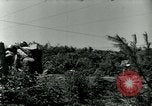
U.S. 223rd Infantry Regiment soldiers set up sound locators, locate enemy artillery positions and fire in Korea.
U.S. soldiers of the 223rd Infantry Regiment Counter Fire Platoon run through dense undergrowth looking for a place to locate the sound recording equipment in Korea, during the Korean War. They cross a road and run uphill carrying heavy equipment. Soldiers reach the hill top and take out the equipment from boxes. Soldiers open the bags and boxes. They set up the sound locators on the side of the hill. Brown sets up the microphones in a pattern called an array on ground higher than the surrounding hills. Military vehicles on the road below. Soldiers fix equipment and smoke. Gun and artillery fire sound. A soldier records the artillery fire sound while another one records the sound as a visual image. Another soldier computes the direction line and radios the information to the counter fire headquarters. 'Counter Fire Plt' sign board outside tents. The plotter plots down the information on a boards and draws the direction line on a map. He pin points the enemy gun and draws it on a chart. He then calls the artillery fire direction center. A soldier receives the message. An intelligence officer checks the information and the order is sent to the artillery battery. Soldiers amidst barricades. They load HE fire charges and fire a 105 Howitzer. Many artillery guns fired. A soldier watches through binoculars.
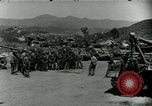
U.S. 31st Regiment Tank Company during attack on Hill 1062 ("Battle of Old Baldy") during Korean War
U.S. Army 31st Regiment Tank Company during attack on Hill 1062, or Papasan Hill, in Korea during the Korean War "Battle of Old Baldy". Commanding Officer of the company briefing the soldiers (white and some African American soldiers) about mission on Hill 1062 (Papasan Hill). Tanks parked in the background. Soldiers on tanks. They load the tanks with shells. Soldiers put on bullet proof vests. The tank convoy advances. Close-up view on moving tank from must behind should of soldier in lead tank, with his head out of the lead tank hatch. Tanks moving on valley floor toward Hill 1062. Smoke from explosions and bombardment on Hill 1062 ahead. 7th Division artillery provides protective fire as the tanks get into position. Enemy fire incoming including machine gun and artillery fire. Soldiers in U.S. Army tanks fire at enemy positions on hills. U.S. aircraft in the air dropping bombs. Smoke due to bombardment. A smoke screen laid out by chemical engineers on the roads. Chemical engineer soldiers carry materials for laying down smoke screen to provide cover as tank convoy retreat from forward positions. Tank convoy moves back to the camp.
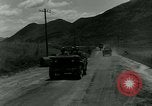
A coffee and doughnut shop run by the Military Police in Korea during the Korean War.
A U.S. military convoy of jeeps on a road. Soldiers seated in the jeeps. The soldiers are flagged down by Military Police (MP) in a jeep. The two jeeps stop at a barricade. They approach a shack coffee shop called Uncle Dan's Doughnuts run by the MPs. Sign boards reads 'Stag Night Tonight' and 'Unescorted ladies not Permitted'. MPs and a soldier stand and drink coffee and eat doughnuts outside the shack. The soldiers talk. Sign boards read 'Mud and straw houses for sale'. The soldier reads signs about 'Turkey Sandwiches', 'Formal Dance' and 'Military Abbreviations' put up at the coffee shop. The U.S. Army soldiers get into their jeep and leave.
A tramway built by the military engineers to transfer supplies and wounded soldiers at Punchbowl in Korea.
The "Punchbowl" summit being resupplied after it was scaled and captured by the U.S. Army 2nd Division in Korea, during the Korean War. Scenes from late 1951 or early 1952. A convoy of jeeps and trucks on the road. The trucks are loaded with supplies and soldiers. Soldiers on trucks unload rations, ammunition and barbed wire supplies. They pass the boxes onto the human assembly line of South Korean soldiers. The South Koreans begin their ascend on the stairway built by the 13th engineers. They climb uphill with the supplies tied onto their backs. Supplies are loaded onto cars that take them further uphill by the tramway built by the U.S. military engineers. Soldier operates the tramway and sends the car uphill. Soldiers receive the supplies on the hill top. A wounded soldier brought on stretcher to the tramway. He is lifted onto the car. A soldier operates the pulley car downhill. Message sent on radio. Soldiers receive the wounded. He is lifted and taken downhill. Signal sent to bring in a H-13 Sioux helicopter. The helicopter lands, wounded soldier is strapped in, and it takes off. It lands at the Mobile Army Surgical Hospital 8209 AU. Soldier on stretcher is shifted from helicopter into a military ambulance.
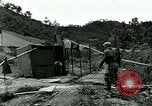
U.S. soldiers shower in a cleverly designed hot water shower house in Korea.
Soldiers take a shower in a make shift hot water shower room in Korea during the Korean War. Soldiers approach the shower cabin. Sign reads 'Macon Springs'. Soldiers stand with towels and clothes. They remove their clothing and helmet and put them in a make shift locker room. A soldier turns the knob and waits. Another soldier operates the power plant. The power plant consists of an airplane oil pump and military jeep. The soldier begins the jeep ignition. Water from a large puddle on the ground is pumped to the makeshift heater and through pipes into the shower. Soldier showers under the flowing water. Interior of the ingenious hot water shower room.
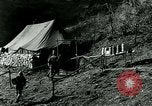
U.S. soldiers eat hot food for dinner and prepare for the night in Korea.
U.S. soldiers eat hot food for dinner and prepare for the night in Korea during the Korean War. Soldiers approach a tent on a hill. Sign reads 'Kitchen'. Prepared food is packed into Marmite cans to keep it hot. South Koreans carry these cans to the front lines. Men with the cans on their backs, climb up barb wire bordered pathways. They reach the front line and help unpack the food. Soldiers heat the food and serve it out in plates. White and African American soldiers in chow line. Mashed potato, fruit salad in plates. Soldiers fill mugs of coffee and juice. They sit and eat at dinner time. Hills with enemy positions. Soldiers sit nd wait for the night. A tank returns from no man's land at dusk. Soldiers prepare for the night. They raise roadblocks and barricades to seal off lines. Soldiers in position with their guns and artillery. A Turkish soldier patrols with his bayonet. Other UN soldiers including South Koreans ready with their rifles in trenches. Soldier smokes a cigarette. Soldiers run uphill and fire at night. Machine gun fire. Captain Carl Zimmerman talks about U.S. soldiers in various outposts the world over. He talks about the next episode of 'The Big Picture', a weekly U.S. Army television report.
CRITICALPAST.COM: About Us | Contact Us | FAQs - How to Order | License Agreement | My Account | My Lightboxes | Shopping Cart | Advanced Search | Featured Collections | Website Terms & Conditions | Privacy Policy ©2026 CriticalPast LLC.
License Agreement |
Terms & Conditions |
Privacy Policy
©2026 CriticalPast LLC.