


 Francais
 Deutsch
 Italiano
Refine Your Search
-Cebu,-Philippines stock footage and images
- Showing 3673 to 3678 of 58885 results more
more Hide
Hide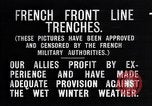
Views of French troops in their trenches at the front lines in the western Front during World War I
Views of the French Army's front line trenches on the Western Front during World War 1. They have tried to make them liveable in the face of wet winter weather. French soldiers stand upon shoulders carved into a very deep trench It has also been reinforced with vertical poles and lined with saplings and twigs. Other soldiers sit upon benches fashioned from trench sides, amidst various examples of improvements, such as dugouts, tables formed of stones, sandbagged upper barriers, partial roofing,and other similar features designed to make life more bearable. In another scene, French artillerymen use teams of horses to move caissons and field pieces through a muddy stream. An encampment and wagons are seen in the background.
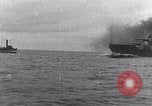
USS Nevada steaming on Builder's trials
The USS Nevada steaming a measured mile course off Rockland, Maine. The ship has not yet been accepted by the U.S. Navy and still has depth or elevation marks on her bow.
Belgian Armored cars with guns on it during World War I in Belgium.
Belgian Armored cars move on the road during World War I in Belgium. Soldiers sit on it. They drop down and salute as an officer arrives. The guns mounted on car are clearly seen. A soldier talks with the officer who had just arrived, whereas the other one climbs up the car. The car moves.
Motorcyclists of the Belgian Expeditionary Armored Squadron, ACM-corps (Autos Canons Mitrailleuses) assemble for parade
Armed members of the Belgian Expeditionary Armored Squadron, ACM-corps (Autos Canons Mitrailleuses) are seen assembling with their motorcycles in preparation for their unit's parade in Longchamps, Paris, France, on April 17, 1915, before their departure to Russia, during World War I.
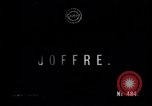
A carton depicting Karl Von Bulow captured by Joseph Joffre after the First Battle of Marne during World War I in France.
A carton depicting Karl Von Bulow captured by Joseph Joffre after the First Battle of Marne during World War I in France. Picture of Joseph Joffre, French Marshal formed from letters 'Joffre' in an animation. Two soldiers hold captured Karl Von Bulow of Germany and the French Marshal points towards him in the animation. Cartoon depicts French victory in The First Battle of Marne during World War I.
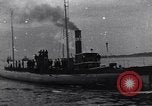
The German Merchant Submarine, Deutschland, arrives with merchant cargo in Baltimore, Maryland, during World War I.
The German merchant submarine Deutschland being assisted by the tugboat "Thomas F Timmins" into Baltimore Harbor (Maryland) on July 9, 1916. Her crew stands on deck and she flies the German flag. The Captain (Paul Koenig, sometimes spelled König, or Konig) and crew pose on shore for a photograph, behind a sign reading: Deutschland, Bremen. (Note: This commercial submarine was operated by the North German Lloyd Line. Submerging to avoid British patrols, she was able to carry valuable cargoes through the British (and other Entente Powers) WWI blockade. On this first trip to the U.S. She carried industrial dyes and gemstones. The Deutschland left Baltimore about 3 weeks later and returned safely to Bremen with with cargo of nickel, tin and rubber.)
CRITICALPAST.COM: About Us | Contact Us | FAQs - How to Order | License Agreement | My Account | My Lightboxes | Shopping Cart | Advanced Search | Featured Collections | Website Terms & Conditions | Privacy Policy ©2026 CriticalPast LLC.
License Agreement |
Terms & Conditions |
Privacy Policy
©2026 CriticalPast LLC.