


 Francais
 Deutsch
 Italiano
Refine Your Search
-Cebu,-Philippines stock footage and images
- Showing 379 to 384 of 58885 results more
more Hide
Hide
Progressive aggression leading to the take over of Tibet and fleeing of the Dalai Lama.
Progressive aggression leading to the take over of Tibet and fleeing of the Dalai Lama to India in exile. Men raise the People's Republic of China flag on a mountain as armies of Communist China conquer Tibet. 1950: The Dalai Lama and Panchem Lama are brought to Peking in China. They are received by Chinese officials, presented with bouquets. A function at their arrival. 1955: African and Asian delegates at the Bandung Conference in Indonesia. China agrees to the 5 principles of peaceful co-existence. Delegates including Chinese Premier Zhou Enlai and Indian Prime Minister Pandit Jawahar Lal Nehru. 1956: The Dalai Lama and Panchem Lama are permitted to visit India to celebrate the 2500th birth anniversary of Lord Buddha. They are greeted by Pandit Nehru, Premier U Nu of Burma and other Indian officials an arrival. The Lamas with Indian officials seated for a meal on the ground in a hall. The Lamas are welcomed in a ceremony and Dalai Lama addresses the gathering. Tibet: China begins to impose Communist system on Tibetan borders. Construction work and forced labor. March 1959: Communist bombardment over Lhasa. The Potala monastery. Tibetans take up alms. Handcuffs and confinements. Demonstrations and protests outside the Chinese Embassy in Delhi. Former Prime Minister Of Tibet, Lukhangwa and other monks pay their respects at Mahatma Gandhi's samadhi (mausoleum) in New Delhi. Indian government officials and members of the international press reach Tezpur in Assam. They welcome the Dalai Lama. Photographers take pictures. The Dalai Lama addresses a gathering. Statues of Lord Buddha all over India and Asia. Tibetan monks pray. People sing Indian devotional song.
Incendiaries destroy the Reichstag dome in Tiergarten, Berlin, Germany.
Destruction of the Reichstag dome in Tiergarten, Berlin, Germany, which had been partially destroyed in World War 2. View of the Soviet War Memorial (Straße des 17. Juni 10623 Berlin) in the British zone of Berlin. The old Reichstag Building in the background. Incendiaries, tied to metal girders of the 50-ton dome, ignite and burn away the structure. Flames arise as the structure burns and collapses. A cameraman films people and cars moving across the street in front of the Brandenburg Gate (Brandenburger Tor).
German policemen and a USAF airman watch as explosives bring down the Reichstag dome in Tiergarten, Berlin.
Demolition of the Reichstag building dome in Tiergarten, Berlin, still in it's bombed out state following World War 2. Incendiaries start to burn and dome falls to ground. Writing on main entrance to the Reichstag. People look at the rubble of the tower laying on the crumbled floor of the Reichstag. The sky through the hole in the ceiling. People stand along sides of streets, some seated on their bicycles. Brandenburg Gate in the background. German policemen look at the Reichstag dome through binoculars. A U.S. Air Force airman standing with them. View of the dome from between the head of the airman and German officer. American airman looks through binoculars. The incendiaries start to burn. Flames as the dome catches fire during demolition process.
Rubble and construction work near the Tiergarten in Berlin.
Rubble and construction work near the Tiergarten in Berlin. Rubble lying around at a site. Men load bricks into wheelbarrows. Men use spading forks and shovels for the work. A wheel barrow lying near a pit. A man and woman with bricks on a stand. They scrape and clean the bricks with tools. Brick piles behind them. Men bring more bricks in wheel barrows and dump them nearby. Traffic on the road in the background.
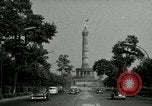
The Siegessaule or Victory Column and the Soviet War Memorial in Berlin.
The Siegessaule or Victory Column at one end of the Victory Avenue in Berlin. Traffic moves across the avenue. The Soviet War Memorial in Tiergarten. Cars and people pass by the Memorial. A tank before the Memorial. The Reichstag building in the background. The building in ruins. Military officers stand before the central pillar of the Memorial. Construction work in progress. Piles of rubble with buildings in the background.
Berlin Germany in the first hundred days of Soviet Blockade during the Cold War
Film opens showing Russian Bear covered by iron gate and slate reading 100 days Blockade. Camera pans over war-damaged areas of the city of Berlin, Germany. Narrator refers to the Berlin Airlift by the Allies and the Berlin residents not giving up. Views of several buildings undamaged by World War 2, including Kammergericht, the Headquarters of the Allied Control Council. Streets crowded by pedestrians going about ordinary business in Berlin. Among them is seen a German soldier, missing a leg and using a crutch. Some Berlin industry activity is seen in a factory where welders are at work. Blockade fences are seen separating the Soviet zone of east Berlin from the allied sectors of West Berlin. Trams are seen that cannot travel between the zones. A person trying to use a gas stove to cook, but has no gas pressure. The city grows dark at night due to electricity shortages, resulting in blackout conditions. Berliners trying to manage simple things at home such as exercising on a fixed bicycle. A man planting a garden in sight of the Brandenburg Gate, at the boundary of the Soviet zone. A police officer using a radio in an automobile in the free part of the city. View of the City Council meeting in West Berlin. This is contrasted with view of East Berlin where members of the Socialist Unity Party of Germany (SED) backed by the Soviet authorities are seen meeting in a separate city council of East Berlin, not long before the formal founding of East Germany in 1949. Next, Dr Ferdinand Friedensburg, Mayor of West Berlin, addresses the West Berlin City Council.
CRITICALPAST.COM: About Us | Contact Us | FAQs - How to Order | License Agreement | My Account | My Lightboxes | Shopping Cart | Advanced Search | Featured Collections | Website Terms & Conditions | Privacy Policy ©2026 CriticalPast LLC.
License Agreement |
Terms & Conditions |
Privacy Policy
©2026 CriticalPast LLC.