


 Francais
 Deutsch
 Italiano
Refine Your Search
-Cebu,-Philippines stock footage and images
- Showing 4219 to 4224 of 58885 results more
more Hide
Hide
Medium tractor moves over muddy ground in Aberdeen, USA.
Medium tractor on proving ground, Aberdeen. Medium tractor T-31 moves over muddy terrain. Tractor moves over terrain with and without 4.5 caliber gun on M-1 carriage.
Mortar carrier T-21 at Aberdeen proving ground in USA.
Mortar carrier T-21 circles the field at Aberdeen proving ground. It moves over rough and level terrain. Soldiers open rear door revealing mortar. Soldier climbs into the carrier and inspects grenades and other equipment. (Note: The 4.2" M2 heavy mortar recoil was hard on the halftrack chassis so the T-21 was cancelled and never adopted.) (World War II period).
The Battle of P'ohang-dong and the Pusan Perimeter in the Korean War
Opening slate of August 1950 newsreel refers to Seesaw battle on beachhead. It shows several U.S. soldiers manning a 105mm howitzer field piece on sandy ground beside a steep hill. A small American flag marks their position. Scene shifts to a bivouac area of large tents and vehicles on flat ground. A body of water and higher ground is seen in the background. Next, an American flag flutters in the breeze, on a makeshift flagpole, atop a hill, where several soldiers are maintaining a lookout. A large radio antenna is installed on the hill. Back down on the flat land, American troops are breaking camp, pulling down the large tents. At Pohang Air Base (K-3) American troops are pulling down tents and packing up to leave. A C-46 transport plane sits nearby and a C-47 transport is in the background. Troops burn papers in 55-gallon drums. Troops load Army trucks with tents and equipment. Aerial glimpse of the area showing high hills surrounding it. View from a farm field where farmers are working, as four USAF F-80C jet fighter planes take off from the nearby airfield. View from aircraft flying above, as an F-80 attacks a ground target. Gun camera view of American aircraft strafing an installation at the base of a mountain. Explosions from striking rounds. Pilot pulls up abruptly to avoid the mountain. Gun camera view of rockets being fired from attacking aircraft on lines of communication, including rail and port facilities. Fires and smoke from the attacks. A strafing attack against a moving railroad train. The aircraft passes through heavy black smoke as the pilot breaks off the attack. Two views from aircraft making low passes over a major fire at a port facility. Both times the aircraft barely skirts heavy billowing black clouds. A line of white smoke arising from ground targets. Change of scene to the beach area shown at opening of the film, where an American gun crew is firing an M-101 105mm howitzer field piece, viewed from several angles. Change of scene shows U.S. troops working their way carefully along a mountain road in the Pusan Perimeter. Two soldiers run back from the front of the column. Troops pausing while staying close to the mountainside. Suddenly, a shell bursts just a short distance fron them, raising dense black smoke. Soldiers run across the road to seek protection close to the mountain. American soldiers moving carefully behind a parked M8 light armored car. Various vies of American soldiers operating in the mountainous area. Glimpse of fallen North Korean soldiers in the brush and foliage. American troops display a captured North Korean flag. South Korean soldiers on sentry duty outside fortified compound. Armed South Korean soldiers escort two ambulatory wounded North Korean prisoners. Wounded American soldier on a stretcher, being removed from a Sikorsky H-5 helicopter, at an airfield and being carried toward the aircraft flight line.
Allies demand the unconditional surrender of Japan in World War II. Entry of Soviets and use of atomic bomb ends the war.
Representatives of three nations, seated around table at Potsdam Conference held at Cecilienhof in Potsdam, Germany. British prime minister, Clement Attlee; President of United States, Harry Truman; and representative of Soviet Union, Joseph Stalin at the Potsdam Conference, July 1945. They deliver an ultimatum of unconditional surrender to Japan. Swarms of B-29 bombers and Aircraft Carrier Task Forces destroy Japanese homeland. Planes on carrier decks.Navy Grumman carrier-based TBF aircraft dropping bombs.. Destruction of ships at sea. Mushroom cloud due to atomic bombing. Chart depicts the power of one atomic bomb. Britain's 'grand slam' bomb, most destructive conventional bomb ever produced. Doctor Ernest Orlando Lawrence, inventor of the cyclotron (atom smashing machine). A man works at the Cyclotron at the University of California, Berkeley. General Leslie Groves, head of the project speaks. He is seated with Dr Vannevar Bush, government director of science and research, and Dr Richard Tolman, technical expert. Quantities of uranium shipped from Alberta, Canada are used in bombs. The atomic bomb process (Manhattan Project) is developed in widely separated areas; scenes from Hanford Project plant in Richmond, Washington. Project personnel exit cars and enter into the search area before starting their work day. Lieutenant colonel Franklin T Matthias with the army corps of engineers, appointed to the Hanford Project. Sign of 'Oak Ridge' in Tennessee. Largest of the three atomic bomb plants located near the Tennessee Valley Authority (TVA) dam. Employed personnel in atomic bomb plants are seen going to work. Man and woman employees at the plan read and smile at a Knoxville Journal newspaper in August 1945 with news headline "Power of Oak Ridge Atomic Bomb hits Japs" after the atomic bomb was dropped in Hiroshima. View of dense prefabricated home communities to house large number of Oak Ridge plant workers. View of families setting up their houses in trailer towns after the prefabricated homes were full. People come out from the Henebry's Jewelers and supermarket, among stores setup to meet the needs of the quickly built city. Scenes changes to show view of Soviet leader Joseph Stalin at conference. Russian artillery and troops in a parade at Red Square in Moscow, Russia (these parade scenes are from the May 1, 1945 May Day parade, just days before Germany's surrender). President Harry Truman reports on the latest developments regarding the war with Japan. He states that the United States is prepared to destroy every productive enterprise in Japan and the U.S. shall completely destroy its power to make war. He warns of an attack by the U.S. due to the rejection of the July 26th ultimatum at Potsdam. He warns that Japan "should expect a rain of ruin from the air; the like of which has never been seen on this earth." Truman notes that it will be followed by an unprecedented sea and land invasion of Japan.
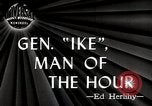
General Eisenhower returning home to Washington, DC after World War II, by way of Paris and London.
With the war ended, General Dwight D. Eisenhower is feted in London, on his way home to America. He is seen stepping into a ceremonial horse-drawn carriage, as throngs of spectators line the sidewalks to watch. Accompanied by British Air Marshal Arthur Tedder, Eisenhower rides in the carriage, escorted by police on white horses. Crowds cheer Ike from the sidewalks as the carriage passes. The carriage stops at the London Guildhall. (A sign reads: "Site of the Guildhall Chapel, 1299-1822.") Inside, Sir Frank Alexander, Lord Mayor of London, is seen making Ike an honorary citizen of London and presenting him a token sword that once belonged to the Duke of Wellington. Outside, the streets are jammed with London well-wishers who applaud and cheer the Supreme Allied Commander as his carriage passes them on the way to Mansion House. At some points, Eisenhower stands and acknowledges the crowds cheers and he sometimes salutes, while seated. Glimpse of spectators jammed side-by-side in the streets. Eisenhower is seen standing on the balcony of Mansion House, flanked by Prime Minister Winston Churchill, in a top hat. The balcony is decorated with British and American flags. Sounds of the cheering crowd can be heard as Ike says: "Whether or not you know it, I am now a Londoner, myself." The crowd cheers. He continues: "I have just as much right to be down in that crowd, yelling, as you have." He goes on to make other remarks about the peaceful state of things. He bids all farewell and he and Churchill turn to enter the building. Scene shifts completely to the Arch of Triumph in Paris, where General Eisenhower is seen ceremoniously laying a wreath at the tomb of the unknown soldier. He steps back to stand beside French General Charles de Gaulle. They and accompanying military officers salute. The memorial flame at the tomb fills the foreground. Next, in a closeup, General de Gaulle is seen decorating Eisenhower with the Medal of Liberation. Glimpse of enthusiastic French citizens cheering as Eisenhower tours the city with de Gaulle, in an open car escorted by police on motorcycles. They proceed along the Champs Elysees, with the Arc de Triomphe in the background. Ike and de Gaulle both stand as they drive along. Closeup from moving vehicle passing close to crowd. Views from rear as the car and escorts move through the spectator-lined streets. Similar views from ahead. Scene shifts to Eisenhower finally arriving in the United States. A pointed arch supports a large American flag above a "Welcome Ike" banner. General Eisenhower steps from an airplane in Washington,DC, where Mrs. Mamie Eisenhower greets him. The two pose for the camera. Next, a motorcade of jeeps travels along Pennsylvania Avenue. The Post Office building is seen on the right and the capitol in the far background. District Commissioners present Ike keys to the City. Views of jeep motorcade proceeding along Pennsylvania Avenue. Eisenhower standing in a jeep acknowledging the crowds. As they reach the capitol, a disabled veteran gives something to Ike. Inside, Eisenhower makes his way to the podium to address a joint session of the Congress. View of Ike addressing the session, with Speaker of the House, Sam Rayburn and president pro tempore of the United States Senate, Kenneth Douglas McKellar, behind him. (The latter was serving as President of the Senate, in the temporary absence of a Vice President, after Harry Truman became President upon the death of Franklin D. Roosevelt.)

General Dwight D. Eisenhower is honored by citizens of New York (WW2)
A motorcade for General Dwight D. Eisenhower in New York City. Citizens of New York welcome the man who headed the armies and helped to win World War 2. General Eisenhower smiles, waves, and accepts the honor. People shower ticker tapes to welcome General Eisenhower. U.S. flags on buildings. Large crowd welcomes Eisenhower at ticker tape parade. He receives city's gold medal and honorary citizenship. He addresses a throng. Cameraman records the event. General Eisenhower in a parade from the battery to City Hall (City Hall Park, New York, NY 10007). Soldiers hold the U.S. flag. Soldiers and Generals salute. Lieutenant Colonel Franklin T. Matthias salutes.
CRITICALPAST.COM: About Us | Contact Us | FAQs - How to Order | License Agreement | My Account | My Lightboxes | Shopping Cart | Advanced Search | Featured Collections | Website Terms & Conditions | Privacy Policy ©2026 CriticalPast LLC.
License Agreement |
Terms & Conditions |
Privacy Policy
©2026 CriticalPast LLC.