


 Francais
 Deutsch
 Italiano

Refine Your Search
-Cebu,-Philippines stock footage and images
- Showing 42607 to 42612 of 58987 results more
 Hide
Color Sound

Freighters escorted by American battleships, destroyers and submarine chasers in the Atlantic.
American battleships, destroyers and submarine chasers escort freighter in the Atlantic. A passenger cruiser passes in the foreground. The U.S. flags at the bow and stern sections of the cruiser. Battleships move in formation. Sun sets at far horizon.
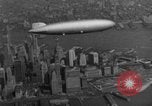
Final flight of the airship Hindenburg, then it bursts into flames when landing
The German rigid airship Hindenburg on its final flight. Views of the airship flying over Manhattan Island, New York City. Swastika symbol visible on the airship's tail section. The airship descending for landing at Lakehurst Naval Air Station in New Jersey. Views of the passengers in the windows waving to the onlookers on the ground. Explosion and massive fire and smoke consumes the airship. It crashes to the ground in flames and collapses. Rescuers in the foreground run toward the burning wreckage.

American airpower advocate speaks on the importance of air power and strong defense for the United States, shortly before WWII
American wearing hat and bow tie makes a statement to reporter. He talks about war being imminent in Europe (World War II) and an increasing interdependency between nations of the World. He highlights that aircraft air power will have a massive impact in any future conflict and that a powerful defense force is vital for a nation to make its stand in the world.

German Luftwaffe fighters bomb the city of Dunkerque (Dunkirk) in France
German Air Force's raid on the city of Dunkerque (also spelled Dunkirk) in northern France. German Luftwaffe fighter planes in formation, including Heinkel He-111 bombers and JU-87 Stuka dive bombers. German pilot inside the cockpit of a JU-87 Stuka. The plane dives and drops bombs on an airstrip. Bombed and burning buildings in the city of Dunkirk. Luftwaffe Stuka fighters bomb Allied vessels. Antiaircraft guns fired. A German plane crashes in water. View of the wrecked city of Dunkirk, with many fires burning and smoke. Large number of people in the streets. Aerial and ground views of a destroyed church (possibly the St. Eloi Church) with the roof gone and the interior completely destroyed. German parachute troops jump from transport planes descending on Dunkirk. (World War II period).

Davis Wing aircraft wing design tested at a wind tunnel in the United States
Wind tunnel test of a wing design, the "Davis Wing" designed by aeronautical engineer David R. Davis. Animation shows the flow of wind around a wing of the plane. View of a model-plane at the mouth of the wind tunnel.
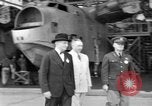
Aviation business and military leaders meet at Consolidated Aircraft; views of aircraft assembly plant operations
A meeting of business and U.S. military leaders at a Consolidated Aircraft assembly plant during World War II. View of General Henry "Hap" Arnold, Consolidated Aircraft founder Reuben H. Fleet, and William S. Knudsen (President of General Motors, and appointed by President Roosevelt as Director General, Office of Production Management. He developed the "Knudsen Plan" for rapid U.S. war materiel production expansion in World War 2). The three men are walking in front of an aircraft hangar with partially finished PB2Y Coronado flying boat aircraft at the Consolidated Aircraft factory in San Diego, California. Group of American military and industrial leaders gathered talking at the site, including Henry Ford of Ford Motor Company, and James H. "Dutch" Kindelberger, President of North American Aviation. (Consolidated, North American, Douglas, and Ford all produced B-24 bombers during the war.) Change of scene: Men at unidentified location view blueprints for expanded aircraft manufacturing and assembly facilities. View of war production factory workers as they stream out of a factory at end of shift. Views of PB2Y Coronado flying boat patrol bomber, and B-24 Liberator bombers under construction. Views of factory operations with metal forging and tempering work. Views of wing and engine assembly operations.
CRITICALPAST.COM: About Us | Contact Us | FAQs - How to Order | License Agreement | My Account | My Lightboxes | Shopping Cart | Advanced Search | Featured Collections | Website Terms & Conditions | Privacy Policy ©2026 CriticalPast LLC.
License Agreement |
Terms & Conditions |
Privacy Policy
©2026 CriticalPast LLC.