


 Francais
 Deutsch
 Italiano

Refine Your Search
-Cebu,-Philippines stock footage and images
- Showing 43885 to 43890 of 58987 results more
 Hide
Color Sound
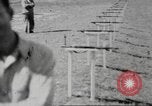
U.S.Army Air Corps recruits receive small arms training at a basic training base in Florida, during World War II
Opening scene shows rifles placed on each of a series of stands along the firing line of a rifle range at a basic training base in Saint Petersburg, Florida, during World War 2. U.S. Army Air Corps recruits are lined up side-by-side with their instructors, behind the firing line, awaiting instructions from the Range chief (unseen). Upon his order, they advance and take up prone positions, in pairs, at each firing position. Each recruit is assisted by his instructor and fires his rifle while his instructor observes and notes results. Non-commissioned officers (NCOs) monitor from behind the firing line. Camera pans across the firing line. Next, men are seen lowering bulls eye paper targets and replacing them with new ones that they raise high overhead, and signal with flags, when done. Views of the targets. Next trainees stand along the firing line, with Thompson M-1928 A1 submachine guns at ready. Upon command, they fire bursts from their weapons at silhouette targets. Bullets seen striking targets and dirt hill behind them. Face of Hitler and swastika are scrawled on one target.
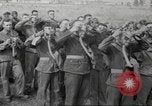
U.S. Army Air Corps recruits undergoing gas mask training at a basic training base in Florida during World War II.
U.S. Army Air Corps recruits l receive gas mask familiarization at a basic training base in Saint Petersburg, Florida duringf World War 2. Trainees are seen donning gas masks in preparation. Closeup of some trainees in their masks. The group enters through a doorway labeled "Danger Gas Chamber." Next, they are see exiting the doorway, carrying their masks and exhibiting some effects from tear gas, which they have been deliberately subject to as part of their familiarization training. Closeup of several men with tearing eyes from the brief exposure. Change of scene shows a smoke screen flowing over the ground. A jeep carrying several officers emerges from the smoke. Next, a cadre of trainees emerges on foot.
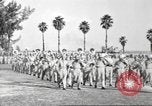
Military and civilians parade on Armistice Day in Saint Petersburg, Florida
In the opening scene, a U.S. Army Air Corps brass band leads a parade, followed by a contingent of army troops with shouldered rifles wearing steel helmets. A fairly large ship, emiting some smoke from its stack, is stationary in the background. Spectators watch from edge of the parade grounds. Palm trees dot the area. Next, a contingent of Air Corps trainees marches in formation, with a three-man color guard and the American flag behind them. The band now stands in formation off to the side as it plays. Other formations of airmen trainees march in the background. Scene shifts to downtown Saint Petersburg, where Army Air Corps officers, plus Marine and Naval officers occupy a reviewing stand with Robt. J. McCutcheon, Jr., the Mayor of Saint Petersburg. Closeup of Air Corps Colonel E. R. Householder rendering a salute. Camera pans the reviewing stand and then pans across the heads of standing spectators, to a large group of civilians occupying reserved seats. Scene shifts to the Air Corps band playing as they lead the parade down Central Avenue. The sidewalks in this business district are filled with spectators. The parade units follow in the same order as they had in earlier scenes at the parade grounds. Camera keeps pace with the unit of soldiers in steel helmets. Closeup of the soldiers executing left-shoulder arms as they march. Remaining units are seen and the color guard. Next, several formations of sailors, in whites, are seen from the rear, as they march. Camera shifts to Drum Majorette strutting between the trolley tracks on the avenue. Behind her are others in white and a contingent of sailors. A color guard of Womens Army Corps (WAC) passes the reviewing stand. Several High school cheer-leaders in white uniforms are seen next. followed by a large group High school girls, some wearing bobby socks, that seem to be marching with seniors first, trailed by successively lower classes. High School Drum majorettes in white strut ahead of their marching band. Another group of majorettes leads their band. In front of them is a drum major pushing an infant in a small stroller. He has some trouble as its wheels get caught in the trolley tracks. A group of nurses is next in the march, followed by a WAC formation in uniform. An African American marching band and majorettes is next. Their lead majorette twirls her baton. (World War II period).

U.S. Quartermaster Corps salvaging war materiel during World War II, in Italy
Film opens showing a burning building collapsing during World War 2, in Europe. A burning U.S. millitary vehicle on a street explodes. Another one catches fire and black smoke billows from it. American troops gather in the area, along with a truck, a jeep and an ambulance. Next, a bulldozer driven by a U.S. soldier, is seen moving debris from the scene. Then a large salvage depot is seen, with huge pieces of metal and parts stacked in it. Camera pans across the acres of materials, as it follows several soldiers walking along a path in the depot. The materials seen include pieces of American and German airplanes and armaments. A so-called mop-up crew of a Quartermaster Salvage Company is seen driving in a truck along a highway. They pull up next to the hulk of a crashed airplane. They pick up gasoline Jerry cans. They raise remains of a knocked out tank, by means of cables. One soldier is seen picking up personal military gear. A mop-up crew uses a derrick to retrieve parts of destroyed railroad cars. A soldier retrieves abandoned small arms near a river, as another fishes military clothing from the river, itself. Trucks are seen carrying retrieved items along a road to the depot. Two trucks enter the depot. One carries several German airplane wings. Several loaded trucks are directed to areas of the depot where they are to dump their loads. Views of the depot show how similar items are relegated to the same parts of the depot. Rubber tires are stacked in one area, and aircraft parts in another. Heavy trucks and tanks are seen being transported into one section of the depot.
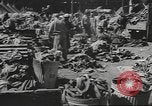
Numerous scenes of U.S. Army Quartermaster salvage operations in Italy during World War II; also brief aircraft crash scene.
U.S. soldiers in the textile repair section of a Quartermaster Salvage Depot, are seen sorting military clothing of all types to be recycled an reissued, or otherwise used as rags for cleaning purposes. Workers from the local populace are hired as paid employees in these salvage operations. A woman removes bundles of used army uniforms from a horse drawn cart and gives them to children who carry them to other women and children who are seen working on various levels of a building, where they mend and otherwise repair and restore the garments. A man works at a sewing machine on the ground floor of the building. But the women and girls seen are all engaged in hand sewing. Scene shifts to a section of the depot yard where tents are being examined, sorted and repaired. Large tents are suspended from a crane to facilitate inspection. The next scene shows interior of a mobile repair shop designed for the Signal Corps, where soldier technicians work on electrical and electronic equipment. A soldier repairs an SCR 536 (better known as handy talky) and an Army Technician fourth grade (T/4) works on an SCR-508 mobile Signal Corps Radio. He tests each tube and connection. A Staff Sergeant removes parts from a BD 72 field switchboard. Outside, several local civilian men employed by the Depot, are physically salvaging useful items, such as brass knuckle joints from metal tubing. Another pulls worn copper wire from an armature. Elswhere in the yard, soldiers and local helpers salvage lead plates from old storage batteries, where they are melted down over a fire and poured into old army helmets, serving as improvised ingot molds. A huge collection of spent artillery shells covers a vast area in the depot. They are loaded aboard barges and brought to ships for transport back to the U.S where they will be repacked and reused. Soldiers collect unserviceable tires for reshipment back to the U.S. Soldiers inspecting a pile of tires. Soldiers inspecting rubber tubes and checking them for leaks. A pile of inflated tire tubes left to sit awhile before being inspected. Outside the infantry too repair shop, soldiers repaint pick mattocks and set them out to dry. Using tools they invented, two soldiers remove wooden handles from shovel blades and from ax handles, in the infantry shovel repair department. Inside the building, soldiers are seen repairing stoves in the stove repair department. One ignites a stove and checks its flame. In a corner of the shop, a worker repairs gasoline lamps. Several are seen illuminated. Soldiers hammer out dents in mess kits and use compressed air and stone molds to take dents out of canteens. One disinfects mess gear by dipping in a lye bath and then in water and repeating that procedure again. He hangs them in the sun to dry. At one spot (where no smoking is written on the wall in Italian) a soldier works repairing 5 gallon (Jerry) gasoline cans using air pressure and water immersion to detect any holes. A jerry can is brazed by a worker using an acetelyn torch and rod. A warplane is seen crashing in flames. Signs advertising salvage as savings, are seen in various places. Salvage trucks and cranes are seen along with glimpses of salvage crews at work. A cartoon sign by a destroyed building shows a GI with ax holding Hitler's head. It reads: "Behead Hitler. Turn in Salvage." Another cartoon sign shows a girl and reads: "You will bet back to me sooner, if you turn in your salvage." A GI whistles in admiration as he passes the sign to pick up two discarded jerry cans. He salutes the sign as he walks away.
Food and rations supplied by New Zealand to U.S. Army Quartermaster South Pacific operations during World War II.
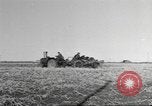
Cooperation between New Zealand and the U.S. Army Quartermaster Corps during World War II. A tractor on a farm in New Zealand. A tractor plows the field. The Pukekohe Golf Club, near Wellington, converted from golf to farm to grow crops for the war effort. New Zealand farmers works in the field. Farmers load a truck with sacks of potatoes. Close up view of potatoes on a sorting belt and farmers sort potatoes and bag them. Women workers sort cabbage and package the cabbage for shipment. Men and women farmers picking fruits and vegetables in farm fields. A factory shows apples being moved on a belt driven machine, and peeled and cored by a machine, cut into very small pieces and dehydrated in order to conserve shipping space. Canning operations are shown as the dehydrated fruits and vegetables are packed in moisture proof tins in packing houses. Meat and vegetable are mixed in proportions to prepare Quartermaster combat rations. Combat ration cans being filled and sealed at a factory plant. A machine re-generating chocolate bars from old chocolate by melting them down and reprocessing them. Soldiers unloading cartoons from the truck. Rations from New Zealand are loading on to ships by cranes with nets at large shipyards, with ships bound for the Solomon Islands. A dairy warehouse of the New Zealand Co-op Dairy Company (later Tatua) is seen at an airport near Auckland (Possibly Tatuanui or Pauanui). Milk is loaded into a specifically converted B-24 aircraft at the airport. Soldiers loading the aircraft with milk containers. The B-24 aircraft takes off. The aircraft arrives at the Tontouta Air Base in New Caledonia. A nurse serves milk to a wounded soldier patient in a hospital. Sign over the patient's bed says "Pappy Shooter, 27th Division; Saipan; Oahu, Hawaii". The patient drinks milk. Bread being made in Quartermaster bakery. A group of Army bakers working together to form loaves of bread dough on a large work surface. Workers making bread. A worker opens an oven revealing many loaves of baked bread. Ice slabs being formed at an ice plant, and soldiers picking up ice blocks for use in preserving meats and other foods, and in making ice cream. A soldier making ice cream using an ice cream churn in the field. View of a larger Quartermaster ice cream plant that was setup at a large base.
CRITICALPAST.COM: About Us | Contact Us | FAQs - How to Order | License Agreement | My Account | My Lightboxes | Shopping Cart | Advanced Search | Featured Collections | Website Terms & Conditions | Privacy Policy ©2026 CriticalPast LLC.
License Agreement |
Terms & Conditions |
Privacy Policy
©2026 CriticalPast LLC.