


 Francais
 Deutsch
 Italiano

Refine Your Search
-Cebu,-Philippines stock footage and images
- Showing 44161 to 44166 of 58987 results more
 Hide
Color Sound

Italian raiding bombers attack the seaport of Haifa, a vital oil shipping center, in Palestine
Italian aircraft attack the British Mandate of Palestine during World war II. Italian Royal Air Force raiding bombers conduct the first air raid on the Holy Land seaport of Haifa, a vital oil shipping center. Savoia-Marchetti SM.79 Sparviero bombers in flight. The crew in the aircraft. Bombs dropped. The aircraft bombard the coastline and the port. Smoke due to heavy explosions during the bombardment.
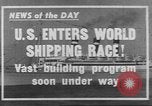
Joseph Kennedy proposes a plan to build new merchant ships to replace ships like the Leviathan in the United States.
A vast ship building program to be undertaken by the Maritime Commission in the United States. The newly appointed Chairman of the Maritime Commission Joseph P. Kennedy, speaks on the proposed plan to build new merchant ships. He emphasizes the necessity for a complete refurbishing of the Merchant Marine. Outmoded merchant ships built during World War I. Several ships docked at the New York harbor. People cheer and wave as the new ocean liner SS Rex sets sail. Flagship of the United States Line, the Leviathan, in dry dock. The British ocean liner Queen Mary leaves for Europe. Foreign merchant ships entering and leaving the harbor.

U.S. Marines land and advance near Mount Suribachi amidst enemy fire during the Battle of Iwo Jima in World War II.
'Action on Iwo Jima' depicts the Battle of Iwo Jima or Operation Detachment during World War II. United States Marines Divisions eliminate positions on Mount Suribachi. Mount Siribachi on the island coast. Additional waves of Marines arrive at the island. 3rd Marine Division arrives to enforce the 4th and 5th Divisions. Landing crafts and ships approach the shore amidst enemy fire and explosions. Crouched Marines in a Landing Craft Vehicle Personnel (LCVP). Marines advance inland amidst mortar fire and machine gun fire by the Japanese. They advance across mine fields on the beach. Soldiers unload supplies from landing crafts and ships. They pull a tank across the beach. A view of the battle from inside a tank. Marines battle around Mount Suribachi. Advanced units scale cliffs and take cover against grenades and demolition charges from the Japanese in caves and pill boxes. The Marines use flames to flush Japanese soldiers out of dug in positions. A Japanese soldier takes cover from machine gun fire. Guns fired and explosions on the island.
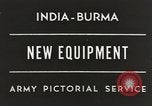
A U.S. Soldier demonstrates the use of a carbine equipped with a night vision sniper scope in Burma during World War II.
U.S. Army soldiers train with new "Sniperscope" equipment during the Burma Campaign in World War II. The 475th Infantry regiment of the U.S. Mars Task Force are seen gathered for a demonstration of the new Sniper Scope. A U.S. Army soldier demonstrates the parts and use of the sniper scope. He shows a carbine equipped with the sniper scope for accurate firing in the dark. He explains the functioning of the scope and how its attached infrared spotlight operates in conjunction with a telescopic sight mounted on the rifle to enable night vision. He looks through the telescope sight. He demonstrates the use of a unit, attached by a cord, that contains batteries and an electrical focusing attachment. He turns a focusing dial on the unit. The American soldiers examine the carbine and look through the telescopic sight. Narrator explains that the night scope will be used primarily in preventing night infiltration of U.S. held positions.

The AZON bomb is assembled and dropped over target areas by B-24 bombers in Burma during World War II.
The use of the AZON (AZimuth ONly) smart bomb by United States during World War II. The Tenth Air Force Base in Burma. A soldier unpacks components of the AZON bomb. He unpacks a flare. Soldiers test the radio receiver. An airman conducts a final check on the tail assembly and inserts the radio receiver and battery. A 1 million candle power flare is fixed to the tail. The assembled bombs are brought to the waiting U.S. Army Air Forces B-24 Liberators of the 9th and 493rd Squadrons of the 7th Heavy Bomber Group. The bombs are loaded onto the aircraft for mission targets in lower Burma. The B-24s in flight. The bombs are released. The flare is ignited by a delay fuse. Explosions on the ground as the bombs hit targets. The bombers in flight drop numerous more AZONs. They target roads, canals, and bridges. Six different bombs are dropped simultaneously.

Allied soldiers prepare material for especially prepared German broadcasts at Radio Luxembourg during World War II.
Radio Luxembourg operated by the Allied Forces' Psychological Warfare Division to break down German morale and induce nazi troops to surrender during World War II. The Radio Luxembourg station in Luxembourg. U.S. Army soldiers in the recording studio. They read information from a document over the microphone. Other soldiers seated inside. Towers at Radio Luxembourg, the most powerful long wave station in Europe. A man at the controls. officers check the wavelengths. for various locations of reach. The Radio Luxembourg news room. Army Intelligence and other military sources prepare material for the especially prepared German broadcasts. The recording studio: A soldier operates controls. Two soldiers seated at a table. They read from a document into a microphone.
CRITICALPAST.COM: About Us | Contact Us | FAQs - How to Order | License Agreement | My Account | My Lightboxes | Shopping Cart | Advanced Search | Featured Collections | Website Terms & Conditions | Privacy Policy ©2026 CriticalPast LLC.
License Agreement |
Terms & Conditions |
Privacy Policy
©2026 CriticalPast LLC.