


 Francais
 Deutsch
 Italiano
Refine Your Search
-Cebu,-Philippines stock footage and images
- Showing 47095 to 47100 of 58986 results more
more Hide
Hide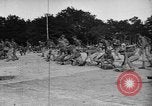
U.S. Marines in prone positions holding guns and practice the use of weapons in the United States during World War I.
U.S. Marines practice with Lewis machine guns during World War I. U.S. marine three-man machine gun teams set up Lewis machine guns and fire them during training at Key West, Florida, in World War 1. Teams set up in prone positions, with gunner ready to fire. Second man fastens circular ammunition magazine atop the gun and third man stays low behind. The guns are on a bipods, and equipped with large cooling shields around their barrels. The gunners fire one magazine, replace it, and fire again.
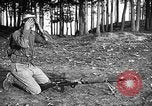
A U.S. Marine machine gunner demonstrates weapon familiarity by field stripping his weapon, blindfolded, in World War I
A U.S. Marine demonstrates his weapon familiarity by taking a blindfold test. The blindfolded marine kneels on the ground next to his Lewis machine gun. The gun is set on the ground in front of him on a bipod support. He reaches and removes the cylindrical magazine from the gun. Then he removes the stock and proceeds to field strip the weapon down to the smallest parts, entirely by feel. He leans back and removes his blindfold, when done, and stands up.
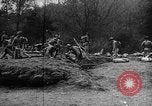
U.S. Marines practice trench warfare techniques during their training in World War I
U.S. Marines occupy trenches at their training facility in World War 1. Once positioned in them, they climb from the trenches, in squads, and charge forward. They are followed by a second wave of squads. Some marines are seen down in a dugout of the trench. Another scene shows more squads of marines going over the top of deep trenches, in successive waves. They climb rustic ladders to get out of these deep trenches.
U.S. Navy troop transport operations in World War I
A freighter in foreground,and a troop transport ship, docked at a U.S.Army Transport Service Terminal during World War 1. (A large oceanliner seen berthed on opposite side of the terminal.) U.S. Army troops jam the lower decks of the troop ship as she prepares to get underway to France. Three twenty-man life rafts hang on the side of the troop ship and an American flag flies at her stern. Scene shifts to American Expeditionary Forces boarding a very large Navy transport ship at Hoboken, New Jersey. Some troops with all their gear, climb a steep gangway to an upper deck, while others, below, walk a level gangway to a lower deck.
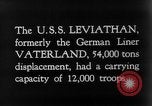
U.S. Navy troop transport operations in New York and New Jersey in World War I
The SS Leviathan, the largest ocean liner afloat, (former German ocean liner Vaterland, seized and renamed by the U.S. Government in 1917, as America entered World War 1). Tug boats assist the three-stacker Leviathan as she enters New York harbor. Tug boats working with another troop ship (two-stacker) in the harbor. Ferry boat in background. A sleek troop transport ship with two slanted stacks and rakish lines, accentuated by camouflage, in a New Jersey harbor.Two Navy troop ships underway with an airplane flying overhead. A column of U.S. Navy troop transport ships underway in the Atlantic ocean. A barrage balloon is seen overhead.
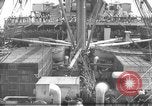
Life aboard the American troopship, SS Leviathan, during World War I.
The upper deck of the SS Leviathan, carrying American Expeditionary Forces to France during World War 1. Formerly the German ocean liner, Vaterland, she is the largest ship afloat, and carries 12 thousand troops. This footage shows the U.S. Navy commissary Officer inspecting various functional activities related to care and feeding of the crew and troops aboard. He checks sides of beef in cold storage of the meat locker. He samples a pie in the bakery; and inspects the galley. Next sequence shows Army troops forming two chow lines as they come down into the mess area, carrying their individual mess kits. Mess personnel serve the troops, who then proceed to long tables where they eat.
CRITICALPAST.COM: About Us | Contact Us | FAQs - How to Order | License Agreement | My Account | My Lightboxes | Shopping Cart | Advanced Search | Featured Collections | Website Terms & Conditions | Privacy Policy ©2026 CriticalPast LLC.
License Agreement |
Terms & Conditions |
Privacy Policy
©2026 CriticalPast LLC.