


 Francais
 Deutsch
 Italiano
Refine Your Search
-Cebu,-Philippines stock footage and images
- Showing 47161 to 47166 of 58986 results more
more Hide
Hide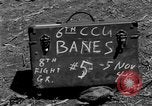
Enlisted men of 8th Fighter Group remove wires, loud speakers and insulators from trees on Morotai Island, Indonesia.
Activities of U.S. Army Air Force 8th Fighter Group on Morotai Island in Indonesia during World War II. A truck loaded with enlisted men (EM) moves in a camp area. Clothes on a string. A building. Men pack camp chairs in crates. A lineman climbs up a palm tree to remove communication lines. Another lineman removes insulators. An EM unscrews water pipes. The EM picks up a section of a pipe and walks out. A man removes a loudspeaker from a palm tree. An electrician removes a loudspeaker from a tree and gives it a man on the ground. A man on a tree remove wires. An EM takes apart a small table with a hatchet. A man puts articles in a file cabinet drawer.
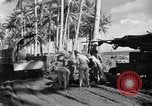
EMs of 8th Fighter Group attach a chain to a generator and load it on a truck on Morotai Island, Indonesia.
Activities of U.S. Army Air Force 8th Fighter Group on Morotai Island in Indonesia during World War II. Men pull a portable generator from a tent. A wrecker truck backs up towards the generator. The men unwind a hoist chain. EMs (Enlisted Men) attach the chain to the generator. The EMs load the generator from a hoist to a truck backed up to the wrecker truck. The men push the generator trolley on a muddy road. A man paints a shipping code number on a crate.
Fictional reenactment of ordinary life and travel in the 19th century, before the age of the automobile.
A film titled 'The American Road' depicts travel in the 19th century, before the advent of the automobile. A house in New York. A man and a woman on a horse drawn cart. A doctor arrives by horse and buggy to attend a sick person and speaks to a woman, at the door.. The doctor gets on his horse carriage. A man rides a horse drawn cart. They pass a church. A railway station. The man and the woman in the cart arrive at the station. A man at the station. The man and the woman get off from the cart. The man at station talks to the man who was on the cart. The man waits for the train. A railway track.
Views of New York City around the turn of the 20th Century
Streets of New York city around the turn of the 20th century, showing horse-drawn vehicles and people, in Gilded Age dress of the times, some appearing wealthy, going about their daily affairs.Transportation is primarily dependent upon the horse. A man and woman on the street pull a fire alarm and scene shifts to a firehouse with firemen responding to alarm, sliding down a pole and hitching up their horses and engines. The Horse-drawn fire engines rush down the street as spectators watch from the sidewalks. City street with merchants selling wares outside, in front of their establishments. Boys,wearing knickers (knickerbocker trowsers) playing stickball in the street. Horses pulling wagons underneath the elevated railroad train tracks, where a steam locomotive is pulling a passenger train. People gathering in front of a baseball park advertising a game between New York and Chicago. Scenes of amusements and amusement carnival rides at Coney Island. Women gather to climb aboard an open train to an amusement. Views of the "Shoot-the-Chute" concession at Luna Park, with patrons riding down the chute in boats. Women patronizing a concession that offers camel rides. The beach at Coney Island, crowded with bathers, on its sands. City dwellers cooling off in water from a fire hydrant on the city street in front of their houses.
Film depicting transportation at turn of the 20th century in the United States
Actors portray 19th century folks riding bicycles, on an outing in the country. Woman on bicycle, country road, with men as well. As the road narrows, one of the cyclists falls. The party decide to turn back to the better road again. Scene shifts to Detroit, Michigan, where actor portrays Henry Ford working on his Quadricycle. He is depicted working on it at night in his home workshop. One night he pushes it out for a trial run, and drives it successfully on the neighborhood streets. A couple in an early American automobile being pulled along a dirt road by a horse. Two men driving an early car that stops unexpectedly. They open the hood to look for the problem.
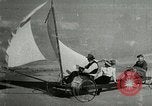
Henry Ford's "999" racing car
Actors, dressed in early 20th century clothing, ride in a wagon propelled by wind and sail, across a sand flat. Actor portrays Henry Ford working on the gasoline engine for a racing car called the Ford 999. Workers at a forge making repairs and adjustments on the car. The actual Ford 999 being demonstrated on a race track. Driver seated in the car. An assistant cranks the Ford 999 engine to start it, and it is driven around the track. (Signs painted on the track wall refer to Tommy Milton; Duesenberg; and Meteor, which relate to auto racing in the 1920s and 30s.)
CRITICALPAST.COM: About Us | Contact Us | FAQs - How to Order | License Agreement | My Account | My Lightboxes | Shopping Cart | Advanced Search | Featured Collections | Website Terms & Conditions | Privacy Policy ©2026 CriticalPast LLC.
License Agreement |
Terms & Conditions |
Privacy Policy
©2026 CriticalPast LLC.