


 Francais
 Deutsch
 Italiano
Refine Your Search
-Cebu,-Philippines stock footage and images
- Showing 49999 to 50004 of 58885 results more
more Hide
Hide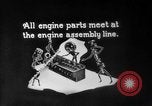
Car engines being assembled and tested in Studebaker automobile plant
Views of an engine assembly line in Studebaker automobile factory in South Bend, Indiana. A worker selects a crankshaft from a stack and places it into an engine block. Another worker moves an engine block using an overhead chain hoist. At another assembly station, a worker places piston rod assemblies into an engine block. Workers seated at a series of stations add more parts into engine blocks. Nearly completed built up engines move slowly on a conveyor as workers add final touches to complete them. An engine started and run on a test stand. A small amount of oil smoke is seen as an inspector checks the running 6 cylinder engine.
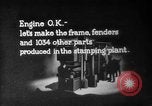
Auto body parts being manufactured and assembled in the Studebaker factory
Camera on a slowly moving overhead conveyor shows numerous stacks of sheet metal next to machines in the stamping section of the Studebaker automobile plant in South Bend, Indiana. Next, as a stamping machine slowly rises open, men remove automobile frame parts from it. Closeup of the stamping machine slowly stamping the frame parts which men then remove from the press. The name Studebaker appears on the machine. At another location men are seen removing stamped auto fenders from a similar press. Closeup of a machine slowly pressing sheet metal between a pair of mating presses to form a fender. Worker holds finished fender up for the camera. In the auto body section of the factory, men place an auto body frame on a wheeled dolly. Next workers are seen placing a lower rear body section on a car being assembled. Other workers are seen hand grinding and otherwise smoothing surfaces of assembled auto bodies. In final scenes, workers sit inside the assembled bodies and apply trim to the interior using tack hammers and other tools.
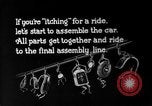
The final assembly of a new automobile in the Studebaker Automobile plant
Film begins showing a worker moving a collection of final assemble parts for a new automobile in the Studebaker automobile factory in South Bend, Indiana. As he rotates the "package" of parts to move it by overhead hoist, some of the contents can be seen, including: tires, a radiator, mud guards, and other finishing items. An engine is lowered into an auto chassis. Then an auto body is lowered into it from an overhead hoist. New automobiles (without engine covers) are driven from stalls into another section of the auto plant. A line of the Studebaker cars is seen parked with rear wheels rotating on dynamometers built into the floors, as inspectors check their uncovered engines. Closeup of a cars rear wheels spinning over the dynamometer. Closeup of inspector using screw driver to adjust something on the running engine. An inspector looks at a completely finished car and gives it an "OK" tag. Studebaker wings hood ornament seen on car.
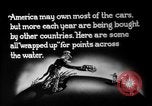
American made automobiles are exported to foreign countries. A Studebaker sedan travels over dirt roads on Catalina Island off California.
Workers in a Studebaker automobile factory move a fully wooden crated new automobile on an overhead hoist. It is labeled "Studebaker Automobiles" on it's side. Views of crated cars bound for different destinations overseas. Seen are those headed to: Buenos Aires, Capetown, Melbourne, and Cairo. Next, a Studebaker sedan car is seen raising lots of dust as it races at high speed over a dirt road on Catalina Island, off the coast of California. The driver is trying to climb a 1500 foot hill over a distance of 3 miles, as fast as he can. His car is seen negotiating hairpin turns during the ascent and finally arriving at the summit.
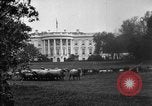
President Wilson in his office at White House in Washington DC, and signs proclamation of war against Germany in World War I
U.S. President Woodrow Wilson at White House in Washington DC during World War 1. Exterior views of the White house with sheep grazing on White House lawn in the foreground. U.S. President Woodrow Wilson works in his office. He stands and watches sheep graze on the White House lawn. Wilson talks on phone. Wilson, seated at table in his office, looks at documents. President Wilson sitting in chair. On April 6, 1917, Wilson signs documents proclaiming a state of war exists between the United States and Germany (Presidential Proclamation 1364) during World War 1. Several officials standing behind him during signing.
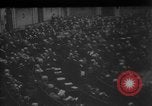
U.S. President Woodrow Wilson asks Congress for a declaration of War against Germany
Film opens showing the U.S. Congress filling the U.S. Capitol chamber on April 2, 1917, when President Woodrow Wilson asked Congress to declare war against Germany. Four days later, on April 6th, President Wilson is seen in black topcoat and top hat delivering an address from a building in Washington, DC announcing that Congress approved his request for a declaration of War. Former President Wiliam Howard Taft sits nearby. View of President Wilson dressed in summer white, relaxed and very casual, speaking impromptu to a group of persons in front of a brick building. Patriotic bunting is seen nearby. Change of scene shows Woodrow Wilson's youngest daughter, Mrs. W.G. McAdoo,Eleanor Randolph Wilson McAdoo. An unidentified old woman is nearby.
CRITICALPAST.COM: About Us | Contact Us | FAQs - How to Order | License Agreement | My Account | My Lightboxes | Shopping Cart | Advanced Search | Featured Collections | Website Terms & Conditions | Privacy Policy ©2026 CriticalPast LLC.
License Agreement |
Terms & Conditions |
Privacy Policy
©2026 CriticalPast LLC.