


 Francais
 Deutsch
 Italiano
Refine Your Search
-Cebu,-Philippines stock footage and images
- Showing 50359 to 50364 of 58885 results more
more Hide
Hide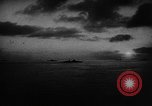
U.S. Navy ships bombarding Okinawa and fighting off attacks by Japanese Kamikaze aircraft in World War II
Conclusion of U.S. Navy film: "The Fleet That Came To Stay." Role of U.S. Navy Task Force 58 during the Battle of Okinawa in World War 2. Opening scene shows ships of U.S. Task Force 58 sitting quietly in waters off the coast of Okinawa, at dawn on May 9, 1945 (VE Day, when Germany surrendered in World War 2). Navy gunners silhouetted against the dawning sky, with twin Bofors anti-aircraft guns. Silhouettes of sailors on early watch. Sailor walks on deck of an aircraft carrier, past parked aircraft with it's vertical stabilizer and rudder riddled to pieces by battle damage. An escort aircraft carrier and other warships are moving slowly past the camera ship. A Douglas Dauntless dive bomber, with only a pilot aboard, takes off from a carrier. Brief glimpse of aircraft taking off from a carrier. It carries a bomb underneath and displays the number 559 on its engine cowling. Numerous American aircraft in formation above the ships. A U.S. cruiser in the distance. Closeups of capital ships bombarding Okinawa with heavy guns and firing anti-aircraft guns at attacking Kamikaze aircraft. Black flak clouds and tracer bullets tracking a Japanese aircraft. Superimposed slate tallies Japanese aircraft shot down: "May 12th: 164; June 3rd: 45; June 6th: 67; June 8th: 30." A kamikaze plane crashes into the sea. Gunners aboard a ship work rapidly to reload their anti-aircraft guns. View of an Essex class aircraft carrier with black flak clouds overhead. Two explosions occur next to her hull. Gunners track a Japanese airplane flying low and close to the water. It passes a carrier and crashes into the sea. More views of sailors working at speed to reload anti-aircraft guns. A sailor firing an Oerlikon 20 mm cannon from gun position atop a ship. A Kamikaze plane crashes at starboard side of an Escort aircraft carrier underway. View of long line of anti-aircraft guns firing simultaneously from beside the flight deck of an aircraft carrier. Smoke rising from the firing and driven by the wind. Remains of a Kamikaze plane spin down amid black flak clouds, after being hit by gunfire. Slate reads "4232 (Japanese planes shot down). The spinning pieces of the Kamikaze plane crash well clear of a nearby Cleveland class light cruiser. Against background of flak filled sky, a Washington Post Newspaper headline is shown reading: "Navy Okinawa Casualties near 10,000 and 2 more ships hit."
Japanese atrocities against Chinese people; burning Chinese cities; U.S. war bonds fund weaponry in fight against Japan.
U.S. propaganda film during World War 2 aimed at spurring investment in U.S. War Bonds. Narrator opens and closes film asking audience "Have you killed a Jap today?" Scenes of American workers at munitions and ware equipment factories. Images (some real footage and some staged) of Japanese soldiers murdering Chinese civilians, bombing and burning Chinese cities, burying Chinese civilians alive, and executing Chinese civilians and American soldiers. Bodies of Chinese dead being loaded into trucks. Narrator explains that investment in U.S. War Bonds, fueling manufacture of armament and war supplies can bring justice against Japanese atrocities and kill Japanese soldiers. American people working in factories. Iron being forged. Workers work at factory machines. They shovel coal into a combustion chamber. Skyline views of San Francisco, Chicago, Pittsburgh and New York. U.S. War Bond for $100 is shown. American tanks, trucks, shells, airplanes and guns used to fight Japanese soldiers. Views of dead Japanese soldiers lying on the ground and on screen messaging, "Every War Bond kills a Jap!" encouraging Americans to buy war bonds in bond drive number 6.
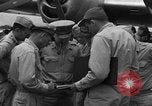
Major General Curtis LeMay holds a conference with his staff after a raid on Kobe in Saipan, Mariana Islands.
Review of air raids in Saipan, Mariana Islands during World War II. United States Army Air Forces Major General Curtis LeMay and General Thomas S. Power discuss the bombing mission on Kobe, Japan with other officers. Colonels Blanchard, Roberts, Warren and Muehleisen read maps and orders.
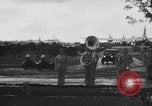
Gen. Henry H. Arnold arrives at headquarters and visits 314th Bombardment Wing at North Field in Guam, Mariana Islands.
U.S. Army General Henry H. Arnold visits 314th Bombardment Wing at North Field in Guam, Mariana Islands during World War II. Staff cars and military police escorts arrive at headquarters. A band plays in the foreground. U.S. Army Air Force Major Generals Curtis E. Lemay and Thomas S. Power greet General Henry H. Arnold. Generals and staff officers at attention as the band plays. The Generals leave the headquarters and walk to service apron where General Arnold speaks to 314th Wing personnel.
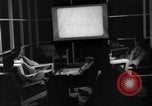
Major General Curtis E. LeMay and staff watch movies in Guam, Mariana Islands showing B-29 Superfortresses bombing Japan.
Major General Curtis E. LeMay and staff watch movies in Guam, Mariana Islands during World War II. U.S. Army Air Force ( USAAF ) Major General and Commander of 21st Bomber Command Curtis E. LeMay with staff watches movies. A screen in the background. LeMay and staff seated in chairs as they watch the movies. Major General Lemay smokes a cigarette as he talks a staff personnel. The screen shows USAAF B-29 Superfortresses taking off to bomb Japan. A pilot and a copilot in a cockpit. Bombings over a target. Explosions and smoke over targets. Staff personnel look at a map.
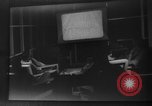
Curtis E. LeMay and staff watch movies in Guam, Mariana Islands which show B-29 Superfortresses taking off to bomb Japan.
Major General Curtis E. LeMay and staff watch movies in Guam, Mariana Islands during World War II U.S. Army Air Force ( USAAF ) Major General and Commander of 21st Bomber Command Curtis E. LeMay with staff watches movies. A screen in the background. LeMay smokes a cigarette as he talks to a staff personnel. The screen shows USAAF B-29 Superfortresses taking off to bomb Japan. A pilot and a copilot in a cockpit. They operate controls. Bombings over a target. Explosions and smoke over targets.
CRITICALPAST.COM: About Us | Contact Us | FAQs - How to Order | License Agreement | My Account | My Lightboxes | Shopping Cart | Advanced Search | Featured Collections | Website Terms & Conditions | Privacy Policy ©2026 CriticalPast LLC.
License Agreement |
Terms & Conditions |
Privacy Policy
©2026 CriticalPast LLC.