


 Francais
 Deutsch
 Italiano
Refine Your Search
-Cebu,-Philippines stock footage and images
- Showing 51145 to 51150 of 58885 results more
more Hide
Hide
Republcan Thomas E. Dewey and incumbent Democrat Franklin D. Roosevelt, compete in 1944 U.S. Presidential election during World War II
The 1944 U.S. Presidential election in 1944, during World War 2. Newspaper boy hawks newspaper extra edition, with headline referring to "Nip and Tuck" race. View of Times Square in Manhattan, New York City, at twilight, as lights begin to turn on. Wooden barricades seen set up in front of some establishments to protect against damage from large crowds anticipated as election returns come in. Moving illuminated marquee sign on the Times building reads: "Nearly 45 per cent of Bronx and Manhattan voters said to have cast ballots." Two men look up at the sign. Officials open a voting machine and begin to report information. At another location officials remove paper ballots from their precinct box. A radio announcer reviewing results and reporting them over the air. A woman is seen entering voter returns in chalk, on a national tote board. Citizens gathered to watch results. American soldier listening to results over a radio, in Italy and France. Newscasters reporting on radio as the returns come in. Many people listen to radios. An American family of man, woman, boy and girl children seated in their living room listening to vintage console radio reporting voting returns. A fire is burning in the living room fireplace beside the console radio. Another, different scene is shown with a family gathered around a radio listening to election reports. A framed photograph of a U.S. Army soldier is atop the console radio. Scene is shown of crowds surging in Times Square as returns displayed on Times Building marquee indicate likely victory for FDR (Franklin Roosevelt). Crowd in Times Square including many American military service members in uniform.
Animation depicts Private Snafu undergoing extremes in weather conditions in the Aleutian Islands, Northern Pacific Ocean.
Cartoon character Private Snafu undergoes extremes in weather conditions in the Aleutian Islands, Northern Pacific Ocean during World War II. Animation depicts thunder and rain. Solution about clothing under extreme conditions. Vegetation on islands. Gummy mud. Earthquakes and cold breeze. Transportation by vehicles on sledge. Aircraft in flight covered with snow. Airstrip submerged under water.
Tanks and troops of U.S. First Army enter Cologne, Germany,during World War II.
U.S. First Army troops advance in Cologne, Germany during World War II. View of Cologne Cathedral still standing. Sherman tanks tow away street cars used to block roads. M-26 Pershing tanks roll through streets of Cologne. City almost destroyed by bombing. U.S. Soldiers walk through streets and fire machine guns from behind piles of rubble. Heaps of debris on streets. A German car is struck by a collapsing building. U.S. troops shoot at German soldier walking across street. Sherman tank firing from a park square. Close range view of a German Panzer tank, filmed by combat cameraman Jim Bates, as it is is hit by fire from an US Army M-26 Pershing tank (gunner Corporal Clarence Smoyer) and the German crew jumps out. The tank goes up in flames. Wounded German soldier lying on ground. Two American officers shake hands, standing on an abandoned German Panther (Panzer) tank, in front of the Great Dome Cathedral, which was deliberately spared by U.S. bombers. Many German prisoners of war. Hohenzollern Bridge, destroyed by retreating German forces. A road sign reads: "Welcome to Koln, courtesy of the Spearhead Division." German residents stream back into the wrecked city. An older German civilian man sits on his luggage next to a damaged train track. Damaged street car on rubble-filled street. Views of the Cologne Cathedral, standing in the midst of destroyed city.
U.S. troops capture and defend the Ludendorff Bridge over the Rhine River in Remagen, Germany during World War II.
View of the Ludendorff bridge over the Rhine River, at Remagen, Germany. An American soldier crossing the bridge on a pedestrian walkway. Captured German prisoners. A jeep approaches the bridge to cross. U.S. antiaircraft guns fire at German planes attempting to bomb the bridge. German bombs seen splashing into the river near the bridge. U.S. army vehicles line street and cross the bridge. A sign posted on the bridge reads 'Cross the Rhine with dry feet courtesy 9th Armored Division'. U.S. Infantry men march across the bridge. U.S. forces arriving on the East bank, from the bridge. Large numbers of German prisoners march along a road, guarded by U.S. Army soldiers. Mountains in the background.
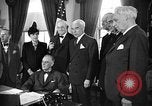
U.S. delegates meet with President Franklin Roosevelt before UN Security Conference; San Francisco city views (WW2)
United States delegates to the United Nations Security Conference meet with President Franklin Delano Roosevelt in Washington DC, United States. Seen are: Congressman Sol Bloom, of New York; Virginia Gildersleve, Dean of Barnard College; Senator Tom Connolly, of Texas; Edward Stettinius,Jr., Secretary of State,Commander Harold Stassen, USN, former Governor of Minnesota; In San Fransisco : Senator Arthur Hendrick Vandenberg, of Michigan; and Congressman Charles Eaton of New Jersey. View of Golden Gate Bridge and street scenes of San Francisco. Views of San Francisco hotels. The San Francisco Civic Center. Hotel buildings. Veterans War Memorial building. In Washington DC, U.S. delegation meets to form preliminary plan for their part in the organization of the World Security Council and International Court of Justice. Secretary of the State Edward Reilly Stettinius as Chairman of the U.S. delegation, speaks about their mission. (World War II period)
U.S. industrialist, Henry J. Kaiser appeals to Americans to donate used clothing for war victims throughout the world
American industrialist, Henry J. Kaiser appeals for donating clothing to war victims in China and Europe during World War II. Seated at desk in office, he addresses the nation and announces a drive, commencing April 1, 1944, to collect used clothing for war victims, all over the world. Scenes shows : War victims in food lines. Starving and wounded civilian victims of war. An American woman and a girl at home in America select clothing for donation. Mr. Kaiser shows a banner which reads "what can you spare that they can wear?"
CRITICALPAST.COM: About Us | Contact Us | FAQs - How to Order | License Agreement | My Account | My Lightboxes | Shopping Cart | Advanced Search | Featured Collections | Website Terms & Conditions | Privacy Policy ©2026 CriticalPast LLC.
License Agreement |
Terms & Conditions |
Privacy Policy
©2026 CriticalPast LLC.