


 Francais
 Deutsch
 Italiano
Refine Your Search
-Cebu,-Philippines stock footage and images
- Showing 529 to 534 of 58885 results more
more Hide
Hide
A tank retriever, DUKWs, Army trucks and bulldozers as Allied troops establish a beachhead at Normandy.
Allied troops establish a beachhead at Normandy. A tank retriever makes a left turn as a DUKW (amphibious craft) drives by. 6X6 Army truck driving up the beach. DUKWs and bulldozer on the beach. Crafts in the background. A Military Policeman (MP) in a trench coat holding a rifle. Soldiers march in the background. (World War II period).
German Prisoners of War seated on the sand in a small barbed-wire enclosure in Normandy (WW2)
Allied troops establish a beachhead at Normandy during World War II. German prisoners marching along as an Allied soldier watches. A Military Policeman (MP) walks along. German Prisoners of War (POW) seated on the sand in a small barbed-wire enclosure. Group of prisoners. Trucks on the beach in the background.
Troops and vehicles off load from Landing Crafts at the beachhead in Normandy.
Allied troops establish a beachhead at Normandy. Soldier on the beach waves a white flag in the air. A Landing Craft tank (LCT) beached in the background. LCT pulled up to beach, soldiers begin to offload. Two soldiers standing on the beach, LCT in the background. A bulldozer pulls a DUKW (amphibious craft) out of the water. LCT loaded with soldiers. DUKW comes up on the beach, LCI underway in the background. Landing Crafts Mechanized (LCM) and barrage balloon in the background. LCT up on the beach, off loads troops. A column of troops advances up over the beach, some carrying bazookas with packs on their backs. Troops off load from the LCT. They wade through the surf towards the beach. (World War II period).

Hydraulic, fuel and electrical system of a U.S. Navy T2V-1 SeaStar.
Aircraft system as well as normal and emergency operating procedures of the U.S. Navy T2V-1 SeaStar. A T2V-1 taxis on the airstrip. Hangars in the background. Wing span, fuselage length, height and gross weight of the plane. Diagrammatic representation of the plane's hydraulic system. The plane in flight as the landing gear opens up. Diagram of the plane's fuselage system. Total fuel load. The pilot turns on the tip tank fuel dump switch on the plane's control panel. Fuel dumped from the plane. Diagram of the plane's tanks. Diagrammatic representation of the plane's electrical system including the AC / DC systems. Diagram of the boundary layer control system.
Pre-flight procedures including exterior and cockpit inspection of the U.S. Navy T2V-1 SeaStar.
Pre-flight procedures of the U.S. Navy T2V-1 SeaStar. Exterior inspection: Two airmen approach the plane to conduct a normal walk around inspection which includes highly important and unique inspection points. The airmen manually retract and extend the leading edge wing flap to check for freedom of movement. They inspect the ram air orifices in the nose of each tip tank, speed brake, fuel dump outlet, boundary layer control orifice, position of snubber piston, main hydraulic reservoir, and upper left fuselage. Interior inspection: The pilot in the cockpit. He inspects the engine, aircraft performance, navigation and fuel controls. He checks the electrical, navigational, air conditioning and lighting controls on the right panel and console. Pre-start Cockpit Check: The pilot adjusts the tip tank switches, oxygen supply valve, main fuel shut off switch, battery generator switch, flight instrument power switch, cabin pressure and temperature switches.
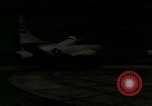
Normal operating procedures including start, take off, stall and landing of the U.S. Navy T2V-1 SeaStar.
Normal operating procedures including start, take off, stall and landing of the U.S. Navy T2V-1 SeaStar. Start: The plane on the runway. A crewman arrives with the air impingement car. He inserts the pipe into the air impingement inlet. The crewman gives a signal when the air impingement hole is secure. The pilot adjusts the battery operator switch and turns on the ignition. He moves the throttle to ignite and then to idle position. The exhaust gas temperature gauge. The pilot signals the crewman to disconnect the air impingement starter and adjusts the instrument power switch. Post-start Cockpit Check: The pilot checks the RMI for alignment, adjusts S2 compass controller, annunciator panel touch button, fire detector test switch, fuel quantity indicator button. He checks the communication, navigational, annunciator and left panel. He goes through the take off check list, moves the plane into position, advances throttle, inspects the tachometer, exhaust temperature, releases brake and taxis to the end of the runway. The plane taxis, pilot applies brake and rudder control and takes off. He raises the nose wheel, retracts the landing gear and flaps after take off. The plane in flight over clouds. Stall occurs. The attack angle gauge. Landing procedure: View of the runway. The pilot begins the let down, reduces power, extends the brake, lowers landing gear and flaps, and continues to reduce speed. Diagram of the runway depicting approach. The plane approaches the runway, touches down and lands.
CRITICALPAST.COM: About Us | Contact Us | FAQs - How to Order | License Agreement | My Account | My Lightboxes | Shopping Cart | Advanced Search | Featured Collections | Website Terms & Conditions | Privacy Policy ©2026 CriticalPast LLC.
License Agreement |
Terms & Conditions |
Privacy Policy
©2026 CriticalPast LLC.