


 Francais
 Deutsch
 Italiano
Refine Your Search
-Cebu,-Philippines stock footage and images
- Showing 5389 to 5394 of 58885 results more
more Hide
Hide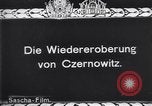
Reconquest of Czernowitz, Capital of Bukowina (Bukovina or Buchenland), by Austro-Hungarian forces during World War I.
Emperor (Kaiser) Karl I is enthusiastically greeted by the liberated population of Czernowitz, Capital of Bukowina (Bukovina or Buchenland) following the reconquest of the city by Austro-Hungarian forces during World War I. His car drives down the cobblestone main street, and citizens heap it with bouquets and throw flowers. The Kaiser stands and salutes the crowd. The Kaiser acknowledges the speech of the Burgomeister and receives more flowers from little girls. Then the Kaiser returns to his car and drives away to the continuing cheers of the crowd.
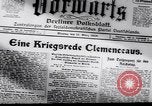
View from Berlin Germany, of events leading up to, and subsequent to, the Armistice in World War I.
Succession of Berlin, Germany, newspapers shown, from 1918 through 1919, chronicling progress of war towards the World War 1 Armistice, and subsequent problems and conditions in postwar Germany. Newspaper of November 12, 1918 addresses concerns about the conditions and the price of the truce. Crowd stands on a road covered with snow around statue of the Kaiser, with scaffold around it. Crowd in a square in War Bond rally. One of crowd carries a Communist red flag. Newspaper refers to gunfire in Berlin from Unter den Linden to Friedrichstrasse. Newspaper announces the Kaiser's abdication, which is then illustrated by reversed footage showing the Kaiser walking backwards and being lifted into his automobile, which then drives away backwards. Returning German soldiers are happy to see the war end, and sing in their returning trucks. An officer inspects war trenches that are now empty. Newspaper announce increasing domestic problems . Newspapers raise issue of German prisoners of War held in foreign countries. Troops are seen moving in streets and at checkpoints in Germany.
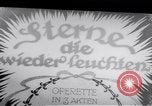
Post War unrest in Germany following World War I. Martial law is declared. Artillery and soldiers in Berlin, Germany.
Clip opens with scene from a play in Berlin entitled: The Star Shines Again. German officer stands on a stage and gives speech. Following street scenes and newspaper headlines illustrate the increasingly desperate conditions developing in postwar Germany following World War 1, culminating in declaration of martial law by the Ministry of Defense. Scenes of civil unrest and use of martial force to control the population during the German Revolution of 1918-1919. German soldiers and artillery in the streets work to control unrest of German citizens. Massive crowd of German citizens running and dispersing in panic on streets of Berlin. Newspaper headlines describe the unrest.
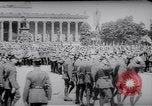
Germans celebrate formation of the Weimar Republic and their new President, Friedrich Ebert.
Germans celebrate formation of the Weimar Republic after World War 1. Soldiers parade as spectators watch. Their new President, Friedrich Ebert, is escorted by a Berlin Police officer, and followed by two statesmen, as he prepares to address the crowd at the Lustgarten. They walk past the Berlin Cathedral, where a woman speaker stands, slightly above the crowd, next to a large effigy of a woman. The President and statesmen tip their hats as they are saluted by a military officer. Army troops are assembled in formation. Cavalry on horseback parade, as spectators watch from the park. Scene shifts to President Ebert delivering remarks to assembled soldiers and spectators.
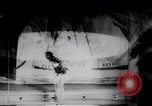
Scenes of the "Roaring 20s" or the "Jazz Age""
"The Roaring 20s" or "the Jazz Age" with most scenes being from Berlin Germany (but this is not obvious in some of the shots, which could be in the USA or elsewhere). Couples dance the "Charleston" at night club in Berlin, Germany. Views of jazz bands playing. African American man dancing with Thompson's Band. Newspapers chronicle the political events of the era, including Hitler's struggle for political power.
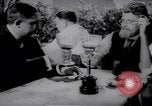
Film shows contrast between the prewar and postwar times in Germany, before and after the First World War
Two German men at a cafe reminisce about former times. Views of those prewar days (before World War I) in Germany. German Workers pack goods at a factory. Elevated view of German people walking at platforms of a busy railway station and people sit in train. Woman stands and approaches lake beach water, she removes her robe to swim; children play and swim at a beach. Many families cooking on portable stoves near the beach shore. Two women cook and taste food. Boy eats food and view of his family enjoying a meal together. People sit on a wagon. Brief return to restaurant scene with the two men. Then scene of female performer as she blindfolds a male trapeze artists who then performs in a German circus, leaping from a platform in a trapeze act, releasing from the trapeze while blindfolded, and successfully catching the hands of another trapeze artist. Scene switches to postwar era (after World War 1), where the emphasis is on Girls! Numerous scenes of various female dancer groups performing on stage, with high kicks and precision dancing in Follies-type productions. In next scene, outdoors, German soldiers are seen on parade through the Brandenburg Gate. Numerous outdoor scenes of Germans enjoying themselves in Berlin. Many Berlin landmarks and statues shown in the time before World War 2. Scenes include: the Berlin Cathedral; The Poseidon Statue next to Alexander Platz; Brandenburg Gate; Unter den Linden; Lustgarten; a tour bus flying an American flag; and the winged Berlin Victory column rising up, as seen from a moving vehicle.
CRITICALPAST.COM: About Us | Contact Us | FAQs - How to Order | License Agreement | My Account | My Lightboxes | Shopping Cart | Advanced Search | Featured Collections | Website Terms & Conditions | Privacy Policy ©2026 CriticalPast LLC.
License Agreement |
Terms & Conditions |
Privacy Policy
©2026 CriticalPast LLC.