


 Francais
 Deutsch
 Italiano
Refine Your Search
-Cebu,-Philippines stock footage and images
- Showing 56323 to 56328 of 58885 results more
more Hide
Hide
Robert H. Goddard tests rockets in Roswell, New Mexico
American scientist Robert H. Goddard tests a rocket in Roswell, New Mexico during the 1930s. Title card “United States Marine Corps”. Program host, Dennis James, introduces. Early rocket launchpad built in 1927 by American scientist Robert H. Goddard. Robert H. Goddard and his assistants unload a rocket at their test site located in Roswell, New Mexico. Robert H. Goddard demonstrates an early gyroscope used for automatic stabilization. Assistants securing the rocket into the launchpad. Robert H. Goddard and his assistants watch the rocket from the observation shed during ignition. Distant view of rocket as it shoots straight up to 7500 feet in the 1930s. Robert H. Goddard and his assistants examine rocket and parachute after landing.

Field awards are given to Fifth Armored Division soldiers in Hoensbroek, Netherlands during World War 2
A two star general, probably Lunsford Errett Oliver, gives field awards to soldiers of the US Fifth Armored Division in Hoensbroek, Netherlands (Holland.) Soldiers lined up for field awards. General salutes soldiers in front and pins medals on them. Assembled soldiers receive brief instructions and then disband.

Protestors disrupt traffic and rally at Justice Department building several days after May Day anti-war rally
Protestors in Washington DC on May 5, 1970, following several days of "MayDay" anti-war protests, against the Vietnam War, organized in part by the National Peace Action Coalition. Wide shot of Washington Monument with helicopters flying near it. Protestors walking into streets in small groups and attempting to block traffic and disrupt traffic and operations in the city as part of a multi day May Day protest. View of police officers blowing whistles and attempting to clear protestors from streets, as cars drive around protestors. Protestors drag a trash can into a street as an obstruction. Police on motorcycles drive by, one passing a Volkswagen bus van. Police directing traffic. A group of hippies and protestors gathered in a median between roads. One protestor is smoking. Another shows a peace sign with his hand. A police officer stands by guarding the seated group. Police in riot gear stand in front of the Justice Department awaiting a noon rally of antiwar protestors. Several thousand protestors show up, exceeding the numbers expected by police. The protestors sing, dance, chant, and clap hands as they fill the road in front of the Justice Department. Police use bull horns warning crowd to disperse or be arrested. Many protestors remain and are shown being arrested and carried away, some without resistance, and others resisting arrest.A hippie protestor being arrested holds up both hands showing peace signs.
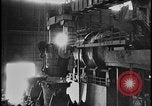
Interior and operations at Ford Rouge River steel plant in Dearborn Michigan
Film opens showing interior of the Ford Rouge River steel plant, with large crucible being lifted vertically on an overhead conveyor system from where it is tilted and emptied. Next, another container of molten steel is seen being emptied, raising a huge amount of fire and sparks, which soon disappear. Closeup of an overhead crane moving, connecting to stubs on the ladle, and carrying it toward the camera. Change of scene shows a ladle of steel being poured into what appears to be an ingot mold. An empty crucible moves by conveyor, is refilled again, and moves away to deliver molten steel.

Operations of rolling mills inside the Ford Rouge River steel plant in Dearborn, Michigan
In opening scene, a special train carries hot ingots from the Ford Rouge River steel plant. Then,scene shifts to inside the plant, where hot glowing ingots of steel are being raised from a storage area and carrried by overhead crane to a rolling mill. Closeups of the ingot passing through rolllers and descending along a gravity conveyer to another set of water-cooled rollers for further shaping.
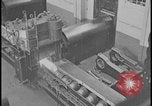
Steel ingots being processed in the rolling mill at Ford Rouge River steel mill in Dearborn Michigan
Film begins with views from a camera in an overhead conveyor at the Ford Rouge River steel mill in Dearborn, Michigan. It focuses on a hot ingot of steel moving through a succession of nine consecutive rollers. Each roller reduces the size of the ingot, until it becomes a long rod of hot steel, many yards long. It is then transferred horizontally, across an array of rails. Change of scene shows another ingot, in a different part of the plant, moving through a set of rollers along the side of factory shop. Next, a hot ingot is seen discharged from a chute. Camera follows as it passes through a series of water-cooled rollers. Long rods of hot steel are then seen being channeled to a converging point on a conveyor, where they flip sideways and reverse course. A new view shows men using poles to guide ribbons of hot steel in and out of rollers. Change of scene shows long ribbons of hot steel being automatically moved along conveyors into large saws that cut them into desired lengths. The ribbons of steel are then moved sideways to an extremely long and wide sort of table, where they are transferred, by devices that keep them aligned and prevent them from breaking or damage during movement.
CRITICALPAST.COM: About Us | Contact Us | FAQs - How to Order | License Agreement | My Account | My Lightboxes | Shopping Cart | Advanced Search | Featured Collections | Website Terms & Conditions | Privacy Policy ©2026 CriticalPast LLC.
License Agreement |
Terms & Conditions |
Privacy Policy
©2026 CriticalPast LLC.