


 Francais
 Deutsch
 Italiano
Refine Your Search
-Cebu,-Philippines stock footage and images
- Showing 57283 to 57288 of 58885 results more
more Hide
Hide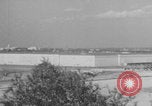
Major General Lucius D. Clay speaks of importance of scrap metal for war production (WW2)
Exterior view of the Pentagon building in Washington DC. Entrance facade of The Pentagon. Inside the Pentagon, sign says “Director of Materiel Army Service Forces Major General Lucius D. Clay”. Major General Lucius D. Clay, Director of Materiel speaks about the importance of steel in the production of US war materiel for World War 2. A secretary writes down his speech. “However our contribution to the collection of scrap can in no way meet the demand. We must depend on our home front, to exert its best effort, to collect the huge tonnage of scrap. The steel industry must have the scrap if our arms services are to obtain the high quality of steel needed for invasion. The collection of steel scrap is a vital part of our war supply program” Major General Lucius D. Clay says as he concludes his speech.
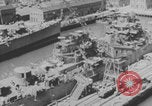
Naval guns and torpedoes manufactured, USS Wisconsin launched (WW2)
Steel used for ship building and war materiel manufacture in the United States during World War 2. Shipbuilding at a dock. Sign says “U.S. Naval Advance Base Depot”. A steam locomotive pulls a 16 inch naval gun from a war production factory. Men move newly made Navy torpedo via overhead conveyor. Men building torpedoes in a factory. A huge engine is being lifted by an overhead crane. War production workers on factory floor building items for U.S. Navy. A United States Naval officer speaks with a factory executive. Narrator mentions importance of scrap metal for use in ship building. The launching of the Iowa-class battleship, USS Wisconsin (BB-64), in the Philadelphia Navy Yard on December 7, 1943. Assisted by Rear Admiral Melo F. Draemel, Mrs. Margaret Roche-Goodland, wife of Wisconsin Governor Walter S. Goodland, successfully breaks a bottle of champagne over the ship's bow. The USS Wisconsin starts down the dry dock during launch.
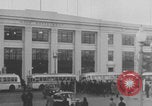
Rear Admiral Edward L. Cochrane speaks about United States Navy shipbuilding steel needs during WW2.
View of the Navy Department building, also known as the Main Navy and Munition Buildings (now demolished and turned into Constitution Gardens. Constitution Ave. NW, Washington, DC 20024, United States). Sign says “Bureau of Ships”. Rear Admiral Edward L. Cochrane speaks about the United States Navy’s shipbuilding and maintenance program during World War 2 and great needs for steel. To underscore his point, he notes that, "A single salvo of the main battery guns of such a ship as the South Dakota, for example, will take 10 tons of finished steel." He goes on to say, “Our job in the Navy until the war is over is using steel to build and to fight. We must continue to rely on the Homefront efforts to collect the big tonnage of heavy industrial scrap which is needed to make a fine quality steel in huge quantities which we need in the Navy” concludes Rear Admiral Edward L. Cochrane.
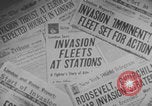
United States and British military officials convene for a high-level meeting (WW2)
Front pages of various American newspapers such as the New York World Telegram and Journal American reporting World War 2 related news with headlines such as “INVASION FLEETS AT STATIONS”, “INVASION “IMMINENT”! FLEET SET FOR ACTION” “ROOSEVELT, CHURCHILL MAP INVASION STRATEGY”, and “INVASION THRUST AT EUROPE EXPECTED HOURLY IN LONDON”. United States and United Kingdom senior military officers gather for a meeting. Two officials read a report together.
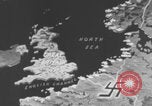
Germans building fortifications in the Maginot and Siegfried lines (WW2)
German fortifications in the Maginot and Siegfried Lines in World War 2. Illustrated map of Western Europe depicting Great Britain, Netherlands, Ireland, Scandinavia, Belgium and Germany during World War 2. The Swastika symbol is shown on the German-occupied side. German soldiers and slave labor workers digging ditches for fortifications along Atlantic Wall. Shadows of men digging ditches. Men building tank barriers and roadblocks. A man twists a wire in place. Men constructing a bunker. German troops marching on the beach under watch by soldiers with guns. German troops enter a bunker. German soldiers ducking to go through a fortification bunker door one by one. Nazi German soldiers push a field gun to a camouflaged underground bunker. German soldier puts down his telephone. A howitzer in a German fortification facing the coast. Gun turrets moving up. German soldiers with a Karl-Gerät siege mortar called “Thor” during the Battle of Sevastopol. Nazi German railgun “Schwerer Gustav” during the Battle of Sevastopol. German soldiers load a 7.1 ton shell to the “Schwerer Gustav” railgun. A German officer uses a telescope. Dragon’s teeth tank obstacles in the Siegfred Line fortification in Western Germany. Barbed wire fences in a battlefield.
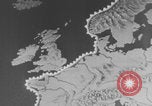
Allied forces load vehicles and materiel for the Allied invasion of Sicily (WW2)
Map of Western Europe showing possible landing spots of the Allied forces from London. Allied invasion of Sicily during World War 2. Military armored vehicles and artillery are boarding on ships (LSTs) heading for Sicily. Barrage balloons over ships. Tanks and more vehicles are loaded to ships. A tank board a ship. Allied soldiers boarding for ships heading to Sicily. A ship departs. Trucks on deck. Allied ships in heavy seas. Gun turrets on battleship. Destroyer USS Ralph Talbot (DD-390) in heavy seas. A United States military official points on a map to sailors. A radioman speaks through a microphone. Naval artillery fire. Explosion from naval artillery seen hitting land. A huge explosion on land.
CRITICALPAST.COM: About Us | Contact Us | FAQs - How to Order | License Agreement | My Account | My Lightboxes | Shopping Cart | Advanced Search | Featured Collections | Website Terms & Conditions | Privacy Policy ©2026 CriticalPast LLC.
License Agreement |
Terms & Conditions |
Privacy Policy
©2026 CriticalPast LLC.