


 Francais
 Deutsch
 Italiano
Refine Your Search
-Cebu,-Philippines stock footage and images
- Showing 57823 to 57828 of 58885 results more
more Hide
Hide
Golden Gloves amateur boxing competition
The annual Golden Gloves amateur boxing competition in Sunnyside Gardens, Queens, New York. Spectators watch a boxing match. Enthusiastic amateur boxers compete in boxing match before a wildly enthusiastic crowd. A boxer is cornered by his opponent. An elderly spectator watches the match with excitement. The referee stands near the two boxers during the fight. A boxer knocks out his opponent. An amateur African American boxer competes against a colored opponent. African American boxer falls on the side of the ring. Young White men watch a boxing match. Boxing match ends with a TKO knock-out.

Bomber planes dropping bombs over cities during WW2
Damage from aerial bombing during World War II. A city on fire, probably London, after being dropped with incendiary bombs. Smoke come out from a burning building. Skeletons of buildings damaged and surrounding areas showing the aftermath of a serious aerial bombing. Smoke emanates from rubble of a bombed church. A group of bombers dropping bombs in flight. Bombing of a village or forest. A house with gaping hole from bombing. The United States flag is laid on the roof of bombed house. A group of Boeing B-17 Flying Fortress bombers turn on the tarmac. Three Boeing B-17 Flying Fortress bombers dropping bombs in flight.

Animation shows types of bombs used during WW2
Types of bombs used during World War 2. Animation enumerates the chemical type bombs- namely the gas, smoke, and incendiary bombs. Fragmentation and demolition bombs are the classification of explosive bombs. Cross-section anatomy of a fragmentation bomb. Animation demonstrates a fragmentation bomb falling and exploding on impact. Close view of actual 20 lb. M41 fragmentation bomb and a 23 lb. M40 bomb.
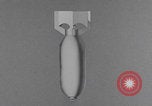
Animation depicts bombs used by the United States Army during WWII
Types of explosive bombs used during World War II. Animation of an “explosive bomb” depicting its anatomy and mechanism. High explosives are seen inside the bomb. Animation shows a bomb falling and exploding on impact, creating a crater. A cartoon showing the five sizes of demolition bombs compared to a soldier. The largest demolition bombs weigh around 1000 lbs. and 2000 lbs. The smaller demolition bombs weigh 500 lbs., 300 lbs., and 100 lbs. A 100 lbs. demolition bomb packed in an angle iron crate.

Ordinance Department personnel fits tail on bomb during WWII
Personnel from the Ordinance Department handling and packing bombs during World War 2. An Ordinance Department personnel fits the tail into a 100 lbs. explosive bomb. Nose plug of a bomb. Animation depicting fragmentation, demolition, chemical (except phosphorus) and chemical phosphorus bombs. A hand points to the table of contents of the Ordinance Department Training Regulation. Pen underlines “Quantity-distance tables”. A scene depicting the ideal distances between military establishments, inhabited buildings, railways, public highways and fuzing area for bombs.
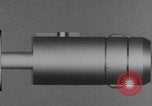
Animation depicts bomb fuse safety, internals of bomb used during World War II
Animation depicting the safety of bomb fuses used during World War 2. An artistic rendition of a bomb’s fuse. Animation depicts the inner parts of the fuse- the pin, striker, arming pin, arming spring, and arming wire. Animation shows the arming wire withdrawn, causing the arming spring to fall and ejects the arming pin. Sheer wire inside fuse is resistant to air pressure but light enough to break upon impact. Pin breaking through the sheer wire upon impact, detonating the fuse.
CRITICALPAST.COM: About Us | Contact Us | FAQs - How to Order | License Agreement | My Account | My Lightboxes | Shopping Cart | Advanced Search | Featured Collections | Website Terms & Conditions | Privacy Policy ©2026 CriticalPast LLC.
License Agreement |
Terms & Conditions |
Privacy Policy
©2026 CriticalPast LLC.