


 Francais
 Deutsch
 Italiano
Refine Your Search
-Cebu,-Philippines stock footage and images
- Showing 57919 to 57924 of 58885 results more
more Hide
Hide
Men transport and load incendiary bombs, chemical officer reads a bomb chart in Europe (WWII)
World War II (WW2) Chemical Warfare Service logo and words, "Incendiaries over the Axis." An M76 incendiary bomb explosion. The United States officers in meeting room in front of wall map of Europe. A man puts a pin into “Berlin” on the map. A pillar of smoke rises from a bombed Nazi German war plant. Allied trucks carry chemical bombs on the road to a chemical park. A man carries a bomb, stacking it on a neat pile of incendiary bombs. Men unload wooden crates with incendiary bombs. Bomb warning reads “Do not assemble fuze to cluster until loaded into airplane”. The chemical officer at the headquarters of the United States Strategic Air Forces in Europe signs a document from his desk before handing it over. The chemical officer reads a chart showing the increased use of incendiary bombs by Allied forces from January to March 1944.
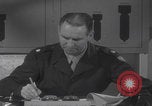
Incendiary bombs moved from United States to England during WW2.
Chemical Warfare Service (CWS) handles the distribution of incendiary bombs in Europe during World War II. Lieutenant Colonel R. N. Isbell of the Chemical Warfare Service (CWS) makes calculations from his desk. An incendiary order addressed to the Commanding General is typed on a typewriter. Buses arrive at the motor pool of the United States War Department, now known as the Pentagon. Women disembark from the buses and head to the War Department. Employees working in the office inside the War Department. Men prepare bombs at an arsenal. Men hauling carts with large incendiary bombs in warehouse. A man stencils labels onto bomb that read, "PT-1 Incendiary," and "Bomb Burster." The United States flag waving on a ship. Ships carry a shipment of incendiary bombs to the United Kingdom. Incendiary bombs inside wooden crates are unloaded from ships. Steam locomotive train running on track as railroad signal activates. Incendiary bombs are removed from train cars. Two munitions are suspended on a crane. Trucks loaded with bombs drive out of the depot, passing past village cemetery. An Air Division Chemical Officer receives new shipment information. The Air Division Chemical Officer reads the document and updates bomb listings on chalkboard.
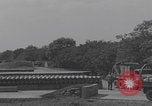
Men unload large incendiary bombs, arming sky markers before storage in bomb dumps (WWII)
Incendiary bomb storage in Allied bomb dumps during World War II. Incendiary bombs are neatly stacked in a bomb dump. A truck backing on the right of the pile. Men unload wooden crates and large incendiary bombs from trucks. Man unloads crates containing 100-pound M47A2 bombs. Men unpack bomb from its wooden protective crate. 500-pound PT-1 Pyrogel-filled AN-M76 bomb is rolled off from the truck. The AN-M76 is also called "Blockburner" or "Goop". Technicians remove the shipping bands off the AN-M76. Truck crane carries an AN-M76 bomb. Stacks of AN-M76 bombs are stacked in the bomb dump. Men carefully place the bomb in the stack. Men flip the crate containing an M17 Aimable Cluster bomb. Men unpacking the M17 500lb Aimable Incendiary Cluster Bomb. Technicians remove the tape and cuts the wires securing the incendiary bomb. A man removes the protective frame of a bomb. The men roll an M17 Aimable Cluster bomb to a stack. Two men stand in front of a shed with a door sign “Bursters”. Man opens a crate, inspects bursters. A Chemical Warfare officer shows a sky marker (made from a converted M47 bomb casing filled with FM smoke producing solution) while other soldiers look on. The Chemical Warfare officer demonstrates the method of arming the sky marker with a modified US 101 fuse. A sky marker is sealed with a rubber washer and a plastic disc. A threaded aluminum fuse adapter and another fuze are inserted. A flange is bolted down. Men marking sky markers prior to storage in bomb dumps. Wooden sign reads “DANGER ACID”.
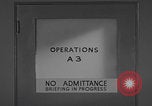
United States Eighth Air Force command headquarters WW2.
United States Eighth Air Force officials deliberate and issue field orders to drop bombs during World War II. Writing on the frosted glass door reads “Operations A3”. A sign in door reads “No Admittance Briefing in Progress”. Daily operations conference headquarters of the Eighth Air Force. The commanding general shares his plan of action. Map of the United Kingdom and Ireland is seen behind the general. The assistant of the commanding general uses a long stick to point to a wall map. Eighth Air Force officials review a map on the desk. An official shows the commanding general a place on the map. The general makes a decision. An officer from the general’s officer makes a call. Men and women using teletype to write field orders and messages. Operational staff of air division headquarters discuss important details regarding the new field order. Operational staff member points to a large wall map. Other officers listen during a meeting. The chemical officer puts down his phone after a call.

V2 rocket launches and officers meet at Wright-Patterson Air Force Base buildings.
Slate reads “Secret”. A V-2 rocket launches from launch pad. A nighttime V-2 guided missile launching. Aerial view of the Wright-Patterson Air Force Base near Dayton, Ohio. View of the main entrance of the Air Materiel Command building of the Wright-Patterson Air Force Base. Cars are parked near the building. Various buildings of the engineering division inside the Wright-Patterson Air Force Base. Three men enter the administration building of the Aero Med Lab, an engineering division laboratory. View of the Supply and test building. Officers (USAF) & civilians at meeting in above building. United States Army Air Force officers during a meeting. An officer points out item on chart of air-to-air missile.
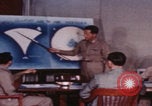
Artist’s concept of air-to-air missile in development by the United States Army Air Force
United States Air Force officers during a meeting. An officer points to air-to-air missile on chart. An artist depiction of the supersonic United States Air Force Republic Hughes MX-904 Falcon air-to-air missile. Officers and civilians discuss during a meeting.
CRITICALPAST.COM: About Us | Contact Us | FAQs - How to Order | License Agreement | My Account | My Lightboxes | Shopping Cart | Advanced Search | Featured Collections | Website Terms & Conditions | Privacy Policy ©2026 CriticalPast LLC.
License Agreement |
Terms & Conditions |
Privacy Policy
©2026 CriticalPast LLC.