


 Francais
 Deutsch
 Italiano
Refine Your Search
-Cebu,-Philippines stock footage and images
- Showing 58219 to 58224 of 58885 results more
more Hide
Hide
Congolese tribal performers dancing during a celebration of the Republic of Congo independence
A celebration of the Republic of Congo independence following riots during the Congo Crisis. Crowds gather in the Stade Roi Baudouin (The King Baudouin stadium) in Léopoldville, Congo (present day Kinshasa, Congo). Prime Minister Patrice Lumumba of the Republic of the Congo arrives in the stadium via limousine with another official. Congolese dancers in tribal attire perform traditional dances. Congo leaders arrive at the arena and take their places in stands. A performer wearing a grass skirt hangs and rocks from a rotating wooden prop. Congolese woman carries a baby on her back as she performs a group dance. A Congolese tribal boy wearing face paint beating drums. Prime Minister Lumumba listens to a politician speaking to him. Congolese dancers performing as a musician beats his drum. Congolese women wearing face paint dancing.
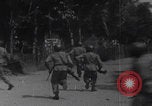
Congolese soldiers brutally arrest civilians in village during the Congo Crisis
Republic of Congo soldiers arrest civilians in a village during the Congo Crisis. Congolese soldiers chase after dissenters in a village. Soldiers brutally striking a man. An angry woman shouting and pointing to a someone outside her house. A soldier attacks another man with rifle butt during arrest. Troops hitting civilians with rifle butts. A man carries an injured boy as soldiers escort them to a military truck. Prisoners climb up a military truck. Soldiers make prisoners sit on the ground.

Tribal war zone in Congo; Soldiers arrest men from makeshift hospital in Congo
A tribal war zone in Congo. Crowds of Africans in traditional costumes gather on the foothills of a mountain in Central Africa. Congolese troops with weapons practice charging forward on a road. African soldiers let women carrying jars and sacks on their heads pass by roadblock. Soldiers inspect motorists at a checkpoint. Patients sit in front of beds inside a hospital in Congo. An injured prisoner with head bandage. Another patient sits down while others are seen lying in beds. A white officer, probably Belgium, talks to a handcuffed patient. A lock is seen on patient’s wrist. A handcuffed African prisoner stands behind the general. Torn clothing or fabric scattered on the floor. Congolese soldiers take away handcuffed wounded prisoners from the makeshift hospital.
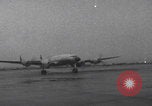
President Kwame Nkrumah of Ghana meets President Kennedy during to the United States
Ghanaian President Kwame Nkrumah arrives at Washington National Airport for an official visit with U.S. President John F. Kennedy. President Kwame Nkrumah climbs down air stair from Military Air Transport Lockheed Constellation as an attendant holds an umbrella behind him. President Kennedy talks with the Ghanaian president at bottom of stairs while Clement Conger (wearing glasses), assistant chief of protocol, stands over his shoulder. At frame left, in dark hat, Chief of Protocol Angier Biddle Duke listens in. Photographers taking pictures of Kennedy and Kwame Nkrumah while the two leaders walk to the hangar of the airport. United States military and government officials meet Presidents Kennedy and Kwame Nkrumah inside hanger.
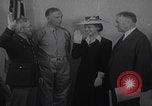
Oveta Culp Hobby is sworn in as Director of the United States Women’s Army Auxiliary Corps (WW2)
Oveta Culp Hobby is sworn into the Army with the rank of Director of the United States Women’s Army Auxiliary Corps during World War II. The organization would later be called the Women's Army Corps (WAC). Major General Myron C. Kramer administers oath of office to Oveta Culp Hobby. General George C. Marshall stands between Kramer and Hobby as he witnesses the ceremony. United States Secretary of War Henry Stimson also witnesses the event. Hobby stands with her arm raised under oath. Hobby shakes hands with Stimson, Marshall, and Kramer after the oath taking. Oveta Culp Hobby makes short statement, noting that, "This new corps is the 1942 expression of the patriotism and courage that the women of America have always demonstrated in every national crisis." Hobby continues, “In a total war, there is a total responsibility of all citizens regardless of sex, race, or creed. Every woman must do her part. The Women’s Army Auxiliary Corps offers an opportunity for every woman eligible under the law to do her part.”
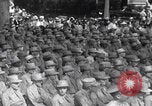
Director Oveta Culp Hobby speaks to first batch of graduating WAAC officers in Fort Des Moines (WW2)
United States Women’s Army Auxiliary Corps Director Oveta Culp Hobby speaking to first WAAC officers to graduate from Officers Candidate School in Fort Des Moines, Iowa during World War II. The Women’s Army Auxiliary Corps salute before taking their seats. Audience clapping before Director Hobby congratulates the graduates of the six-week WAAC program. “In the days and years to come, this saga will become of increasing strength to the nation. Shortly you will go on active duty, your graduation today is, in a real sense, a commencement of service” Hobby continued. “I can assure you, that you will be serving the purpose you had in mind when you volunteered as officer candidates for the Women’s Army Auxiliary Corps. I can assure you that it is a path of duty and devotion. You will serve as incorruptible witnesses for freedom. You have formed the soul of this corp. We will flourish and inspire and guide those who will follow you” Hobby concludes her speech before introducing Representative Congresswoman Edith Nourse Rogers to the graduates.
CRITICALPAST.COM: About Us | Contact Us | FAQs - How to Order | License Agreement | My Account | My Lightboxes | Shopping Cart | Advanced Search | Featured Collections | Website Terms & Conditions | Privacy Policy ©2026 CriticalPast LLC.
License Agreement |
Terms & Conditions |
Privacy Policy
©2026 CriticalPast LLC.