


 Francais
 Deutsch
 Italiano
Refine Your Search
-Cebu,-Philippines stock footage and images
- Showing 58591 to 58596 of 58885 results more
more Hide
Hide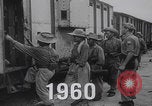
United States Army advisors train South Vietnamese, combat and capture Vietcong before Vietnam War.
South Vietnamese soldiers board an armored rail car in a train in 1960 before the Vietnam War. Close view of steam locomotive wheels and piston as it starts up. A silhouette of a soldier with gun on board a train with tracks in the foreground. An explosion on train tracks ahead. A gun firing from a gun turret. A machine gun firing from a slit. Soldiers running up a hill and field. They shoot with guns in the smoke-covered battlefield. Explosion in the field. South Vietnamese soldiers evacuate wounded and carry equipment out of battle. United States officials disembark from United States aircraft. A United States official, possibly retired General Maxwell Taylor, is interviewed by the media. United States and South Vietnamese soldiers inspect a cutaway of an airplane engine and propeller during training. A United States Air Force instructor shows an aircraft model to South Vietnamese pilots. United States and South Vietnamese pilots shake hands. South Vietnamese pilot sits in fighter plane cockpit. The cockpit canopy closes. A United States Army specialist speaks to South Vietnamese soldiers in Vietnamese during weapons training. United States military adviser talks to some soldiers, pointing to a map. Soldiers carrying ammo boxes and weapons, and wearing foliage for camouflage. An African American soldier holding a 60mm M2 mortar. Soldiers shoot guns, including M1919 Browning machine gun, as Vietcong soldiers run away. Camouflaged U.S. and South Vietnamese soldiers running towards jungle. A U.S. soldier points as a young Vietcong soldier emerges from brush. Captured Vietcong prisoners sit on the ground and are led away. United States medical specialists treat Vietnamese civilians in village. An army doctor uses a stethoscope on a woman’s chest.
Vietnamese soldiers jump out of helicopters and fire at enemy positions (Vietnam War)
United States helicopters on airfield during the Vietnam War. United States Army advisors talk to one another. They share maps, papers and discuss plans. U.S. and South Vietnamese soldiers board United States helicopters...including a CH-21C Shawnee. A Sikorsky UH-34D Seahorse takes off from airfield. South Vietnamese soldiers onboard helicopter holding rifle and machine gun. A group of helicopters in flight. Point of view from helicopter as it flies down a river. Piasecki H-21 helicopter in flight. A South Vietnamese soldier looks out of window. South Vietnamese soldiers jump out of helicopters and cross rice field after landing. Aerial view showing some soldiers using a field telephone in the middle of a dense jungle. Two United States soldiers shout at each other. An injured U.S. soldier lies on a stretcher and loaded on helicopter. A South Vietnamese soldier in helicopter. The helicopter flies away. A South Vietnamese Navy captain shows his United States counterpart enemy positions after looking through binoculars. Swift boats shooting at Vietcong forces. South Vietnamese soldiers carrying weapons and landing on beachhead. A South Vietnamese soldier gives signal to fire. An explosion on beachhead. South Vietnamese soldiers load shells into mortar and fires them. An injured South Vietnamese soldier with saline tube attached to him lying on a stretcher. The injured soldier cries in pain. Vietnamese women watch medics clean another soldier. A Vietnamese soldier prays for the dead, incense burns in front of him.
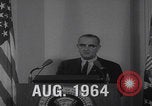
President Johnson addresses the public on United States actions against North Vietnam
During the Vietnam War, President Lyndon B. Johnson addresses the United States public during the “Radio and Television Report to the American People Following Renewed Aggression in the Gulf of Tonkin” from the Fish Room at the White House in August 4, 1964. "Renewed hostile actions against United States ships on the high seas in the Gulf of Tonkin have today required me to order the military forces of the United States to take action in reply,” says President Johnson. The USS Constellation (CV-64) aircraft carrier sailing. Pilots walk away from Douglas EKA-3B Skywarrior fighter jets in the USS Constellation. Aircrafts fire missiles, destroying facilities in North Vietnam. United States Secretary of Defense Robert McNamara addresses the public to explain the direct attack against North Vietnam. “We wish to emphasize we seek no wider war. Our response will depend upon the action of the aggressors, in this case the North Vietnamese. The key to the situation remains the cessation of infiltration from the North into the South,” says Secretary McNamara.
United States soldiers find captured North Vietnamese weapons and ammunition with Chinese markings
United States soldiers unload weapons and place them on the ground during the Vietnam War. Crates with various markings. Captured North Vietnamese weapons such as rifles, submachine guns, and ammunition on display. The soldiers inspect Chinese anti-tank and mortar rounds captured from North Vietnamese forces. A finger points to Chinese markings. North Vietnamese leader Ho Chi Minh meets with delegates. Ho Chi Minh and other North Vietnamese communist leaders attend meeting with United States officials. “Our war aim in South Vietnam is peace. President Johnson has directed me to do everything possible to bring this matter from the battlefield to the conference table. And so we’ve been utilizing all of the existing and available political machinery for that purpose” says Secretary of State Dean Rusk during an interview.
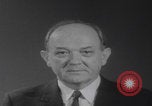
President Johnson addresses the public at a news conference about the Vietnam War
President Lyndon B. Johnson addresses the United States public at a White House news conference about the Vietnam War on July 28, 1965. “We do not seek the destruction of any government, nor do we covet a foot of any territory. But we insist and we will always insist that the people of South Vietnam shall have the right of choice, the right to shape their own destiny in free elections in the South or throughout all Viet-Nam under international supervision, and they shall not have any government imposed upon them by force and terror so long as we can prevent it… We do not want an expanding struggle with consequences that no one can perceive, nor will we bluster or bully or flaunt our power, but we will not surrender and we will not retreat,” says President Johnson,
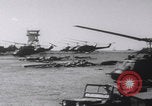
United States Embassy workers injured after North Vietnamese terrorist attack in Saigon
Helicopters on an airfield during the Vietnam War. Wreckage of a destroyed plane with debris. A nose art of a destroyed plane. Bombed soldiers’ barracks at a United States airbase in South Vietnam. Photographs of soldiers’ loved ones, including a portrait of a young girl, among debris in bomb site. Vietcong car bombing of the United States Embassy in Saigon, South Vietnam on March 30, 1965. A 1962 Chevrolet C10 Suburban ambulance arrives in the scene. A bloodied embassy worker covers his face. Another embassy worker is taken away. A bleeding victim holds his cigarette as he’s carried on a stretcher. A United States Army Bell UH-1 Iroquois “Huey” helicopter in flight. U.S. Army soldier in helicopter fires machine gun. Soldiers advancing in field and an upturned helicopter is seen in the foreground. Soldiers escape from the upturned helicopter. United States soldiers recuperate in makeshift hospital beds. A soldier with head covered in bandage. A shirtless soldier sleeps with his mouth open. Coffins draped with the United States flag at an airfield in South Vietnam. Soldiers and sailors pay tribute to the fallen soldiers. Soldiers carry the coffin of a fallen colleague to an aircraft. Vietnamese civilians look on. A pair of poor Vietnamese children. Vietnamese men and women praying. Drafted soldiers onboard a ship arrive in Vietnam. They unload supplies, one of them holding a banner. Soldiers holding the United States flag and a banner. Combat units of the United States Marine Corps onboard ship heading to Vietnam. The Marines disembark a landing craft upon landing on beach head in Vietnam. A Lockheed C-130 Hercules taxiing at an airfield in Vietnam. Army combat unit soldiers disembark and unload weapons from the transport plane. Trucks carrying combat soldiers moving.
CRITICALPAST.COM: About Us | Contact Us | FAQs - How to Order | License Agreement | My Account | My Lightboxes | Shopping Cart | Advanced Search | Featured Collections | Website Terms & Conditions | Privacy Policy ©2026 CriticalPast LLC.
License Agreement |
Terms & Conditions |
Privacy Policy
©2026 CriticalPast LLC.