


 Francais
 Deutsch
 Italiano
Refine Your Search
-Cebu,-Philippines stock footage and images
- Showing 58951 to 58956 of 58986 results more
more Hide
Hide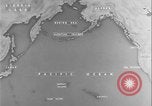
U.S. forces buildup of Aleutian Islands position following the Japanese bombing of Dutch Harbor in 1942, during World War 2
Map of the pacific including Japan, Aleutian Islands, and Alaska. Illustrated lines show various distances from the U.S. mainland to Tokyo and locations in the Aleutian Islands. Graphic zooms in on Dutch Harbor. Scene changes to footage showing the aftermath of Japanese bombing of Dutch Harbor, which took place on June 3 and 4, 1942, during WW2. A large cloud of smoke rises in the distance, more close by. People use hoses to spray out fires. Scene changes to present establishment of a U.S. position in the Aleutians. Shot of General Eugene M. Landrum, who sits on a box, smoking a pipe, wearing a scarf and hat. Wide panoramic shot of U.S. camps being assembled near a beach. Anti-aircraft gunners stand alert beside their weapon. A team of men carry a large roll of field wire through the grassy terrain to establish lines of communication.
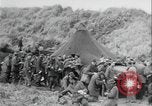
U.S. Military unload supplies to support an aerial bombing campaign of the Japanese in the Aleutian Islands, Alaska, 1942, during World War 2
U.S. troops gathered around a tent, eating, in the Aleutian Islands, Alaska, in 1942, during WW2. A line of soldiers carrying plates and bowls and cups waits to receive food. A man cooks food on a stove. Soldiers sit on the ground eating and warming by a fire. Wide view of the beach with ships and cranes out on the water. Crates of supplies stacked on the beach, soldiers move about. A soldier stacks an ammunition crate onto a large pile. Dozens of unfinned cylindrical bomb bodies on the shore. A crane, tractor, and bulldozer are unloaded from a boat. Panoramic view of a wide flat area to be built into an airfield, covered in shallow lakes.
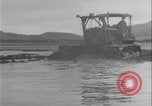
U.S. forces prepare airfield for assault on Japanese positions in the Aleutian Islands, during World War 2
Bulldozer works to clear earth for the construction of an airfield in the Andreanofs, Aleutian Islands, Alaska, in 1942, during WW2. Wide panoramic views of the flat space to be used for aircraft, covered in shallow water. With map visuals, narrator describes that the U.S. Forces are in fighter range of the Japanese position at Kiska Island, and within bomber range of the Japanese position at Attu Island. A B-24 bomber aircraft moves across the makeshift airfield. U.S. soldiers standing on ladders work on aircraft engines. A bomb is loaded into an aircraft. Soldiers stand and talk, examine papers. U.S. Army Air Force troops walk toward a B-24 Liberator and spin the propellers by hand.
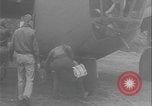
U.S. Army Air Force bombers raid Japanese-held Kiska Island in the Aleutian Islands, Alaska, 1942, during World War 2
U.S. Army Air Force (USAAF) soldiers wearing flight suits board bomber aircraft from a newly established U.S. position in the Aleutian Islands, 1942, during WW2. A soldier pokes his head out a window in the cockpit of one of the aircraft. Bomber aircraft take off from a runway constructed from marston mat (pierced steel planking), mountains in the background. Scenes of the bomber aircraft in the sky, taken from an on-board camera. Close up shots of gunners at their positions. The bombers fly over the foggy islands toward the Japanese base on Kiska Island. A Japanese warship appears in the water far below, one of the U.S. gunners strafes the deck of the ship. Close up of machine gun firing at the boat. Now over Kiska, bomb bays open and American bombs are unloaded. Smoke and explosions far below. A second load of bombs drops toward the Japanese base in slow motion. Wide shot of the target, now covered in streaks of smoke. Shot of the American bomber aircraft in the sky, turning to head back to base.
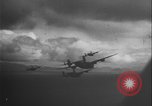
U.S. Army Air Force B-24 bombers return from a raid on Japanese-held Kiska Island in the Aleutian Islands, 1942, during World War 2
U.S. Army Air Force B-24 bombers fly back to base after bombing the Japanese base at Kiska Island, Aleutian Islands, Alaska, in 1942, during WW2. Narrator details the events of the successful mission. Close ups of the B-24 Liberators as they fly over water. Vast mountains of the Aleutian Islands in the background. The aircraft land back at the newly established U.S. base in the Andreanofs of the Aleutian Islands. Close ups of the bombers, now on the ground. U.S. soldiers exit the aircraft, inspect damage taken from Japanese fire on the fuselage. A group of U.S. pilots and crew walk across the airfield. Soldiers circle around and chat. Ending scene of soldier standing with cloudy Aleutian mountain rising in the background.

President of the Protectorate of Bohemia and Moravia, Dr.Hácha, visits Prague Sample Fair in 1940, during World War 2
View of the entrance gates to the Prague Sample Fair (Pražský vzorkový veletrh), in the Protectorate of Bohemia and Moravia, 1940, during WW2. Close up of a winged statue. President Emil Hácha steps out of a motor vehicle and shakes hands with a man. A group of figures including Dr. Hácha walk through the Sample Fair. Nazi swastikas in the background. The group of figures walk past exhibitions and people at work. Close up of sign with the message "Práce Českých Rukou," meaning "The Work of Czech Hands." People bustle about at the fair. Building with Czech company name "Ideal Radio" in large lettering. View from inside multi-story hall with signs and banners covering the walls. Close ups of various displays at the fair, including a motor bike, mechanical drop hammer, and flip-card motion picture device. From a Spanish newsreel.
CRITICALPAST.COM: About Us | Contact Us | FAQs - How to Order | License Agreement | My Account | My Lightboxes | Shopping Cart | Advanced Search | Featured Collections | Website Terms & Conditions | Privacy Policy ©2026 CriticalPast LLC.
License Agreement |
Terms & Conditions |
Privacy Policy
©2026 CriticalPast LLC.