


 Francais
 Deutsch
 Italiano

Refine Your Search
1941 hong kong stock footage and images
- Showing 685 to 690 of 1637 results more
 Hide
Metal sheets being rolled, shaped and workers weigh pistons at the Ford River Rouge Complex in Dearborn, Michigan.
Activities at the Ford River Rouge Complex in Dearborn, Michigan. A crane removes hot ingot from a soaking pit and places it on the conveyor to a rolling mill. An operator's hand on the machinery controls. The ingot tipping into the rolling machinery . It is being rolled and shaped. It is moved from one machine to another until a long thin sheet of metal emerges. A worker examines a thin sheet of metal as it passes him. The rolling machinery in operation. An aerial view of the plant. A line moving to the motor building center. A piston polishing machinery in operation. Workers finish and weigh pistons. The pistons on an overhead conveyor. The workers assemble sets for motors.
Henry Ford speaks at dedication of U.S. Navy Service School in Dearborn, Michigan in World War II. Montage of Navy ships
Opening scene shows Henry Ford speaking at the dedication of the U.S. Navy Service School, on land of the Ford Motor Company, in Dearborn, Michigan, during World War 2. Ford says, "During this crisis, our organization wants to do everything possible to help Americans and the President." Scene shifts to the Eickes-class destroyer, USS Elliot (DD-146), steaming with black smoke billowing from her stacks. Some other unidentified ships are nearby. View of a U.S. Navy Submarine tender with several submarines on either side of her. The U.S. Submarine, USS Sturgeon (SS-187) moving slowly in very calm waters, and then with two other submarines moving together in the ocean. Closeup of submarine O-3 (SS-64) moving at periscope depth and then surfacing and later cruising on the surface with crew on deck.
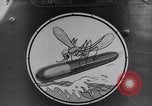
U.S. Mosquito boats maneuvering off the coast in Florida, United States during World War II.
Film opens showing logo of "mosquito boat." A flotilla of the boats is seen tied up at docks. They include PT boats (patrol torpedo boats) numbers PT 10, 11, 12, and 13. View from Florida shore as some ot these PT boats speed through the water. Aerial view of several of them racing over the surface of the water, leaving huge wakes behind them.Closeups of some approaching the aerial camera. View from another PT boat, of PT-17 riding close behind in the camera boat's wake. Extreme closeup of PT 17 bow. Other views of the PT boats generating large wakes as they pass the camera. Another aerial view of the boats running in parallel formation.
The new Brewster SB2A Buccaneer dive bomber enters the U.S. Arsenal at onset of World War II
People gathered around a new Brewster SB2A Buccaneer dive bomber parked on an airfield. Next, the engine starts, groundsmen pull the aircraft chocks, and it taxis out for takeoff. The aircraft takes off delaying gear retraction, somewhat. Then it is seen buzzing the airfield at low altitude, with landing gear up..
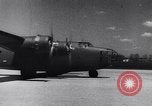
A new B-24 Liberator bomber is inspected by Henry Ford at Dearborn, Michigan
A B-24 Liberator bomber ia parked on a field at Dearborn, Michigan, where it has been brought for Henry Ford to see. (Ford Motor Company will be making parts for the B-24.) Some ladders are placed near Ford Motor Company President, Edsel Ford converses with a U.S. Army Air Forces officer standing near the aircraft. Henry Ford is seen in the cockpit of the bomber. Later, he is seen inspecting the underside of the aircraft, accompanied by an Air Forces officer.
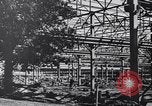
Military Aircraft being produced by Vultee and Lockheed Aircraft companies during World War II
Film begins showing steel framework for a new war plant under construction during World War 2. Next, workers are seen painting aircraft parts at the Vultee aircraft plant in Downey California. A crane at the plant moves an aircraft tail section to mate with the forward fuselage of an airplane. Cranes move wing segments through the plant. Workers, including a woman, lower a radial engine into place at the front of a BT-13 Valiant training airplane. A line of such aircraft is seen behind the one the camera is focused on. Scene shifts to the Lockheed aircraft plant in Burbank, California, where bodies of Lockheed Model 14 Super Electra passenger planes are seen covering the factory floor. A glimpse of Lockheed B-24 Liberator bombers in an assembly line next to men working engines of a partially assembled Electra 14 aircraft. Lockheed P-38 lightning fighter planes being assembled at another part of the plant. A P-38 taxis past a line of parked Lockheed Hudson light bombers and takes off on a test flight. View from below of gleaming aluminum P-38 climbing out. Aerial view from above of P-38 flying over land near some mountains.