


 Francais
 Deutsch
 Italiano
Refine Your Search
1941 hong kong stock footage and images
- Showing 67 to 72 of 1627 results more
more Hide
Hide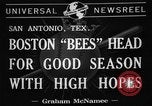
Boston Bees baseball team holds spring training in San Antonio Texas, 1941
Players on the Boston Bees baseball team (formerly the Boston Braves) do spring training drills in San Antonio Texas, March 1941. Players warm up by throwing and catching. Manager Casey Stengel, a future Hall of Famer, clowns around with a movie camera for three of his players. Pitcher Hank LaManna throws a couple of pitches toward the camera. Shortstop Eddie Miller turns a double play in practice.
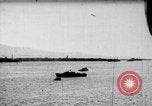
The Japanese attack on Pearl Harbor, December 7, 1941
Attack on Pearl Harbor, Hawaii by the Japanese Navy on December 7, 1941, as filmed from the deck of U.S. Navy Hospital Ship, USS Solace (AH-5). Ships docked at Pearl Harbor. Several small launches speed across the calm harbor. Suddenly a bomb bursts in the water, behind one of the launches. Several U.S. SBD Dauntless and F4F aircraft, from the USS Enterprise, fly over the deck of the Hospital Ship, with their landing gear down (to land at Ford Island). U.S. Navy ship USS Nevada (BB-36) leaves the harbor at high speed, throwing up a bow wave. Japanese aircraft bomb U.S. Navy ship USS Arizona (BB-39) docked. The ship explodes and sinks. A large smoke column rises from the explosion. (This image has been reversed. From the perspective of the USS Solace, the Arizona should be pointing to the right, not to the left.) Anti aircraft firing from U.S. Navy ships fills air with black Flak puffs. Various ships burn. (World War II period).

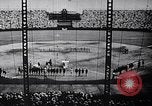
1941 Cotton Bowl Classic between Texas A&M Aggies and Fordam Rams, played in Cotton Bowl Stadium, Dallas, Texas on January 1, 1941
Film opens showing fans filling the Cotton Bowl Stadium in Dallas, Texas. Next. opposing college football teams are lined up on the line of scrimmage. A running play gains some yardage before ball carrier is tackled. Referees mark the location and the teams set up on another line of scrimmage. Closeup of a Texas fan wearing a beat up cowboy hat and ill-fitting eye glasses. More views of play on the field. Final view shows crowd (of 45,507) in the stands. The game was a cliffhanger, with final score: Texas 13 and Fordham 12
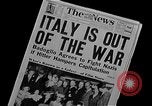
Allied pre-invasion base and activities in Scotland,1941. Allies in Algeria preparing for invasion of Sicily,1943
Activities of the Seabees in Scotland in 1941 and in Algeria in 1943, during World War II. News headlines in 1943 read : ' Italy is out of war' and '17 more Italian towns taken'. An animated map. The Clyde valley in Scotland showing a base built by the U.S. Navy Seabees, in 1941. Numerous quonset huts and vehicles are seen. View of the River Clyde, where 2400 feet of oceangoing dock are being assembled. A ship anchored at a harbor displaying U.S. flag. Allied troops board a landing ship with their belongings. An animated map tracing travel of Allied invasion forces from Scotland to Oran, Algeria, where Seabees are seen testing a floating causway that would be used for invasion of Sicily. Scuttled axis ships and other obstacles and damage that Seabees must repair in occupied ports. Allied ships and troops proceeding for invasion of Sicily. Allied warships bombarding Sicilian coast.

The Philippines gains independence from the United States on July 4, 1946; also scenes from 1941 Japanese invasion WW2
The Philippines are established as an independent nation. Crowds of Filipinos gathered at Rizal Park (Luneta Park) in Manila on the July 4, 1946. View of Independence Grandstand (a temporary structure built in front of the Rizal Monument) with American flag and Philippine flags on tall flag poles.. View looking down on General Douglas MacArthur at a podium, speaking into microphones. Camera pans over various segments of the audience. A map shows the Philippine Islands in context of its neighbors in the Pacific Ocean. Camera pans closeup across faces of many Filipinos gathered at the independence event. View of the Jones Bridge over the Pasig River in downtown Manila. Heacock’s Department Store on the Escolta. The Legislative Building. (later the National Museum of the Philippines). Ocean going ships in a harbor. Cargo being offloaded from a ship onto smaller boat. An industrial complex with eight tall smoke stacks emitting smoke. Steel and petroleum plants. Filipino workers in an assembly plant. The Legislative building with people coming and going. Air raid sirens sounding and people running in streets of Manila at onset of Japanese invasion of the Philippines in December, 1941, at start of World War 2, in the Pacific. People running across the Jones Bridge, seeking shelter. Others boarding a bus. Smoke rising from Japanese bombing. Glimpse of Japanese tanks entering Manila during attack and invasion. Japanese infantry climbing a hill. Bodies of persons killed during the Japanese invasion. Glimpse of Japanese troops occupying Corregidor. U.S. General Wainwright negotiating the surrender of Corregidor with Japanese General Homma. View of an American warship firing during the U.S. campaign to defeat the Japanese on islands in the Pacific. An American landing ship carrying U.S. troops who storm ashore. General Douglas MacArthur striding ashore with a retinue of officers, at Leyte, Philippines, on October 20, 1944. as he keeps his promise to return to the Philippines. Views, back again, to MacArthur speaking at the Independence Day ceremony in Manila on July 4, 1946. Also seen at the ceremony are: U.S. Senator Millard Tydings, (co-sponsor of the 1934 Tydings–McDuffie Act, which provided independence to the Philippines after a 10-year transition under a limited autonomy), and Paul V. McNutt, U.S. High Commissioner of the Philippines, who read President Truman's proclamation of Philippine Independence to the assembly. Camera pans over the gathering which includes many U.S. Service personnel in uniform. The oath of office is administered to the elected President of the Philippines, Manuel Roxas. At the conclusion, the American flag is lowered by Paul McNutt, as President Roxas raises that of the Republic of the Philippines. A celebratory parade in Manila includes a float with signs reading: "Let's Produce and Rebuild," among other things. Other floats represent "Mountain Province," and "The City of Manila," "The University of the Philippines," and "The Division of City Schools." One float, sponsored by the Chamber of Commerce, contains a huge replica machine gear, and models of an aircraft and a ship. It's message is about turning the gear that helps make the nation great. American and Filipino soldiers march, carrying their respective national flags. A white-helmeted military band plays for the marchers. Final scene shows large loose formation of military aircraft in flight very high above the Independence Grandstand, at Rizal Park.
US baseball players visit Japan in 1931; also anti-Japanese propaganda circa 1941-1942 during World War 2.
Huge crowd attends baseball game between visiting American players and Japanese team in Tokyo, 1931. Lou Gehrig, Al Simmons and Lefty Grove mentioned by announcer but not seen. American representatives walk out to pitcher's mound to greet pitcher. Shots of Babe Ruth hitting. Shots of Japanese player rounding third, sliding safely into home. Film suddenly morphs into anti-Japanese propaganda circa 1941-1942; shows Japanese newspaper publisher who was murdered. Scenes of sumo wresting and judo and kendo seen and compared to alleged acts of Japanese diplomatic and military treachery and spying. Shots of fishermen, tourists, barbers and others said to be spies and soldiers for Tokyo. Closeup of a Japanese man gardening. Japanese men on small fishing boats, raising boat sails, and pulling in heavy loads of tuna fish in nets. Japanese tourists supposedly taking photographs of American ships in Hawaii. Female Japanese barbers giving haircuts. Japanese military officials in Japan organizing papers, films, and incoming information. Japanese industrialist figure emerging from car. Scenes of Japanese industry supporting war preparations: Exterior views of Japanese factories in Osaka, textile mill operations in Tokyo, chemical plant operations in Nagoya, steel mills, and a large newly completed ship being launched in Nagasaki. Overhead view of steel mill operations. View of a slum town area in Japan and simple living arrangements of Japanese citizens. Japanese laborers at work in small home factories for textiles, pottery, and other goods, said to be in "semi-slavery." Workers include men, women, and child labor. Shows production of goods said to be produced in other countries that are pirated, mislabeled by Japan, and dumped at low prices abroad to undercut competitors. Products shown include factories and production lines for spark plugs, scotch whiskey, matches, silk, cotton, bottled beer, toothbrushes, hair brushes, hair combs, and American flags produced in Japan and offered for sale at lowest prices in the United States. Shipping dock areas in Japan showing large ships at docks, cranes in use, and importing of oil, rubber, scrap iron, tin for war materiel.