


 Francais
 Deutsch
 Italiano
Refine Your Search
2nd-Rangers-D-Day stock footage and images
- Showing 607 to 612 of 13613 results more
more Hide
Hide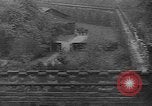
German war criminals are executed by Allied occupying forces in 1945, in World War 2
View from above, of the surrounding walls and courtyard of a prison in Rheinbach, Germany. Ground view inside the prison yard, where German civilian Matthias Gierens is being escorted to the gallows by U.S. military police, and accompanied by a German Catholic priest, on June 29, 1945. They ascend the gallows and final charges and sentence are read to Gierens. Next scene shows bodies stacked up at the Bergen-Belsen concentration camp operated by Nazi Germany. Scene returns to the gallows, and a hood is placed over Gierens' head. View of Allied army officer witnesses, in formation, at parade rest. Noose is placed over Gierens' hood. View of a a bird flying overhead, trapdoor opens, Gierens drops, and noose tightens. Next is an unrelated scene of several German soldiers being executed. They are seen hanging from four gallows in a line in a public square while a large crowd, possibly Soviet citizens, looks on. (Notes: Regarding the execution of Gierens in the opening scene: German civilian Matthias Gierens was a 37 year old railroad worker. He was executed for the August 15, 1944, murder near Priest, Germany, of a downed American airman, who was later identified as U.S. Army Air Forces 2nd Lieutenant Lester E. Reuss. Gierens and three other German civilians, Peter Kohn, Peter Back, and Matthias Krein, were convicted on June 2, 1945 in Ahrweiler, Germany, of the murder. Their trial was the first Allied trial in Germany of civilians charged with a war crime.)
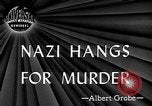
German civilian Matthias Gierens is hung until death for murdering a downed American flier in Germany in World War 2.
German civilian Matthias Gierens, a 37 year old railroad worker, is hanged in Rheinbach Germany for the August 15, 1944 murder of a downed American flyer, who was later identified as U.S. Army Air Forces 2nd Lieutenant Lester E. Reuss, from Forsythe, Montana. Reuss was the navigator on U.S. Army B-17 bomber #42-31183 which was downed by German aircraft after it attacked the Airdrome at Wiesbaden, Germany. Gierens and three other German civilian men, Peter Kohn, Peter Back, and Matthias Krein, were convicted on June 2, 1945 in Ahrweiler, Germany, for the murder of the American airman after his parachute landing near Priest, Germany. The trial was the first Allied trial in Germany of civilians charged with a war crime. Military police are seen escorting Gierens toward the gallows in a prison yard in Rheinbach. A German Catholic priest performs the rites. U.S military officer reads charges as Gierens is readied for execution (the officer is possibly Lt. Col J.V. Roddy, of San Francisco, who was in charge of the hanging). Trap door opens and Gierens is hung. The U.S. Army executioners were Master Sgt. John C. Woods, a former Texas State executioner, and Staff Sgt. Thomas Robinson, of Bronx, New York. Witnesses present included seven U.S. Lieutenant Colonels and one British officer, a number of Military Police, news correspondents, and photographers.
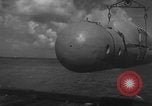
Demonstration shows how Italians intended to employ 2-man SSB torpedo to sink ships
Italian SSB 2-man torpedo hoisted in a crane hook. View of controls in the cockpit of the SSB torpedo. Pilots in the cockpit of the SSB underway in water. Crew put on their scuba type face masks. SSB torpedo dives under the water surface. Torpedo comes on the surface and alongside a merchant ship. The Captain remains in the cockpit and the 2nd man gets off the torpedo. He fastens a clamp to the keel of taget ship and then pulls a warhead from the torpedo and fastens it to the target ship. He climbs back aboard the the SSB and they pull away.
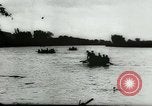
General Patton's troops cross the Seine; U.S. soldiers with French General Leclerc and his soldiers enter jubilant Paris in World War 2.
American columns cross the Seine in France during World War 2. Soldiers in boats reach the shore. Civilians stand by the river. General George S Patton's armored division crosses the river on pontoon bridges. The U.S. troops advance towards Paris. Smoke arises due to explosion. Tanks and soldiers firing machine guns beneath the Eiffel tower. The tanks move past the Eiffel Tower. Civilians crouch on the ground. Tanks on the streets. Nazi prisoners marched on the street. Tanks and soldiers fire at Nazis in the German Headquarters at Chamber of Deputies. French soldiers fight German snipers from the streets. A man closes shop and escapes. Allied soldier leads a Nazi waving a white surrender flag across the street. Large group of surrendered German soldiers gathered as prisoners of war on August 25. Traffic around Arc De Triomphe. The French flag raised on a building. The 2nd Armored Division of the Free French Army of Liberation, under French General Philippe Leclerc, parade on Paris streets on August 26. Large crowd gathers to welcome them home. Nazi prisoners march in the streets flanked by Allied soldiers. General Leclerc and his men on tanks. Girls kiss the soldiers. American, British, and French soldiers drinking from wine bottles and celebrating with the crowd.
Saga of a U.S. Navy Task Group, the USS Guadalcanal and escorts, that captures the German U Boat (U-505) in World War 2
Historic U.S. Navy capture of German submarine (U-505) during World War 2. Crew assembles on flight deck of the USS Guadalcanal (CVE-60). Its Captain, Daniel V. Gallery, looks out from deck above. A Task Group of the Atlantic Fleet, consisting of the Guadalcanal, and five Destroyer escorts: the Pillsbury, Chatelain, Pope, Flaherty and Jenks, proceeds to operate against German submarines West of the Cape Verde Islands. Aboard the Guadalcanal, men train to capture a submarine, intact, if possible. The boarding team includes: Chief Photographer's Mate, Clifford Werler; Chief Pharmacist, Raymond Jackson; LTJG Mylo Keck; Ensign Fred Mittaugh; and Electrician First Class, William Stein; Ensign James Griffin; Machinist Mate 2nd Class, Walter Waller and Commander Earl Torcino. On June 4, 1944, the USS Chatelein makes sound contact with a submarine. The Task Group attacks it and forces it to surface under heavy gunfire. The German crew is rescued. Task Force boarding party successfully occupies and prevents the U-505 from sinking.
Canadian Army attack Carpiquet airfield in Normandy during Operation Windsor (WW2)
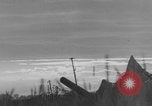
Various field artillery firing under camouflage nets during Operation Windsor, part of the Battle of Caen during World War 2. Royal Canadian forces advance on Carpiquet airfield. Canadian soldiers crouch for cover. Canadian soldiers firing with mortar field artillery. Carpiquet airfield in smoke as seen from the fields. A camouflaged soldier aims his rifle and shoots. Soldiers in a tank. Close up of tank firing its machine gun. Canadian soldiers firing with machine gun behind hedgerows. A soldier uses binoculars, pointing at a direction, while standing on a tank. Carpiquet airfield buildings destroyed after Canadian shelling. The attack was conducted by the 3rd Canadian Infantry Division, 8th Canadian Infantry Brigade, and 2nd Canadian Armoured Brigade.
CRITICALPAST.COM: About Us | Contact Us | FAQs - How to Order | License Agreement | My Account | My Lightboxes | Shopping Cart | Advanced Search | Featured Collections | Website Terms & Conditions | Privacy Policy ©2026 CriticalPast LLC.
License Agreement |
Terms & Conditions |
Privacy Policy
©2026 CriticalPast LLC.