


 Francais
 Deutsch
 Italiano
Refine Your Search
2nd-Rangers-D-Day stock footage and images
- Showing 6319 to 6324 of 13612 results more
more Hide
Hide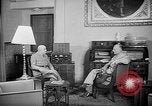
Plenipotentiary French Army General visits Levant States and calls a press conference (WW2)
French Army General Beynet in Beirut, Syria during World War II. General Raymond Humblot and General Beynet talk and listen to radio news. General Humblot dials radio. He is Commander-in-Chief of French troops in Levant States. He leaves Residency and after conference with General Beynet gets into a car. Druze Guard presents arms as the car drives through gardens. They play trumpets. Plate at entrance of building reads 'Here was proclaimed on September 1, 1920, the independence of Great Lebanon'.
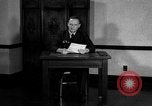
Charles A. Lindbergh speaks against United States participation in European Wars early in World War 2.
Charles A. Lindbergh delivers an anti-war speech early during the outbreak of World War II in Europe. Lindbergh speaks in a studio of the Mutual Broadcasting System. He speaks against American involvement in wars in foreign lands. He states that the Americans should not be asked to fight in foreign countries, but to focus on defense of the United States. Among other things, Lindbergh says: "The doctrine that we must enter the wars of Europe, in order to defend America, will be fatal to our Nation, if we follow it. When men are called upon to fight, and to die, for their country, there must not be even the remotest question of foreign influence involved." He states that Americans have no confidence in decisions of their leaders. He talks about the high number of aircraft and war materiel manufactured to fight in European countries. He talks about the affect on the National debt of the current spending for armaments and war production. He speaks out against the current American leadership (democratic party under Franklin Roosevelt) and how it did not do the right things to see what was coming in Europe and take steps to prevent it. He says that Americans are not confident in their leaders. Lindbergh speaks out against building of untold thousands of military aircraft, but he speaks in favor of a defense-focused American Air Corps.
Alaskan railroad re-opened by United States Army in World War 2, to carry supplies.
Supplies are carried by trains and trucks in Alaska. Ships unload food and supplies at Skagway, Alaska. Smoke rises from smokestack of the ship. Men unload the supplies. Train of the Yukon railroad, under operation by the United States Army is loaded with food and supplies for troops guarding arctic outposts in World War II. A Yukon Railroad train moves along railroad tracks. A sign reads "Whitehorse, Yukon" at the Whitehorse stop in Yukon territory of Canada. Truck on the new Alaska Truck Highway passes by with freight it received at Whitehorse.
U.S. High Command Leaders hold war planning parley in United States (WW2)
United States High Command holds World War II war planning parley. The U.S. High Command leaders stand and talk. General Henry (Hap) Arnold, General George Marshall, Admiral Ernst King, Admiral Land, Admiral William Leahy, Presidential advisor, Harry Hopkins, Paul V. McNutt, Civilian Head of Manpower, and Elmer Davis, Head, Office of War Information, in the conference. The personages are seated on a table. Food served on the table.
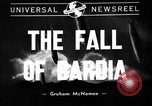
British war ships bombard seaport on Bardia, Libya (WW2)
World War II naval bombardment on Bardia, Libya. A British Navy officer aboard a British war ship looks through binoculars. Naval guns are fired. Black smoke rises up. The seaport is bombarded. A large number of prisoners walk. The prisoners are loaded on railroad cars. Prisoners board ships in large number.
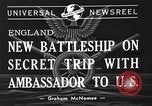
Lord Halifax travels aboard HMS King George V on a secret trip to United States during World War 2.
Lord Halifax arrives in United States aboard a new British warship. British Ambassador to United States, Lord Halifax travels aboard HMS King George V on a secret trip. Lord Halifax and his wife aboard the ship. Sailors stand on deck of the ship. United States President Franklin Roosevelt meets Lord Halifax before the warship reaches the port. Lord Halifax and his wife give a speech. Lord Halifax states that it was a great honor as President Roosevelt came to meet them.
CRITICALPAST.COM: About Us | Contact Us | FAQs - How to Order | License Agreement | My Account | My Lightboxes | Shopping Cart | Advanced Search | Featured Collections | Website Terms & Conditions | Privacy Policy ©2026 CriticalPast LLC.
License Agreement |
Terms & Conditions |
Privacy Policy
©2026 CriticalPast LLC.