


 Francais
 Deutsch
 Italiano
Refine Your Search
2nd-Rangers-D-Day stock footage and images
- Showing 6775 to 6780 of 13612 results more
more Hide
Hide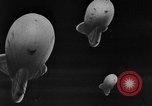
Animation shows the links of the cables of barrage balloons to detect and destroy enemy airplanes in the United States (WW2)
A World War II training film depicts the use of barrage balloon to damage enemy airplanes flying at low altitude during a war in the United States. Animation shows the barrage balloons attached with wired cables in the protected area. A barrage balloon in sky. Enemy airplane in flight against the wind hits the balloon. The cable breaks and airplane can get damage. An airplane in flight in the wind direction. The airplane hits the cable and no damage is caused. The wire falls at the base. The barrage balloon flies away. Animation shows links attached to the cable in a barrage balloon. The enemy aircraft approaches the balloon. The aircraft cuts the link. The cable wire with attached parachute comes on the wing. The parachute opens and the wire cuts the wing of the airplane. The balloons deflates comes down.
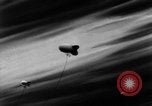
Animation shows the influence of weather on the barrage balloon in the United States (WW2)
A World War II training film depicts the use of barrage balloon to damage enemy airplanes flying at low altitude during a war in the United States. Animation shows the influence of weather on the barrage balloon. A balloon floats in air due to high wind. The cable breaks. The balloon flies and drags cable on the ground. Sparkling on electric wires as cable hits the wires. The cable accidentally breaks. The dive in the balloon explodes cuts the cable. The parachute opens. The balloon deflates floats downwards. Animation shows links attached in the wire cable and their function.
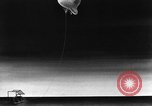
Animation shows the function of upper and lower link attached on a cable as enemy airplane hits the cable (WW2)
A World War II training film depicts the use of barrage balloon to damage enemy airplanes flying at low altitude during a war in the United States. Animation shows the function of upper link attached in the wire cable as an enemy airplane hits the cable. Animation shows the function of the lower link as the airplane hits the cable. The flying cable is cut. The parachute opens. The balloons attached with wire cables in sky. The results of the cable armament operation. An enemy airplane burns. Soldiers look at the airplane as it burns. The soldiers retrieve the balloon. A soldier folds the links of cable. Another soldier holds a link in his hand.
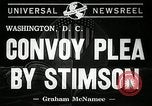
U.S. War Secretary Henry L Stimson speaks about the use of U.S. battleships to convoy war shipments to England, in Washington DC (WW2)
Convoy plea by U.S. Secretary of War Henry L. Stimson in Washington DC during World War II. U.S. Secretary of War Henry L. Stimson, seated at a desk, reads from a paper. War Secretary Stimson speaks about the use of U.S. battleships to convoy war shipments to England. Secretary Stimson also says that the U.S. fleet which is the first line of defense can best defend this country by guaranteeing delivery of goods to Britain.

African American tennis star, Althea Gibson, wins Wimbledon, defeating Darlene Hard, 6-3, 6-2, on July 6, 1957.
Tennis star Althea Gibson, from New York City, USA, is seen in the final seconds of her contest with Darlene Hard, in the Ladies' singles final at Wimbledon, England,on July 6, 1957. She is the first African American to win at Wimbleton. After shaking hands with Hard, she is seen receiving the ladies' Wimbledon tropy "Rosewater Dish," from Queen Elizabeth, II. Althea Gibson displays the sterling silver salver, as she poses next to Darlene Hard.
Paratrooper Leonard and Private Zych receive Purple Hearts from Major Jeannette Blech at Halloran Hospital, Staten Island, NY (WW2)
U.S. Army award ceremony at Halloran General Hospital on Staten Island New York. The honored World War II veterans line up. The recipients salute as U.S. flag is taken down at formal retreat. The flag flutters in wind. Major Jeannette Blech, Chief Nurse at Halloran Hospital, pins the Purple Heart on the uniform of Paratrooper Lance Leonard of Buffalo. A man in the background takes pictures. Major Blech shakes hands with Paratrooper Leonard. The Purple Heart pinned up on the uniform. Private Stanley Zych of Staten Island receive Purple Hearts from Major Blech. Major Jeannette Blech is the first woman in U.S. history to present the Purple Heart to war heroes. The service men and women of the Halloran General Hospital parade.
CRITICALPAST.COM: About Us | Contact Us | FAQs - How to Order | License Agreement | My Account | My Lightboxes | Shopping Cart | Advanced Search | Featured Collections | Website Terms & Conditions | Privacy Policy ©2026 CriticalPast LLC.
License Agreement |
Terms & Conditions |
Privacy Policy
©2026 CriticalPast LLC.