


 Francais
 Deutsch
 Italiano
Refine Your Search
2nd-Rangers-D-Day stock footage and images
- Showing 7585 to 7590 of 13612 results more
more Hide
Hide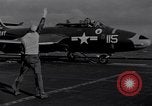
Training film explains techniques for catapulting jet aircraft from U.S. Navy aircraft carriers.
Film illustrating proper technique for catapulting jet aircraft from U.S. Navy aircraft carrier. Yellow shirt officer signals for catapult launch of a U.S. Navy F2H Banshee airplane, aboard an aircraft carrier. The aircraft is catapulted. Film recounts sequence of actions leading up to catapulting of a jet airplane from a carrier. A yellow shirt catapult officer guides the pilot as green shirt catapult gear crewmen adjust the bridle. Others secure the hold-back cable. View of hold-back cable and its slip catch with metal ring that breaks when the catapult is fired. A cover is installed to prevent parts of the ring from being flying loose and injuring someone or being ingested by a jet engine. View of an F2H being catapulted. Pilot given brakes off signal and catapult bridle is tensioned. Catapult officer coordinates with deck-edge crewman who monitoring catapult situation lights controlled by crew in catapult ready room below deck. When they signal "final ready," pilot applies full power and signals when at 100%. After final check, catapult officer on deck gives signal and the plane is launched. Views of jet aircraft being catapulted in pairs. Film illustrates procedures for handling "duds," when pilot signals a problem on the catapult. Pilot and deck officers hand signals are shown. Deck crewmen swarm over the aircraft and rapidly push it off and away from the catapult. Focus shifts safety regarding use of deck elevator. Views of more jets being catapulted at 35 second intervals.
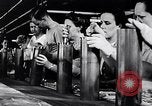
American women actively working and participating in the National Defense Program of the United States in World War II.
Wartime activities of women in United States during World War 2. American women war production workers busy in an ammunition factory helping men with war production. They check the shells at the munitions plant. A woman gives a lecture. A chart on wall. Other women attend the lecture. They wrap surgical dressings for the Red Cross. A woman gives blood to blood bank. Doctor and nurses take the blood in a glass container and put it in a box. The women participate in the defense program and war effort, filling many roles previously occupied by men fighting in World War 2.

Vendors of New York City, lower east side street markets, businesses and New York Stock Exchange stock market activity
German propaganda film released during World War 2 shows scenes in New York City during the Great Depression in the 1930s. Shows a woman being honored by a group of men in New York as she receives an award. A crowded shopping and market area of New York City, with street vendors and laundry service. An African American shoe shine man wearing a top hat finishes shining a customer's shoes, bows, and then performs a dance on the sidewalk. A busy shopping and market area on Orchard Street in the lower east side of Manahattan, with many stores including Guiradi's Antiques Sol Moscot Optical at address 119, Cohen's Optical at 117 Orchard Street, and others. Street area filled with push carts and market activity in a densely populated area of New York City. Workers inside a busy garment factory in New York. Hebrew signs in front of Jewish stores and businesses in New York. View of New York Stock Exchange floor with scenes of frenzied buying and selling as buyers and sellers yell their orders in a trading pit prior to the crash of the stock market in 1929. Hands of a man counting a pile of cash bills. View of Mayor Fiorello H. La Guardia talking to a man, a group of well dressed business men, and LaGuardia addressing a gathering of people. Clip is from an anti Jewish propaganda segment of a newsreel produced by Nazi Germany during World War 2.
OPM chief Knudsen visits Boeing factory in Seattle.
Chief of the Office of Personnel Management OPM Knudsen visits Seattle's Boeing manufacturing factory. Knudsen inspects factory accompanied with factory officials. This is probably Plant 2 on the Boeing grounds. Assembly line production of various Boeing planes goes on. Overhead view of 3 Boeing fuselages under construction. This is a few months before the United States' entry into World War 2.
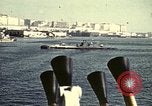
Activity in Port of Tunis, Tunisia, after it falls to Allies in World War II
Opening scene shows Port of Tunisia as viewed from a British warship in its harbor, during World War 2. Foreground shows QF 2-pounder 40-millimetre (1.6 in) British autocannon (commonly called "pom pom" and used as an anti-aircraft gun by the Royal Navy). An Italian submarine moves slowly through the harbor and docks. Sustained view of Italian sailor aboard a warship looking through binoculars. Italian Naval officer at the helm looking through binoculars. Closeup of another Italian naval officer with pipe in his mouth. Landing craft side by side at a stone pier. British soldiers disembarking from a ship onto a dock, with all their gear, and proceeding to the main pier. Change of scene shows a deep sea diver in suit and helmet being helped to descend into the water from a dock. As he sinks underwater, many bubbles rise from his air supply. Another view of a deep sea diver being prepared to descend. Men assist him with hoses and helmet.
Recap of slavery, the Civil War, and job integration in the United States, in the context of the civil rights movement.
African American and white children swim and play in an integrated swimming pool in the United States in the 1960's. A black man beside a white man working on an integrated engine car assembly line. A black shoe shine man. A black street sweeper. Narrator indicates that African American workers are in increasingly skilled jobs and supervisory positions. A black draftsman in an officer environment. A black bank manager gives an application to a black woman. Huey Newton leads the Black Panthers in a protest. Stills portray trade and transport of African American slaves. Stills show the Civil War in the United States, and aftermath of war showing blacks voting and as politicians during reconstruction. Footage of African American people working on farms in cotton fields picking cotton, including boy and girl child laborers picking cotton. Footage of a Rust Cotton Picker machine in operation as African American workers watch. American troops, including African American soldiers of the U.S. Army 369th Infantry "Harlem Hellfighters", marching in victory parade in the United States after returning from World War 1. View of segregated African American soldiers in the parade in New York City cheered by parade attendees. Brief scene with Henry Johnson on the side of the parade route being congratulated by civilians. (Johnson and Needham Roberts received the Croix de Guerre for exceptional heroism). Black and white workers entering or exiting a factory during World War 2. Black American troops and Tuskegee Airmen pilots in segregated units during World War 2. The Tuskegee pilots in uniform gathered together during a briefing on an airfield. View of U.S. military forces comprised of white and black personnel, integrated beginning in 1947. A white officer gives binoculars to a black soldiers.
CRITICALPAST.COM: About Us | Contact Us | FAQs - How to Order | License Agreement | My Account | My Lightboxes | Shopping Cart | Advanced Search | Featured Collections | Website Terms & Conditions | Privacy Policy ©2026 CriticalPast LLC.
License Agreement |
Terms & Conditions |
Privacy Policy
©2026 CriticalPast LLC.