


 Francais
 Deutsch
 Italiano
Refine Your Search
2nd-Rangers-D-Day stock footage and images
- Showing 7609 to 7614 of 13612 results more
more Hide
Hide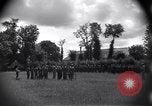
Decoration ceremony for U.S. Army Air Forces 9th Air Force fighter pilots in France during World War II.
Decoration ceremony conducted by Lieutenant General Brereton, Commander of U.S. Army Air Forces 9th Air Force, at advance airfield, Criqueville (A-2) France, during World War 2. Nine pilots of the 354th Fighter Group are lined up at attention in a field. A photographer clicks pictures. Two officers stand beside a table on which medals are kept. Captain Beerbower marches towards Lt Gen Brereton. The Lt Gen decorates him. Lt Gen Brereton decorates a major, a captain and a lieutenant, shaking hands with them. The company stands at attention. The honored men stand back in a line. General Brereton is seen, later, conversing with Captain Beerbower (wearing Silver Star). Among those decorated in this ceremony were: Capt. Don M. Beerbower (Silver Star); Capt. Wallace N. Emmer, Distinguished Flying Cross (DFC) and Lieutenant Carl Bickel (DFC).
Captain Don M. Beerbower, 353rd Fighter Squadron, and his P-51,
U.S. Army Air Forces 354th Fighter Group in Normandy. Ground crew run to pull camouflage from P-51 at advance air strip Criqueville (A-2) in Normandy during World War 2. The P-51 prop turns,engine starts, and it taxis forward. The name "Bonnie B II" is painted on the fuselage, and 17 swastikas are painted below the cockpit. A Mustang is painted on the tail. It's serial number is 43-12375. The aircraft stops. The name, Captain Don M. Beerbower,is painted below the cockpit. He stands up and climbs out of the airplane, wearing his oxygen mask and helmet. Scene shifts to a loudspeaker in a control facility.A soldier is seen talking on the radio in a plexiglassed enclosure. A flight of P-51s approaches the field. They break off and proceed to buzz the field. (Note concerning Captain Beerbower,of Hill City, Minnesota, seen in this clip. He served as acting Commander of the 353rd Fighter Squadron and was later promoted to Major. He was Commander of the 353rd Fighter Squadron when killed in action, by ground fire while flying his P-51, Bonnie B II, leading an attack on a German airfield near Reims, France, on August 9, 1944. His decorations included: the DSC, Silver Star,DFC (3), Air Medal (26), British DFC, Purple Heart, Distinguished Unit Citation and Campaign Medals.)
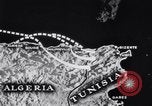
Allied Forces move successfully towards Tunisia but are forced to withdraw by severe German counterattacks during World War II.
Animated map shows Allied forces in three columns heading toward Tunis, from Algeria in World War 2. Another map shows German forces pouring into North Africa, from Italy. German troops disembarking from a troop ship. View of German Marshal Albert Kesselring, the Mediterranean Commander in Chief of the Axis powers, visiting German troops at the front. Skirmishes between Allied and German forces in Tunisia. German troops firing a heavy machine gun from a dug-in position. American soldier firing his rifle. British soldiers advancing across a field, under fire. Germans firing heavy machine gun. British soldier throwing a hand grenade. American M2 light tank advancing. Army truck carrying U.S. troops. British soldiers marching along a roadside. Sign identifying Béja Tunisia. British soldier with field radio. View of French military commander in Tunisia, General Barré, whose troops were holding Medjez-el-Bab) against German forces. Views of the French forces employing only machine guns and rifles to hold the German forces back at Medjez-el-Bab. General Kenneth Anderson, Commander of the British 1st Army is seen observing at the front with binoculars. (Narrator notes, he moved his troops to support the French, and the Germans withdrew.) Allied troops are seen continuing their advance toward Tunis, but suffer attack by German bombers. November 25th battle with Allied and German tanks engaging each other. Views of Allied armor firing and German shells striking. Explosions all over the battlefield. German tank burning. (Narrator says "15 enemy tanks destroyed, and the rest withdrew.") Animated map shows continuing Allied advance toward Tunis and Bizerte. Scenes from what was known as the "Run For Tunis." Milestone showing 64 kilometers to Bizerte. Roadsign showing 14 Km to Tindja, and 27 Km to Bizerte. A patrol of British troops, sheltered in ruins of a hilltop building, looks down over the city (presumably Tunis). Distant view of German Panzer IV tanks crossing open area. German forces begin heavy counterattacks with armor and heavy artillery. A squadron of German Ju 87, stuka dive bombers attacks making their familiar howling sounds. Bombs bursting on the ground. Glimpse of silhouetted German Heinkel He 111 bomber overhead and more attacking German aircraft dropping bombs. Fires raging everywhere among Allied forces locations. British soldiers assisting a wounded comrade. A burning downed British aircraft. Allied forces forced to retreat toward hills.
Allied Forces Build up in Algeria to prepare for Spring offensive against German forces in Tunisia during World War II
At start of film, Allied forces are digging in after retreating from counterattacks by German forces in Tunis, during World War 2.. Rains create mud everywhere. A Lockheed P-38 fighter plane parked in foreground. Ground crews use shovels to free nose wheel of a B-24 Liberator bomber with engines running. A truck tows a C-47 transport plane from mud. Army trucks travel over road inundated by running streams. Soldiers standing in a jeep submerged in water. M2 tanks stuck in mud. Airmen huddled around an outdoor fire. P-38 fighter aircraft parked in the background. Soldiers eating around an outdoor fire. Animated map shows Allied battle lines stabilized in Algerian mountains, while German forces occupy the plains in Tunisia. German artillery batteries firing. British troops sheltering in damaged building. Allied wounded being transported atop, as well as inside a field ambulance. Interior of a transport plane configured for evacuation of wounded on litters. U.S. airmen including a woman in leather flying jacket, presumably an Army flight nurse, tend to the wounded aboard the medical evacuation flight. Wounded being transferred from an airplane to an ambulance. British patrols moving through the night. Heavy artillery firing. British soldiers silhouetted at dawn. They return carrying a wounded comrade on a litter. The British soldiers ("Tommies.") trying to clean mud from themselves and their weapons before heading out on patrols again at dusk. Allied soldiers moving on mules in a long line to obtain needed food and supplies. More views of the interminable mud. A British Hawker Hunter fighter plane taking off. A formation of Hawker Hurricanes peeling off to engage German aircraft. Closeup of one rolling over. A German Heinkel 111 bomber being attacked and trailing smoke. Pilot pressing gun firing button in cockpit and a German Dornier Do 17 bomber hit as British fighter plane passes it in cloud of black smoke. The German plane diving to crash in a fireball on the ground. U.S. B-24 Liberator bombers taking off and flying in formation. Formation of American B-17 bombers in flight. The American planes dropping bombs on Italy, Sardinia, and Sicily. Gunners in the bombers firing machine guns at attacking German fighter planes as their bombs keep dropping. Back on land in Algeria, mud still halted any Allied advance. Animated map showing both Allied and German forces building up on their respective sides of the front. Supply lines illustrated all the way back to factories in the United States and Britain. Allied war plants making bombers and munitions. Allied Soldiers assembling Army vehicles at a port. Lockheed lightning fighters being rolled out of a factory. Sign reading "Railroad Equipment Assembly Plant No. 1." Complete trains from locomotives to freight cars being completely assembled, loaded with freight and sent on their way. A formation of P-38 aircraft equipped with long range fuel tanks being ferried in flight from Brazil. It is led by a B-17 flying fortress bomber providing navigation. British Spitfire and Hawker Hunter airplanes heading to the front are seen taking off from an airfield in Gibraltar. A caterpillar tractor moving earth for a new road at the front. Trucks dropping materials for the road bed as soldiers with shovels smooth them on the surface. Soldiers installing Mardsen Matting pierced steel planking for an airfield surface as C-47 transport planes operate on the field. Crates of food supplies being unloaded at a port. War materiel stored in a large yard at a port.
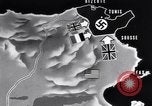
Allied Forces defeat Axis forces in Tunisia during World War II
The final battle of Tunisia, North Africa during World War 2. An animated map shows Allied Forces moving on all sides pressing forward against German forces still remaining in Northern Tunisia. in World War 2. Map outlines battles of Hill 609, Longstop Hill, Goubellat Plain, and Dejebel Mansour, and Takrouna. U.S. forces move 200 miles from the south to confront German forces in the north. Views of U.S. soldiers in trucks and M3 half-tracks, and towing heavy artillery with a tractor. Views of hills where Germans are positioned, west of Tunis and Bizerte. Allied guns firing. French forces sweeping for mines and digging some up with bayonets. French General Alphonse Juin confers with his staff as they review a large map laid out on a jeep. Brief view of French infantry in the field and gunners firing artillery. German Panzer IV tanks moving to counter British attacks. German tanks and artillery firing barrages against the British. Camera pans over destroyed German armor. British 78th Division attacks Longstop Hill. A long line of British infantry moving single file up a hillside. British soldiers firing Vickers machine guns from protected positions and infantry moving uphill, carrying small arms and Bren light machine guns. British troops scaling steep hills, using ropes, as shells burst close to them. One throws a hand grenade that explodes on the hilltop. After reaching the hilltop, the infantry scamper down the other side and continue moving forward, firing their weapons. Several dead German soldiers are seen as the British troops overrun the German positions. British engineers and pioneers working with caterpillar tractors and shovels to build roads. Later, trucks are seen using a new road. In the meantime U.S. troops are seen arriving to commence their assault on Hill 609. It begins with long range artillery firing from camouflaged positions and shells exploding all over on Hill 609. It continues into the night. View of soldiers in artillery headquarters, under a tent illuminated by lanterns. Long sequence of nighttime artillery fire. Medical Corps doctors treating wounded as the nighttime artillery barrages continue. U.S. infantry digging in after taking Hill 609. View of American soldiers walking up Hill 609. View of British Field Marshal Bernard Montgomery consulting with staff officers in the field. British 8th Army commander, Lieutenant General Sir Oliver William Hargreaves Leese, looking through binoculars as he stands with staff members at the front. Scene shifts to U.S. airmen arming machine guns on a parked P-38 fighter plane. Others roughly handling bombs to be placed into U.S. bombers. Bomber with nose art of devil riding a bomb and name "Hell a Poppin." Air crews arrive by jeeps at their B-25 Mitchell bombers and others arrive at their B-17 bombers. View of B-25 number 41-13202 named "Idaho Lassie" of the 321st BG, 445th BS, 12th Air Force. Engines running on bombers and on a British spitfire fighter plane. Formations of Allied aircraft, including B-24 liberator bombers, Martin B-26 Marauder bombers, British spitfire fighters, and B-17 Flying fortress bombers. British and American armor moving forward firing guns. French artillery firing and French infantry advancing. French machine gunners in white hats. U.S. B-24 Liberator aircraft dropping bombs. German fighter planes attacking allied bomber formations. Gunners in the bombers firing at them. Gun camera view of German fighter being shot down. More views of Allied aircraft bombing and strafing. Map shows American forces reaching Bizerte, the British capturing Tunis and German forces split and defeated.
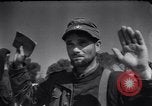
15 Divisions of German troops (266 thousand) surrender to the Allies, ending the Tunisia campaign during World War II
At beginning, the film shows German soldiers surrendering in World War 2. First they surrender in small groups and then in increasingly larger numbers. Eventually whole divisions are seen surrendering, some even marching behind their Division brass band. They are being interned in outdoor areas under guard. A U.S. Military policemen monitors some and collects identifications papers from them as they enter a barbed wire enclosure. Numerous views of the German soldiers, some arriving in full open railroad cars. German commander of the Army Group Africa, Generaloberst (Colonel-General) Hans-Jürgen von Arnim, followed by British officers, steps from a U.S. C-47 transport airplane and salutes. (He was captured by the British Indian Army’s 4th Infantry Division). Aerial view of the wheat field where the German prisoners were interned for processing. Views of numerous destroyed German aircraft, artillery, fuel trucks, tanks, and other war materiel. A pile of German steel helmets. Closeups of German prisoners in the outdoor compound. An unidentified German General stepping from the cab of a truck, to join the other prisoners. German Colonel-General von Arnim leaving a building and standing as if waiting for a car. Series of closeup views showing soldiers from the various countries comprising the Allied forces. Allied soldiers wading through deep waters; and elsewhere in amphibious assaults, as World War 2 continues. Cheering crowds in Tunis welcoming French, Free French, and British forces occupying the city. General Eisenhower standing before Allied flags, with British Field Marshal Harold Alexander, and French General Henri Honoré Giraud, as Allied warplanes fly in formation overhead. Film ends with "V" for Victory.
CRITICALPAST.COM: About Us | Contact Us | FAQs - How to Order | License Agreement | My Account | My Lightboxes | Shopping Cart | Advanced Search | Featured Collections | Website Terms & Conditions | Privacy Policy ©2026 CriticalPast LLC.
License Agreement |
Terms & Conditions |
Privacy Policy
©2026 CriticalPast LLC.