


 Francais
 Deutsch
 Italiano
Refine Your Search
2nd-Rangers-D-Day stock footage and images
- Showing 7729 to 7734 of 13612 results more
more Hide
Hide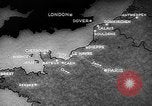
German soldiers respond to the front in Normandy, France, following the Allied invasion in World War II
Map shows French coast and principal cities of interest, during the Allied invasion in World War 2. Truckloads of German troops, including one filled with German woman in uniform, drive rapidly along a dirt road to confront the Allied invasion at Normandy, France, during World War 2. An improvised sign in a tree reads, "Einhahnstrasse Z. Front," identifying the road to the front lines. A German soldier hands out newspapers to others passing on bicycles. A headline in the paper reads:"Eisenhower hat uns nicht überrascht" (Eisenhower didn't surprise us). German soldiers on bicycles ride past the camera. A Sign in large letters reads:"Feindeinsicht" (Enemy in sight) and adds precautionary comments. German army vehicles camouflaged with foliage drive past destroyed Allied armored vehicles. Closeup of a German soldier with foliage on his helmet, looking about as he rides along in an open vehicle. Formations of allied warplanes appear overhead. German troops on the road scurry to the sides of the road and take cover as precaution against Allied air attack. German antiaircraft batteries in action. One Allied aircraft is hit. The pilot bails out. His chute is visible. A U.S. B-17 bomber falls, with part of its left wing blown off. Smoke rising from wreckage of two Allied aircraft on the ground.
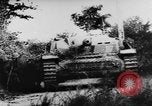
German forces responding to Allied invasion of Normandy in World War II
German forces rushing to combat Allied forces following the invasion of Normandy during World War 2. German sturmgeschütz (stug IV) tank destroyer and other armor heading toward the Allied invasion forces in Normandy France, during World War 2. German infantrymen moving and firing mortars. German infantry moving alongside armor camouflaged with tree branches and other foliage. German infantry moving cautiously by side of dirt road. Huge explosions nearby from Allied shells. A knocked out and burning American M4 Sherman tank. Several more Knocked out Shermans. Closup of parts of a destroyed Sherman tank. German soldiers climbing over and inspecting a knocked out tank of the U.S. 3rd Armored Division. A German officer points out places where shells had penetrated the tank. German Army vehicles passing burning U.S. trucks burning at the roadside. Views from a German vehicle moving along a paved road past several destroyed Allied tanks and trucks. Several British prisoners of war being escorted by a German armed guard. Sign in German pointing to prisoner collecting place. A large number of American soldiers walking into a courtyard of sorts. Camera closeup of wriing on back of one soldier's jacket, reading: "Patchie, P.A. Hershey." American POWs sitting and standing in the confinement area. Armed German guard at the prisoner compound.
Manufacture and deployment of Boeing B-29 Super Fortress bombers during World War II
Film beginning shows a line of Indian women carrying large wooden bowls on their heads as they walk past a line of Boeing B-29 Super Fortress bombers parked on an airfield ramp in India during World War 2. A B-29 bomber descends and lands on the airfield runway. Scene shifts to the Boeing factory at Wichita, Kansas, where most of the aircraft were manufactured during World War 2. (They were also made by Bell Aircraft Company in Atlanta (Marietta), Georgia, and by the Glenn L. Martin Company in Omaha, Nebraska.) In the Wichita plant, a large room filled with B-29s under construction is seen. A line of women uses hand power tools to finish aircraft parts. A large section of a B-29, including landing gear and tires, moves by overhead crane to be mated with another section in an assembly operation. Men manually push a landing gear with tires installed, along a floor. Workers walk along underneath an assembled B-29 as it is towed out of the factory. Tail view of a B-29 with engines running. View of man working on a B-29 tail rudder. Wing flaps being lowered in function check. Scene shifts, again, this time to China, where a line of B-29s is seen on a ramp at a secret base. A jeep drives under the left wing of a parked B-29, guarded by an armed Chinese sentry. Chinese laborers work with hand tools to make a ditch to drain water from the airfield ramp. Chinese workers unload and roll 55 gallon drums of gasoline for aircraft fueling. A Chinese name (Ding How!)painted on the fuselage of a B-29. Major General Claire Chennault shakes hands with some of a B-29s crew as they prepare to depart on a bombing mission. A Chinese soldier gives the crew a "thumbs up" sendoff. The B-29 takes off on the mission. a group of airmen sit atop a B-29 to watch the takeoffs. Camera focuses on another takeoff and then shows a B-29 aloft, glinting in sunlight and then cruising above clouds. Glimpse of B-29 flying over snow covered mountains (possibly in Japan).
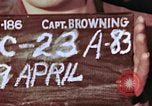
USAAF airmen load bombs on B-26 of 323rd Bomb Group preparing for mission to bomb targets in Germany during World War II
Slate identifies location as A-83 (Denain-Prouvy Airdrome, France) and date as 29 April (1945). Ground crew armorers are connecting wires to bombs and loading them into the bomb bay of a a U.S. Army Air Forces Martin B-26 Marauder aircraft of the 323rd Bombardment Group. View from under the aircraft as a crewman gives signal to close bomb bay doors and they slowly close and lock. Ground crewman removes a metal chock from the aircraft wheel. Flight crew members climb aboard the aircraft. A crew member writes in chalk on a bomb sitting on the ground. The message is: "Happy Boithday Hoimann from Duffy's Tavern," (conveying the New York accent associated with characters in "Duffys Tavern" radio show). World War 2; WWII; WW2.
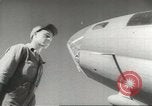
A USAAF officer trains a new B-17 pilot in cockpit inspection and start up procedures in the United States.
A U.S. Army Air Forces (USAAF) training film titled 'How to fly the B-17. Part I. Ground Operations.' about inspections and safety precautions by a pilot prior to take off. A USAAF officer trains a new pilot beginning his career as a USAAF B-17 Flying Fortress pilot. The instructing officer, trainee pilot and aircraft engineer in the cockpit, prepare for take off. The fire guard gives the all clear. The pilot is instructed to check and adjust the: master and ignition switches, batteries and inverter power, volts on the inverter. The pilot reaches out of the cockpit window and gives the hand signal for external power (source of electric power). The ground crew man turns on the portable generator and links the power cable to the aircraft. Further cockpit check includes turning on or inspection of: parking brakes, hydraulics check, booster pumps, pressure carborator filters, fuel quantity in the tanks. the pilot is instructed to give the signal to start engine number 1 and adjust the throttle. Check: the starter switch, hand timer, other start and mesh controls, oil pressure, RPM. The pilot gives the signal to start engine number 2. Adjustment of the vacuum selector switch, flight indicator check. The officer instructs the pilot to repeat all inspection procedures for engine number 2 as conducted for engine number 1. (World War II period).
U.S. Army Training film emphasizing Army Air Forces safety rules of the air for pilots training in PT-17 "Kaydet" aircraft.
Opening scene shows a fuel gauge reading half empty in a U.S. Army Air Forces Stearman Boeing PT-17 “Kaydet” bi-plane trainer aircraft. Closeup of pilot with helmet and goggles in open cockpit of the airplane. Narrator says rules require pilot to return to base immediately. View of the aircraft descending toward the field. Animated diagram showing proper entry into left traffic for the active runway. View of PT-17 on final approach to the runway. Closeup of pilot in the cockpit. He makes a three-point landing on the first third of the runway and rolls without braking. Next, assisted by a wing walker, the pilot taxis to an open slot on a line of aircraft and stops on a parking line. The pilot steps from the cockpit, wearing a seat pack parachute, and begins walking to the field office, when he stops to converse with the narrator. He complains, somewhat about the restrictive rules for pilots in training and expresses desire to fight the Germans and Japanese in World War 2. Narrator defends the rules of safety, first, saying "You can't fight until you can fly." Scene shifts to four pilot trainees who "washed out" of the program for various infractions of the trainin safety rules. They are carrying their belongings in duffle bags and wait at a bus stop for transportation away from the base. Camera focuses on each of the men in turn, as narrator describes their failures to follow rules. Scene shifts to the airdrome where successful student pilots are seen walking toward the camera. Series of scenes showing student pilots performing various preparatory actions before flying their planes. One standing on a wing, checks the "Form One" that contains aircraft maintenance record. Another sitting in his cockpit notes that his gas, oil,cockpit switches, and flight controls all check OK. Another pilot is fastening leg straps of his seat pack parachute and comments about need to keep checking when taxiing down the line for takeoff. Closeups of pilots addressing the camera with admonitions about rules to follow. View of massed parked PT-17 training planes. Views of current war planes in flight, including Bell P-39 Aircobra, Lockheed P-38 Lightning, Republic P-47 Thunderbolt, and Martin B-26 Marauder bombers. Many good views of such airplanes in takeoffs, formations and aerobatic maneuvers. (World War II; WW II; World War 2; World War Two)
CRITICALPAST.COM: About Us | Contact Us | FAQs - How to Order | License Agreement | My Account | My Lightboxes | Shopping Cart | Advanced Search | Featured Collections | Website Terms & Conditions | Privacy Policy ©2026 CriticalPast LLC.
License Agreement |
Terms & Conditions |
Privacy Policy
©2026 CriticalPast LLC.